




A soldier patrols Salisbury Plain in October 2020. (Leon Neal/Getty)





“Time and again, leaders have looked the other way, only re-arming when disaster is upon them. This time, it must be different.” These were Keir Starmer’s sage remarks to the Munich Security Conference in February, as he warned Britain’s allies of the urgent need to increase defense investment. Noting that “the very ground of peace” is “now softening under our feet”, the Prime Minister insisted: “we must be able to deter aggression. And yes, if necessary, we must be ready to fight.” As he spoke, his Government’s Defense Investment Plan, the blueprint which tells industry how much money is available for equipment and how it will be spent, was already behind schedule. Four months later, the plan has still not arrived. It is finally expected next week.
On defense, Starmer’s chutzpah has been staggering. He has burnished his image as a determined and principled leader, while doing very little to reverse the perilous decline of the armed forces. Like his Conservative predecessors, he has promised generous military support to Ukraine. He has demanded that Nato gird itself for a possible conflict with Russia, and since the start of the United States’ unpopular war in Iran, he has distanced himself from Britain’s most important ally. All of this might be commendable if it was backed up by action to improve British security and resilience, but it has not been. With the Treasury mismanaging an ailing economy and unwilling to cut costs elsewhere, it is unclear whether Starmer will even manage his target of spending 2.5% of GDP on defense by next year, equivalent to about a quarter of total welfare spending.
The condition of Britain’s armed forces is frankly terrifying. In March, when Cyprus came under attack from Iranian drones, the Royal Navy could summon just one destroyer to defend the island. It took three weeks to get there and immediately had to enter port for repairs. Despite much of the fleet approaching the end of its service, shipbuilding plans will likely be delayed to cut costs. The British Army still relies on tanks from the Nineties and armored vehicles from the Eighties. It is so short of equipment, weapons and munitions that General Richard Barrons, one of the authors of last year’s Strategic Defense Review, has said that it could only hope to “seize a small market town on a good day”. Various crucial capabilities can only be used with American sign-off. And this is before we reckon with the revolution in military technologies that is now underway, demanding much greater use of complex software systems, high-tech equipment and unmanned platforms such as drones.
The size of the defense budget is not, however, the only thing that matters here. In public discussion, a fixation with headline sums has crowded out the question of whether the money is well spent. The often unspoken issue haunting these debates is the Ministry of Defense’s procurement system, which has a less than stellar record of delivering equipment, and shows few signs of adapting to a fast-changing world. In 2023, a parliamentary committee described it as “highly bureaucratic, overly stratified, far too ponderous, with an inconsistent approach to safety, very poor accountability and a culture which appears institutionally averse to individual responsibility”. This system operates within a defense industry that is dominated by a small number of large, often foreign firms, known as “primes”, which win the lion’s share of government contracts, while controlling the supply chains in which smaller companies must serve as sub-contractors.
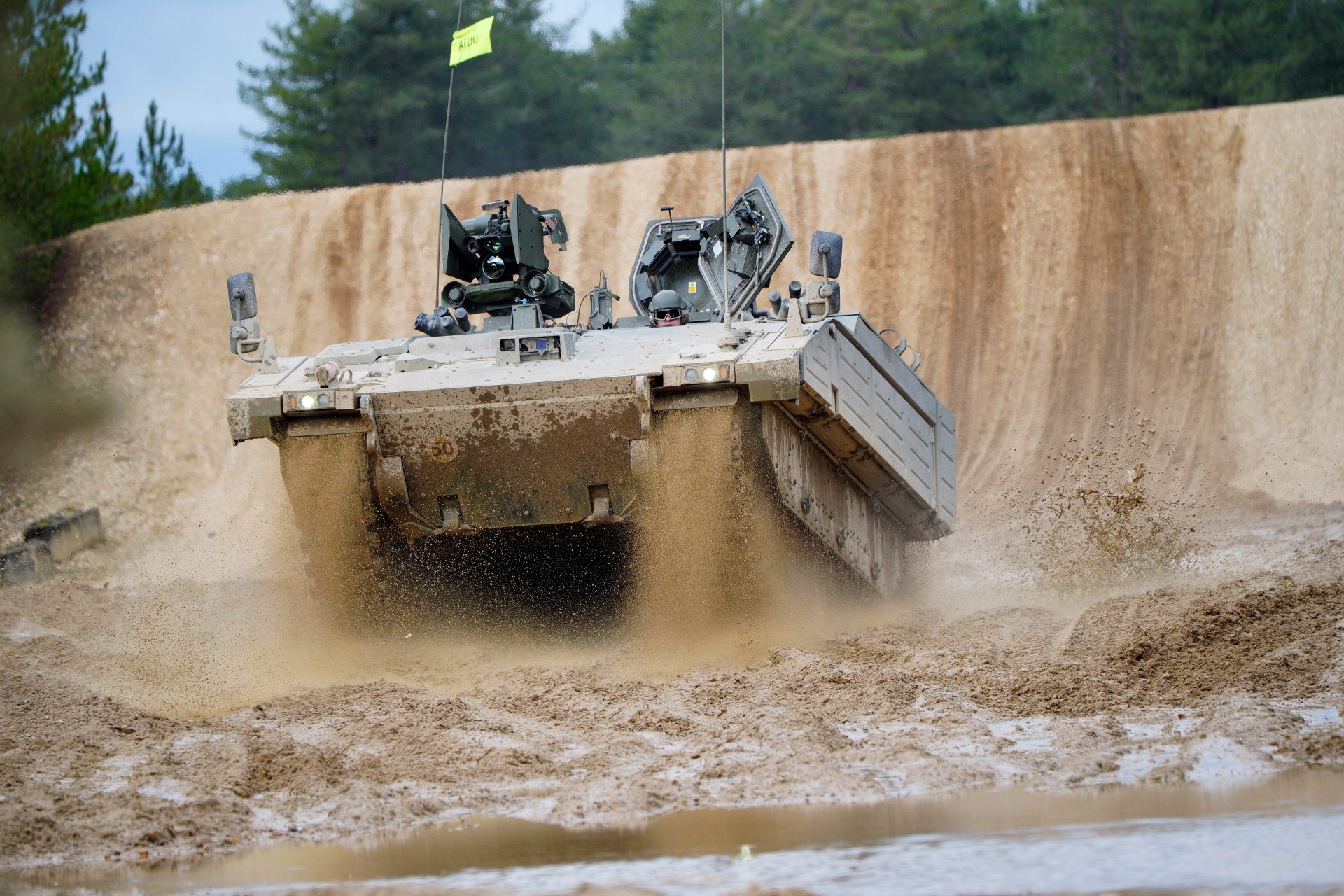
The results paint their own picture. Most notoriously, the MoD’s £6.3 billion program to develop the Ajax armored vehicle is running 10 years behind schedule, having repeatedly injured its crews during trials. The US-based company responsible for Ajax, General Dynamics, was nonetheless given a £330 million contract in 2016 to deliver a new tactical communications system, and that too has been mired in delays. Another big firm, Babcock, has come under scrutiny for its maintenance of Britain’s nuclear submarines. In one instance, broken bolts inside a reactor were found to have been reassembled with glue. Meanwhile, Britain’s drone capability, likely a central plank of any future force, remains small, beset by technical failures, and dependent on Chinese components. In 2021, the National Audit Office found that the delays forecast on 13 different programs came to a total of 254 months.
One man who is clear about the scale of this challenge is Rob Harper, founder of Rowden Technologies, a British engineering company that specializes in information systems for the battlefield and other “edge” environments. I spoke to Harper at a nondescript industrial park on the northern edge of Bristol, where Rowden is headquartered. “I believe very strongly that the golden thread in so many challenges we face is that they are cultural,” the 38-year-old tells me. He is friendly but forceful, clad in Caterpillar-style boots with jeans and a fleece jacket. Chief among the cultural problems he has in mind is risk aversion, across both the public and private sectors: “so that’s entrepreneurs, founders, management teams, and it’s the people buying [for the armed forces],” he says. “We have very clear demand signals for the need for change, and we’re looking at an industrial base and a public sector who culturally aren’t necessarily ready for that. That underpins everything.”
Founded in 2017, Rowden works on the new cutting-edge of warfare, where the battlefield is permeated with sensors, autonomous systems and streams of data. Military equipment must run on software which can be updated constantly and linked together with networks relaying information from satellites. Rowden has won contracts from the MoD, and last month received £25 million for the National Wealth Fund to help with its ambitious expansion plans. At first glance, its spacious and immaculate facilities could belong to any tech company, were it not for the odd detail like a military manikin loaded with radio equipment. I am allowed to inspect a small black box sitting half-assembled on a workbench, its insides a maze of circuitry. This is a decoy device, which emits radio frequencies to confuse an enemy about the location of military assets.
Deeper inside the building, I step into a small room known as a semi-anechoic chamber, where pure signals are recorded to train AI systems. It is lined on every side by hundreds of carbon-tipped foam pyramids to soak up background noise. I am told that if you stand alone in here, you can hear your heart beating.

Rowden is seeking to disrupt the top-heavy structure of the defense industry, which Harper argues has produced too much tolerance for failure. In the MoD, the familiarity and procedural comfort of working with the big prime contractors has meant that they continue to win tenders even if their track record is poor. More importantly, an unwillingness to break with this model is preventing Britain from scaling up homegrown companies and developing new technological tools. Harper says he reached his conclusions after seeing the procurement system from a range of perspectives. He joined the military at 16, and served as a radio operator in the Airborne Forces, getting to know the equipment by “jumping out of a plane with it”. He then worked on acquiring communications equipment for the armed forces, before a stint in defense economics where he modeled big military programs. Realizing there were “weaknesses in the industrial base”, he started Rowden to fill the gap.
Harper is careful not to be cavalier in blaming the civil service for those weaknesses. “It’s easy to bash the system,” he says. He points to Rowden’s success in landing substantial government contracts, including work on the army’s Asgard digital-targeting network, to argue that the growing role of tech is already creating opportunities for new companies if they are willing to step up their own investment. Still, he describes the MoD as an “immune system” that instinctively rejects change, is suspicious of ambition and success, and looks down on people who lack the appropriate rank and length of service, not to mention accent and style of dress. He has apparently been asked “who runs the company?”, as though it could not possibly be a non-officer from the West Country such as him.
Elsewhere in the world, military innovation is being driven, in part, by new players tapping into growing defense budgets and a boom in private investment. In the United States, the rebranded Department of War is acquiring more of its high-tech equipment from “neo-primes” — companies which are young but also very large — such as Anduril, Palantir and Space-X, while creating additional room for start-ups in the procurement system. Besides the computing and weaponry, the Pentagon looks to such upstarts for speed and efficiency in delivering contracts. Europe has been nurturing its own crop of defense tech champions, led by Helsing, a software company turned drone-maker.
Britain has scored some successes too. Kraken, founded in 2020 by a speedboat racing engineer, now designs uncrewed vessels which can be deployed at sea for reconnaissance, transport, or kamikaze attack missions. It has already gained a presence in the US and continental Europe thanks to partnerships with major firms there. By and large though, Britain is best-known as a hunting ground for foreign companies to poach AI talent and promising start-ups. Meanwhile, parliament’s defense committee reported that, as of 2021, just 10 of the MoD’s 23 largest defense contractors were domiciled in the UK, and average British ownership across these companies was only 18%.
Harper is not alone in thinking that excessive caution and inertia is leaving the MoD flat-footed. According to one civil servant with experience of defense procurement, who asked to remain anonymous, “timelines are so long that we only seem capable of procuring things we needed 20 years ago”. Noting that “risk appetite is functionally zero”, she pins much of blame, ironically, on rigorous standards around spending taxpayer money, as well as an “obsession with being absolutely scrupulous and fair”. The MoD tries to treat every tender application on its merits. In theory, this should keep the field open to new entrants, but it also means that firms with a record of failure will keep being considered for new contracts. And if they are big firms with multiple revenue streams, they have a good chance of success, since the process takes longer than smaller competitors can afford to wait.
My source emphasizes that “we get amazing value for money” on many contracts. But this is thanks to an “algorithmic” approach which rules out explorative, trial-and-error development of new capabilities. That would require civil service managers to have the discretion to start funding a program without knowing exactly how much it could ultimately cost.
There are some big-ticket capabilities which only the big prime contractors can provide. In February 2024, for instance, the MoD invited bidders for a new medium-lift helicopter contract, but by September of that year there was only one left: Leonardo UK, the British arm of an Italian multinational. Leonardo then lobbied the Government privately and publicly to close the deal, backed-up by the Labour-affiliated Unite Union, warning that 3,000 jobs at its Somerset factory were on the line. A £1 billion contract was agreed this March. Clearly, such companies have enormous bargaining power. As John McDonald, co-founder of new defense tech start-up Blackmoor, puts it to me: “It’s not like you can go out to some promising young company and ask them to build you a helicopter.”
Macdonald, who previously gained an insight into procurement via think-tank work, also acknowledges that primes are not necessarily less innovative than start-ups, and that they are often best placed to integrate smaller companies into a program. But he agrees that primes are also favored because they appear less risky. Rather than go through extensive approval processes to fund less familiar companies, the preferred solution is to “go to a big prime and ask, just sort this all out, we’ll leave all the subcontracting to you, and we’ll pay you a lot of money to get the whole thing done”. Then, when these mega-contracts start to go wrong, the lack of accountability within the MoD means that no-one has the authority to pull the plug.
The MoD insists that it is trying to help new entrants bid for contracts. Its recent strategy documents include various pledges to work more closely with small and medium enterprises. The people I spoke to, however, say that these efforts have so far been patchy and noncommittal, stringing companies along without any guarantees of substantial work. Politicians bear much of the blame here: the delays to the Defense Investment Plan have left both prime contractors and civil servants uncertain of the funds they have available.
Everyone agrees that the system needs greater accountability, but clearly it needs greater freedom too, in terms of providing attention and resources for ideas with potential, even if not all succeed. A number of people told me that the MoD could harness innovation by simply sharing the problems it wants to solve, along with a budget, and then seeing what proposals it gets. As for the problem with timelines, an AI consultant tells me that rather than having civil servants trawl through the dense and interminable paperwork involved in defense tenders, much of this processing could be done rapidly by new agentic software.
-

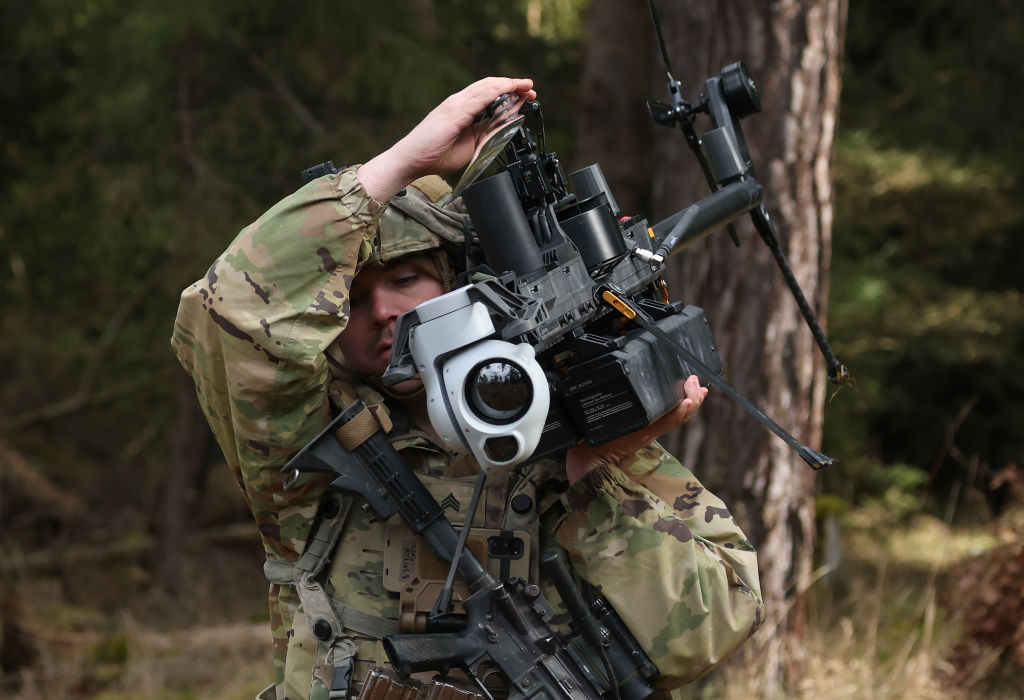
A drone is displayed at the Houses of Parliament. (Jonathan Brady/WPA/Getty)
As things stand, ambitious British start-ups have an incentive to relocate overseas, and especially to the United States, where they can find the investment to scale. Skycutter, a very promising drone maker, recently warned that it will take this option due to the sluggish funding in Britain. It seems that, just as there is no-one to take responsibility for axing a disastrous program like Ajax, nor is there anyone to seize new opportunities when they fall into the MoD’s lap. Still more potential is lost by talented individuals avoiding defense altogether. According to Macdonald, “if you’re a repeat founder, or you’ve got engineering expertise, defense is a nightmare. What we’ve seen in the UK is most people with the requisite skill sets will go into AI and robotics, where the market is far greater. The venture money is also greater.” Harper argues that there is risk aversion in the private sector, but for many companies, the risks of Britain’s defense industry are simply irrational compared with the alternatives.
This takes us to the other conundrum in defense, namely sovereignty. How does Britain ensure that its military capabilities and industry are not so dependent on other states as to be unreliable in a crisis? I raised this with a director at the British subsidiary of a major defense contractor, who asked not to be named. He argues that thinking about sovereignty must be based on two factors. The first is resilience, meaning that we recognize the importance of being able to make things in Britain, with supply chains that are reliable and, as far as possible, local. The other factor is commercial exploitability. Obviously, it is far easier to build and maintain capabilities in Britain if they can pay for themselves, and better still if they can generate prosperity. This means that companies must either be dual-use – making goods and services for the civilian economy as well as the military one – or they must have export potential.
On this front, my source says that the MoD has neglected the importance of intellectual property, the knowledge that underpins technology. “If you want a company to grow, you’ve got to have something to exploit,” he says. “When we talk about high-tech, IP is the key thing that you exploit. Don’t just say we’re buying from a UK company. Use the tender to work out where the IP is held, who controls it, and do they have a commercial exploitation plan.”
But the biggest obstacles to sovereignty, he says, come from the political level. While Britain has “strengths that are just about still there in all areas of science and technology and military experience”, it is being held back by “inconsistencies and outright contradictions in the rest of policy supporting industry.” He points out that the countless strategy documents pledging to build up British industry have been undercut by Treasury decisions to raise taxes for employers, increase fuel levies, and commit to renewable energy subsidies that lock-in “the most expensive electricity we’ve ever had”. All of this acts as a massive deterrent to industrial investment.
Rob Harper agrees that Britain is unlikely to become an industrial power with its current energy policies. But he has a somewhat different view of sovereignty. Unsurprisingly, it involves greater boldness. He thinks Britain should accept that it cannot compete in every field, and play to its strengths instead. “Look at what is being produced by universities, look at areas where we have a really strong legacy, things we will be great at and that will drive export revenues, and focus, blindly focus on those things.” Even if this were just three to five areas of excellence — and even if those areas were quite specialized, such as aerodynamics or systems engineering — Harper believes that allies would opt to rely on Britain for these capabilities, allowing Britain to rely on them for others.
He has a similar outlook when it comes to homegrown companies.“The best thing they can do, which again involves making big decisions, is to choose five companies and say: we want them to win. Then ask, what do we need to stop the founders re-headquartering, or getting bought out by other firms? How do we make them huge?”
Macdonald agrees that Britain should think of sovereignty in terms of interdependence with others, finding points in the supply chain, and levels in the technological stack, where it can become indispensable. Part of this is manufacturing, namely “really, really specialized parts for important military infrastructure like submarines and helicopters”. More generally, it means recognizing Britain’s strengths in technology and design: “leaning into the future of warfare as being dominated by autonomous systems and data, that is absolutely somewhere where we can be a leader. And that’s absolutely something we should be putting money into.”
A strategy based on specialization raises further questions, of course. Which allies does Britain want to be interdependent with? My civil service source says that the MoD already looks for “things we can become so good at that we’re indispensable to the Americans.” But after the shenanigans of the Trump administration in recent months, this no longer seems such a sure bet. As for the gambit of picking five companies and “making them huge”, this seems bound to create another generation of over-powerful prime contractors, such as America’s neo-primes. To some degree, sovereignty and meritocracy are conflicting values, and the MoD will need to find a way of preventing companies it does support from resting on their laurels.
Nonetheless, it is impossible to avoid the conclusion that Britain must decide what kind of battle it wants to be able to fight, for unlike great powers such as China and the US, it cannot try to do everything. The hyper-innovative warfare we see in Ukraine, where drones and other unmanned platforms now dominate the battlefield, is not a universal model. Other scenarios will still require aircraft carriers and battleships, artillery, tanks and large armies of soldiers. But Britain’s leaders must accept that, thanks in no small part to their own role over decades in eviscerating the country’s industrial capacity, most of these scenarios are now beyond its means. The Defense Investment Plan, if it does finally arrive this month, will likely show that the Government and MoD are still trying avoid this reality, spreading resources ever-thinner across many domains so that politicians can swagger a little longer on the world stage.
Wessie du Toit writes about culture, design and ideas. His Substack is The Pathos of Things.
 wessiedutoit