




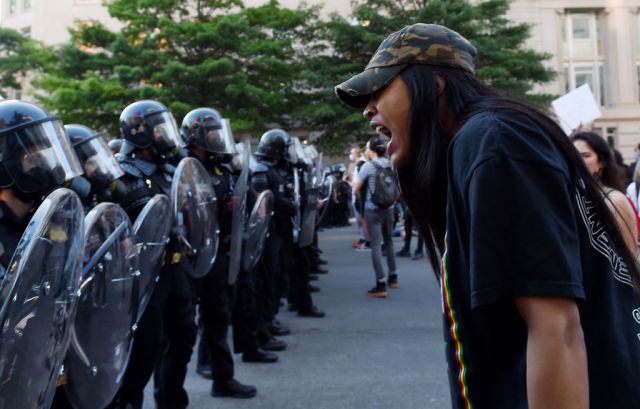
‘Ideological imperatives have warped and corrupted language’ (Olivier Douliery/AFP/Getty)





Man, Nietzsche wrote, is “the unfinished animal”. He meant that nature goes only so far in shaping human beings. We become who we are through the distinctively human capacity to produce and understand speech. That’s why Aristotle called us the animal that possesses logos, whose meanings include everything from word to speech, thought to reason, order to logic, proportion to account. This extraordinary semantic richness tries to capture the manifold articulate intelligence that makes us human — an intelligence that, in the first instance, answers to the nature and shape of things as they present themselves to our minds.
But today, logos — and therefore our humanity — is under intellectual, political, technological attack. It’s not that people have stopped talking. Rather, the difference between speech and what Aristotle called “voice” (phōnē) — the verbal expression not of reason, thought, and judgment, but emotion — is rapidly being effaced. Indeed, the most troubling social phenomena of our time are all reflections of misology: the effective, if largely unconscious, hostility to logos that is perhaps the definitive characteristic of 21st-century life.
Academic culture has, for decades, perversely promoted misology. In the early Nineties, I told a new assistant professor at my university that I taught and wrote about the Ancient Greeks. When I asked her what she worked on, she said: “Sure as hell not dead white males!” The incident was a harbinger of contemporary intellectual trends. The assistant professor’s aggressive dismissal of DWMs, as they were then known, was an expression of academic radical chic: the view that the poets, statesmen, philosophers who founded and developed the Western tradition have nothing worthwhile to teach us, because their (unchosen) membership in certain groups stained them with some sort of indelible sin. What had long been regarded as essential was now understood to be accidental, and vice-versa; being white and male counted for more than being human. This was little more than voice — the communication of feelings of pain or pleasure, as in a dog’s bark — masquerading as speech.
Misology has now taken root far beyond the academy, degrading political discourse and curtailing essential human freedoms. The notion that speech is violence and violence is speech, a confusion of the fundamental categories of liberal democracy that are enshrined in the US Constitution, justifies shutting down speakers and badgering those who wish to remain silent into endorsing positions they do not support. Nor is it permissible for actors to “play the other” — sympathetically to inhabit roles that do not match their identities as members of particular groups — even though doing so has been the lifeblood of dramatic performance since antiquity, when free Athenian males enacted the suffering of female slaves. All these developments constrain and weaken the capabilities of thoughtful speech and moral imagination that make it possible for human beings to live decent and elevated lives together.
At the same time, ideological imperatives have warped and corrupted language. Words like “racist”, “Nazi”, “fascist”, and “genocide” are applied so broadly and inconsistently that they have ceased to signify anything other than the speaker’s disapproval. “Equity” — which originally meant reasonableness and moderation in the exercise of one’s rights — now has virtually the opposite sense: imposing extraordinary measures to ensure equality of outcomes. Neologisms like “undocumented immigrant” or “birthing people” have become necessary in order to avoid acknowledging plain matters of legal and biological fact. Some, notoriously including the Smithsonian Museum, have even condemned objectivity, scientific reasoning, and good grammar as expressions of “whiteness” and “patriarchy”. And, of course, politicians’ constant resort to hyperbole (President Trump being the primary example of this trend) has exacerbated the decay of logos. The looseness of our language and imprecision of our thought have left a void that is increasingly filled by intemperate emotion, making citizens leery of publicly sharing their perceptions of what is just and unjust, or what is best for the body politic — an activity that is vital to the health of any free society.
But it is digital technology that poses perhaps the greatest threat to the development and exercise of logos. Social media connected individuals, but also allowed them to melt into “flash mobs”. The possibility of remaining anonymous encouraged angry outbursts, personal attacks, and other threatening behaviours, so much so that these phenomena required new words: “flaming”, “doxxing”, “swatting”. The online world also promoted simplistic binary thinking: swipe left, swipe right; thumbs up, thumbs down. By limiting users to 140 (later 280) characters, Twitter — now X — got people into the habit of communicating in crude, telegraphic ways: acronyms, truncated phrases, and emojis. All the while, smartphones offered addictive distractions that shortened attention spans and sent reading, already in decline, into a tailspin. These developments have undeniably made us dumber: less able to concentrate, less knowledgeable, less articulate, less nuanced in thinking, and more inclined to respond to political or intellectual challenges with “hot takes”.
Yet all this is nothing compared to the destruction of logos being wrought by AI, which is merely a mechanical simulacrum of a living human intelligence. Chatbots that can summarise books, do homework, and produce exam papers have made it largely unnecessary for students to study, or to read and write beyond a basic level, in order to get good grades. So far, academic leaders have found no adequate solutions to this problem. They’ve either embraced AI, which will ultimately reduce education to efficient prompt engineering, or they’ve allowed professors to formulate their own policies, which will incentivise laziness and low standards on the part of instructors (some of whom are already using AI to write lectures and grade papers). Few universities and colleges are likely to hold the line against AI, especially because continuing to educate students the old-fashioned way is expensive. Yet that’s the only way to ensure that students will learn how to think (or even really come to understand what they think), let alone develop the individually distinctive way of expressing themselves that qualifies as style.
Nor is AI a threat only to young minds. Its sycophancy (it is deliberately engineered to tell users what they want to hear) is sophisticated and seductive — but also manipulative. A small example: Google’s Gmail is using Gemini to summarise long email chains, and these summaries include nudges that are designed to eliminate wrongthink. Gemini’s recent summary of a chain I was on stated that one person “incorrectly claimed Trump opened Straits” and another “used an offensive term for head coverings”. As AI learns more and more about each and every one of us, it will be able to deploy an unlimited number of individualised nudges to influence our thoughts and actions in ways that it (or its hidden masters) prefer. That is misology on the deepest level, for it may irreparably damage the capacities of independent thought, speech, and action that constitute our innermost individual being.
In Plato’s Phaedo, the philosopher Socrates says that “one could suffer no greater evil” than misology. He associates the affliction with misanthropy, the hatred of human beings, as if to suggest that hating logos just is hating human beings. The Phaedo ends with the execution of Socrates for the civic harm he allegedly caused by publicly asking questions that, as he freely admitted, annoyed and embarrassed many of his fellow citizens. That victory of the many over the individual, emotion over logos, was short lived — Plato renewed Socrates’ living speech in his dialogues — but future ones are likely to be more permanent. And what makes this prospect particularly horrifying is that, if independent thought should ever be completely extinguished, its passing will be as unremarked as snuffing out a candle.
Reflecting on life in the Soviet Union, where the Western ideas were criminalised and surveillance, indoctrination, censorship, and violence sought to eliminate the individual human centre of logos, Nadezhda Mandelstam wrote that, “Nothing can be predicted with certainty: people could even forget how to read altogether and books moulder away to dust. We might even stop talking with each other and communicate only by emitting calls of bloodcurdling war cries.” That future seems more likely to me than the supposedly utopian, total biological control of humans by machines predicted by transhumanists like Cristian Daniel Bolocan, when “words become useless” and “only feeling remains”. Yet in either case, we will be faced with the hideous prospect of a world populated entirely by beings that may look (and even genetically be) human: but lack the capacity of speech.
How can we combat misology and reclaim our logos? First, understand that the very core of our humanity is at stake. That’s worth fighting for, so we must screw up our courage for grassroots personal effort, without which we cannot count on institutional or other help. We’ll need courage to stand up to totalitarian impulses wherever they assert themselves, from campus bullies to governmental speech controls, and to relearn how to say what we think in public. We must also try to put down our phones, read good books, reclaim the meanings of high-jacked words, and seek out face-to-face conversations with family, friends, and fellow citizens. Above all, we must purge education of petty politics, and once again make the cultivation of logos a central focus of everything from grammar school through university.
Homo sapiens — the wise hominid, the one said to be made in the image of God — is clearly an endangered species. Who will save us if we are not for ourselves? The capacity of logos is, thankfully, a source of freedom. It enables us to make deliberate choices about the direction of our lives, and, to the extent that we have the means and the will, to shape our collective fate. To do nothing in the face of the present crisis is itself a choice. But would it not be shameful to knowingly abandon what is highest and best in us?