




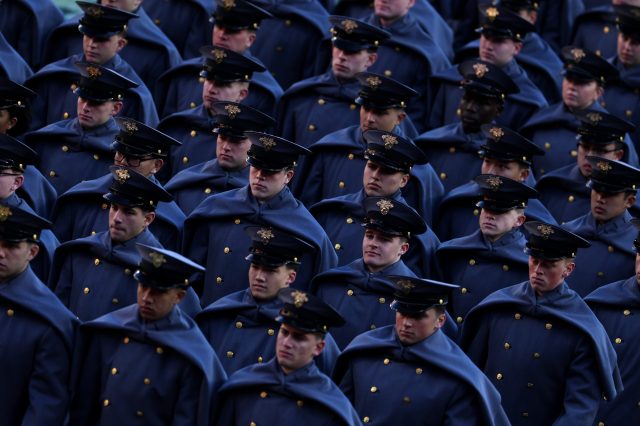
God forgives, brothers don't. (Patrick Smith/Getty)





In September 2025, I received word from a trusted source that Valley Forge Military Academy was closing after 98 years. The place had been founded by a lieutenant general on an old-school promise, but one with seemingly endless appeal: “Send us your boy and we will return to you a man.”
Since the dawn of America, the military has articulated some version of this pledge, solidly staking its claim on the monumental work of building the American man. While the military’s masculine archetype was formed inside the wire, it went mainstream long ago, evident by a dizzying array of cultural tokens, from war movies and toy soldiers to cargo pants, Boy Scouts, bodybuilding, and the Hummer.
America is today in general agreement around certain precepts that all men should aspire to, among them strength, discipline, and self-sacrifice. On close inspection, however, it becomes abundantly clear that these traits are calibrated to enhance the aims of the military state, not the man. In truth, each tenet has nuggets worth living by. But as broadly interpreted today, these characteristics fuel stoicism, self-destructiveness, and nihilism, forming an outlook that is beneficial for cold battlefield environments but not at all equipped to handle the emotional complexities of civilian life.
I first heard about “the Forge”, as insiders call it, in late 2020, when a group of concerned parents reached out and told me the place was falling apart. “We, the parents, paid for a product, we were promised a product,” Scott Newell, a former parent and alumnus, told me back then. “And then they switched the product out and turned it into bullshit.”
For much of its history, the Forge resembled a patriotic paradise. Cadets ranging in age from 12 to 21 aimed to build their bodies and sharpen their minds on a verdant, 100-acre campus located on the outskirts of Philadelphia. Yet when I first dug into the school, I discovered an acrid strain of masculinity that was raw, violent, fiercely hierarchical, and quickly mutating out of control. I uncovered stories of vicious beatings, brutal rapes, predatory grooming, and widespread racism and misogyny. I was told about incidents of waterboarding, whippings, brandings with scalding forks, forced piercings, even horse abuse. These boys of the Forge were hurting, but had only learned how to hurt.
During the previous four academic years, local police had responded more than 300 times to incidents on campus, including for cadets as young as 13 experiencing psychiatric crises and demonstrating suicidal behavior. In the spring of 2016, a promising 18-year-old cadet named Carey Lecamp killed himself in his dorm room. Most shocking, perhaps, was the behavior of the men in charge, who showed not only willful ignorance of this culture, but active complicity in it. They retaliated against boys who spoke out, fixed grades to burnish the school’s reputation, and padded their own pockets.
The Forge’s military high school closed in May, but its brand has remained surprisingly resilient. Its junior college remains open, as of this writing, and officials have floated plans to spin off the old high school into a charter. The Forge has further fortified its future through a training partnership with the Pennsylvania National Guard, plus an NSA-certified cybersecurity program and a gestating drone-pilot initiative. In October 2025, the Forge became the first signatory to President Trump’s “Compact for Higher Education Excellence”, which demands, among other things, that participants ban affirmative action and crack down on programs that “punish, belittle” or “spark violence against conservative ideas”. Three months later, in January 2026, the feds issued a $1 million grant to the Forge. It tasked the troubled academy with developing accreditation standards for military schools across America.
The Forge has also exported its brand overseas through a satellite campus in Qatar that imposes its punitive practices on an even younger cohort — elementary school kids — a sign that, even after perilous battlefield defeats in the Middle East, the image of the upstanding American military officer remains attractive on the world stage.
The story of the Forge points to an even bigger scandal: the dysfunction of America’s military education system more generally. The nation’s dozens of military schools exemplify the stubborn influence and overall emptiness of military ideology, the cruelty of military training and masculinity, and the entire institution’s reliance on schoolchildren. Yet they are still generously funded and enormously influential in shaping the public image of the American man. Their alumni control powerful institutions: four US presidents, including Trump, have attended military schools, as have a handful of Fortune 500 CEOs, dozens of lawmakers, and top figures in the Defense Department, America’s largest employer.
These schools propagate a view of American masculinity that is predicated on the wobbly assumption that man is violent by nature. In a 2025 speech before every senior American defense official, Trump’s self-styled “Secretary of War” Pete Hegseth passionately defended this premise and derided pacifism as “naive and dangerous”. “It ignores human nature and it ignores human history,” Hegseth argued. “Either you protect your people and your sovereignty, or you will be subservient to something or someone. It’s a truth as old as time.”
Hegseth is right that men have fought many wars. But those leading them have never relied on innate aggression to naturally show itself. Rather, they have cultivated violence, often in closed and highly controlled educational environments. And often for years. Since America’s founding, military brass have painstakingly developed and refined a military curriculum that breeds loyalty, teaches obedience, and constructs violence, all the while convincing the public that conflict is a hardwired male instinct.
Instead, the military’s muscular masculine archetype has become one of America’s most coveted assets. Those who secure it make a devil’s bargain. The male military identity is ultimately false, and fleeting, for it is meted out in small doses by men in power, who, for institutional purposes, always withhold unconditional acceptance. Military masculinity is unsustainable. Real self-actualization is never achieved. Some men, having fought their way up the military hierarchy, come to see the tragic fact at the heart of the military system: the military does not make them stronger; it alters and degrades them, sometimes forever.
Far before they see the front lines of battle, many cadets are diagnosed with PTSD, a condition that represents a powerful rejoinder to the assertion that violence is natural. If the human propensity for violence is innate, then it wouldn’t create such persistent pain and mental turmoil in its wake. The mother of one cadet I met saw her boy transform from a warm and idealistic schoolboy into a withdrawn adult who drinks to excess and sleeps with a hunting knife under his pillow. Other cadets told me they go to bed with weapons in close proximity, or, decades after graduation, remain wracked by nightmares and anxiety stemming from their time on campus. One cadet sued the Missouri Military Academy in 2022 after allegedly facing weekly beatings so bad he attempted suicide while on break in hopes of forever forestalling his return.
The Pentagon has always understood the profound impact of schooling on shaping society, which explains why the military has secured a prominent place for itself in academia — establishing five service academies, like West Point, plus various war colleges, a combat studies institute, a defense university, and a national intelligence university. The military also oversees 5,200 ROTC programs in public colleges and high schools, and supports state-run, religiously chartered, and private military schools, like the Forge. These schools rear the elite military officer class; though lower down the ranks, enlisted troops are exposed to an abridged military education, too, via boot camp, which provides its own kind of schooling.
The Pentagon’s reach extends to even younger populations, too, in programs that appear innocuous, like the Boy Scouts or the Young Marines, and into civilian colleges and universities by way of hefty research grants. Between 2014 and 2024, Johns Hopkins University, as one example, received more than twice as much money from the Defense Department as it did in tuition.
The Pentagon likes to frame its training methods as peer-reviewed and pedagogical, a claim bolstered by its well-appointed military schools and their trappings, from grassy quads to academic robes and degrees. All this has elevated, distinguished, and validated the world’s most brutal profession, making bloodshed scientific and deriving an “art” of war.
Yet it is power, not art, which is the true nucleus of these military environments, an indoctrination tool serving as both reward and punishment. Many of the cadets I spoke to didn’t enter these schools seeking power. Many had previously faced bullying, family strife, economic insecurity, or other antagonistic conditions. What they truly sought was armor, not weapons. Once they enter the system, however, these young aspirants are cultivated to want power. That is because they find themselves in an atmosphere of insecurity that is most easily remedied through force. The best way to secure a modicum of peace is by climbing to the top of the hierarchy within the corps of cadets. At West Point and other military schools, the first year cadets at the bottom are called “plebes”, or commoners. At the Air Force Academy, they’re known as “doolies”, which apparently stems from the Greek word doulos, meaning slave. At the Virginia Military Institute, they’re labeled “rats”. The only way to move up is by following the rules and targeting the weakest links. This structure is clarifying, for it suggests that the military does not tease out latent aggression — it breeds it.
Many service members resist the military’s efforts to capture their minds. Some snap out of it early, rebel against it late, or never believe to begin with. But there are also men who lose themselves entirely. Those who become reflexively pro-military should not be seen as weak or gullible. Many entered the field with a child’s mind: malleable, optimistic, and a bit reckless. It is no mistake that the troops serving on the front lines are called the infantry, or that the military school rank of “cadet” translates in French to “youngest child”. War may be commonly described as a man’s game, but it’s boys who have long fed and fueled the whole enterprise.
The military seeks young people not because they are the most physically adept, but because they are the most emotionally vulnerable. One study found that military cadets are often characterized by their sharp sensitivity, strong impressionability, and increased emotionality. Another 1975 paper showed how the military reshapes boys through three interlocking components: “the acceptance of psychological control, the equation of masculine identity with military performance, and the infusion of raw aggression into the entire military mission.”
Modern enlistment age in America was initially set at 21, then pushed down to 18, then 17 with a parent’s permission, where it stands today. The average enlistment age today is 19. These are adults in the government’s eyes, but many remain fundamentally innocent, years away from fully developed brains. The few who harbor violent tendencies at this age generally have a history that’s led to it.
Many boys who join share a tragic and misguided rejection of their youth and are impatient to become men — a transformation the military is happy to facilitate. It hastens their growth through heavy doses of pain and stress, often frontloaded in the early days of training, or in the first academic year. Some who make it through proudly refer to themselves, and each other, as “old men”. Military schooling, or training, precludes natural, more complex versions of manhood from sprouting. What forms in its place is something strange and uncanny: a child’s face extinguished of youth and its accompanying traits, like sweetness, empathy, imagination, and whimsy.
Beyond the military’s promise of manhood is the interrelated assurance of bringing meaning to life. The military understands children’s dreams, aspirations, and anxieties, and it promises to give them what they need, whether it’s status, money, schooling, family, or just a place to escape. It pledges to wipe away an existing identity, and that’s often exactly what people want — the chance to reinvent themselves in a new world. Cadets and recruits alike are cut off from friends, family, and lovers, and told to make new ones; they are given new haircuts, new diets, new clothes, and exposed to new ideas. Marine general Charles Krulak once testified proudly to the transformative potential of the service via one of his economically disadvantaged recruits, who, after emerging victorious from the crucible of training, cried out “I am somebody!”
Much like war itself, the training experiences of cadets are marked by sharp contrasts, highs and lows, hate and love, comedy and tragedy. Some benefit from order, and through the academies’ call to shared sacrifice, they develop a powerful sense of belonging. Others graduate broken or feeling ostracized. Some try to escape. Others die. Many find father figures or make lifelong friendships, including, at times, with kids who have hurt them. There is intense and intentional trauma bonding at these places, part of the military’s drive to build friendship and loyalty via shared moments of intense agitation. All of this serves to ensure that soldiers disgorged onto the barren fields of combat stay dependable and connected — through their commitment to each other more than to any politics motivating the conflict.
For many boys, the military feels like the only true path to become a American man. Many embrace alternative paths when they are offered. But there are few and dwindling paths into other forms of public service, few purely peaceful avenues to defend the nation or show strength.
When an anti-war movement sprouted during Vietnam, millions rushed to the cause, providing not only a direct threat to the Pentagon’s immediate aims, but also an alternative path to meaning. My own father as a youth, anxious to escape his turbulent family life, flirted with ROTC and, before that, military school — Valley Forge, in fact. But after attending a pacifist Quaker school, and finding a father figure at Boston University in Howard Zinn, he ended up a leader in the anti-war movement during Vietnam. My dad could just have easily become a hard-boiled colonel, but there was another option available to him, and he took it.
The peace movement my dad joined offered an alternative model for manhood. This helps explain the verve with which the military moved to violently shut it down. Since Vietnam, the military has continued to work to maintain its grasp on our perceptions and practices of manhood and to cast any countercultural forces as weak and effeminate. Over this same period, American society has mentored and championed girls in ways that have created new and transformational opportunities that redefine what it means to emerge into womanhood.
In the absence of fresh meanings and directions for men, our military’s violence-affirming ideologies powerfully persist, animating unnecessary conflicts and overtaking America’s masculine ideas. This is now spawning radical, revanchist, and vengeful undercurrents among soldiers and civilians alike.
Yet despite mounting evidence, Pentagon officials and other government leaders have failed to step in, and in some cases are actively obscuring problems, sometimes even feeding them. Today, the facts are clearer than ever: military schooling is an increasingly dubious and, when poorly overseen, potentially dangerous form of teaching, one that has spawned polarization, male isolation and frustration, and a child abuse crisis hiding in plain sight. It’s also utterly ineffective at winning wars. And yet the military’s coercive, even cultish, curriculum nonetheless continues to be broadly and blindly declared as essential.
***
Extracted from God Forgives, Brothers Don’t: The Long March of Military Education and the Making of American Manhood by Jasper Craven (Simon & Schuster). The book will be published in the UK on 2 July.
Jasper Craven is a freelance reporter covering the military and veterans’ issues. His work has appeared in The New York Times, Harper’s Magazine, Politico magazine, and The Baffler, among others. He is the author of God Forgives, Brothers Don’t and he is also the coauthor, with Suzanne Gordon and Steve Early, of the academic book Our Veterans.
 Jasper_Craven