




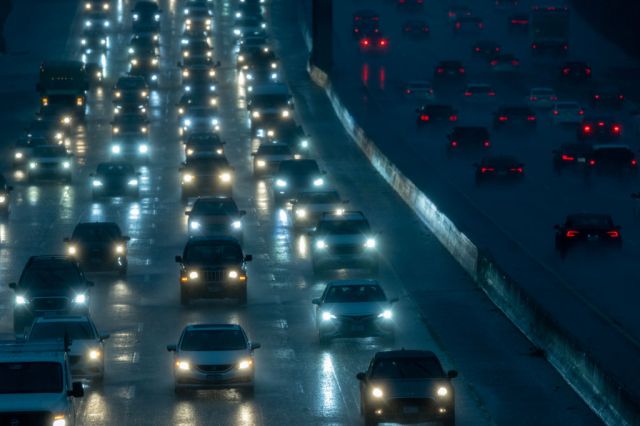
Not a streetcar in sight. (David McNew/Getty)





With the Iran war spluttering to a close, mavens of American decline will be sharpening their pens. We can already guess what they’ll say. Everyone now understands that the United States runs on cheap oil, and that the Washington establishment will risk sandy quagmires to preserve it. But what’s explored less often is why America perennially treats fluctuations in the crude price as a matter of geopolitical life and death.
To answer that question, try traveling to the AT&T Stadium. Not far from downtown Dallas, it’s hosting nine games at this summer’s World Cup. Yet despite being criss-crossed by highways, the stadium is almost comically hard to reach by public transport. Yes, there are shuttle buses for bewildered European supporters. But the whole trip, including an awkward train transfer, takes some 90 minutes, compared to just 20 by private car. From Kansas City to Miami, other host stadiums are similarly tricky to reach, even as 45% of Americans lack any access to public transport whatsoever.
The point, here, is that the US is utterly dependent on cars and trucks to function. Roughly speaking, the average American consumes 22 barrels of oil per year. The average Brit uses less than half that; the average Italian about a third. For all the talk of infrastructure and energy independence, trains and passenger rail remain the houseplant that Washington forgets to water — decade after decade, now going on nearly a century.
Even in a famously embattled industry, it’s been a uniquely difficult year for American rail. In February, Amtrak canceled service between New York and Boston due to intense blizzards, giving intra-state passengers no sense of when service would return. That’s echoed by a more general malaise. Even living in the Acela Boston-DC corridor — where train services are far more extensive than anywhere else in the country — passengers will often be maddeningly frustrated. NJ Transit trains into New York are so frequently canceled for “overhead wire” failures that passengers must now warn their colleagues and employers that, on any given day, thanks to the country’s third-world infrastructure, they might simply not make it into the city.
A great many on the online Right prefer to blame the dysfunction of American rail on Amtrak and the rail industry itself. But, in most cases, that’s unfair. Unlike American secondary education — where high spending coexists with mediocre outcomes — US rail is generally starved of funds. The problem is not a disconnect between spending and performance; it is the simple absence of investment. In total, the federal government spends only about $30-35 per person on rail, whereas Sweden routinely spends roughly 10 times that. Even Germany, lately facing mounting criticism over the decline of its own rail network, spends roughly six times more per capita.
You can’t bake bread without flour. And given the meager funds they have to work with, Amtrak and other American rail systems punch well above their weight in both functionality and reliability. This raises the question: if rail is considered vital across much of the wealthy industrialized world — including in China, a country every bit as vast — why is it still treated as the ugly runt of America’s transit system?
The boilerplate answer involves the country’s uniquely anti-statist brand of politics, not to mention its hyper-individualist mindset. No doubt that’s partly true. American political culture is characterized by what communitarians call “thin” social ties — with most citizens preferring privacy and autonomy to a dense communal life. It’s clear that a great many Americans would, if given the choice, still prefer to commute inside personal, metal bubbles than sit near their social inferiors on the train. But the deeper reality is that even the option of public transport is rarely available to the vast majority of Americans. Only about 15% of urban Americans boast walking-distance access to metros, commuter rails, or suburban rails, compared to about half in Western Europe and three quarters in South Korea.
All this dysfunction is in fact the long-arc result of a deliberate — and criminal — conspiracy to destroy American passenger rail during the most critical years of the country’s urban development. In other words, the country’s toxic relationship with passenger rail did not begin organically. Nor did it emerge, as most presume, from some spontaneous cultural preference for cars and highways. Living in today’s wasteland of car parks and strip malls, it is difficult to imagine now, but during the Depression only one in 10 Americans owned a car. Of course, they still got around, just mostly on streetcars or other forms of rail.
Throughout the long 19th century, and even during much of the Second World War, streetcar systems were at their high point. Streetcars, like those still remaining in New Orleans and San Francisco, were plentiful, safe, and widely used in nearly every major American metro area. In my hometown of Salt Lake City, my great-grandfather Wilhelm Vincent Herrmann rode the streetcar each day from Utah’s capital to Ogden, a distance of over 50 miles. In a city that wasn’t even among the nation’s 30 largest, residents could travel easily on beautiful, ornate streetcars — often between cities and, in Salt Lake’s case, even up steep mountain canyons. At one point, Salt Lake had 18 different streetcar lines. All that remains today is Trolley Square, the old streetcar hub long since converted into a posh shopping mall.
As for intra-city passenger rail, what made it so different from European rail wasn’t necessarily the level of service offered — but the fact that most networks were owned privately by power companies, who founded them merely as an avenue to sell their electricity. Then, in 1936, the federal government passed the Wheeler-Rayburn Act. This well-meaning anti-monopoly bill forced power companies to sell all unrelated business holdings that didn’t actually supply electricity. The law of unintended consequences was particularly cruel here, for this singular act opened the door to a nefarious takeover of America’s passenger rail services. It was a mistake that would forever change the landscape of American life and, ironically, allow the auto companies to create a total monopoly over not only urban transit but eventually the structure of everyday American life — how people moved, where they lived, and how they worked.
When the electric companies were forced to sell off the streetcar-system operations, General Motors president Alfred P. Sloan saw blood in the water. In 1936, a powerful alliance of American auto manufacturers, tire makers and oil interests, all led by Sloan, operated a coordinated campaign to buy up nearly all the country’s intercity passenger rails — then rip them out of the ground.
To hide his direct involvement in the plan, Sloan first created a holding company: the notorious National City Lines (NCL). He then recruited a former Minnesota bus driver called Roy Fitzgerald to head the organization. Fitzgerald would operate as the frontman while GM’s president and his other investors — from Standard Oil to Firestone Tires — directed the operation from the shadows. In this effort, Fitzgerald was the perfect stooge: posing as a plucky small-town entrepreneur, he claimed he was just looking for opportunity, something he found in the nation’s financially struggling streetcar systems, which he purchased simply to “streamline.”
Like villains from a Depression-era film noir, Fitzgerald and his crew of corporate goons would show up at city councils and commissioners’ offices wearing two-tone spats and Panama hats. Then these ersatz entrepreneurs would pressure — and likely bribe — local officials into allowing them to purchase their city’s streetcar systems. They often claimed that they wouldn’t destroy these systems, but merely create a more “modern” arrangement that also included buses. It didn’t turn out that way.
In nearly every case, within months of acquiring ownership, this phony consortium dramatically cut the rail mileage offered; raised fares; and started doing everything possible to turn the public against public-transit systems. In Los Angeles, after the NCL bought up the city’s once-extensive rail system, streetcars went from appearing every five minutes to every 10, then 12, and then, after a while, every 30. From there, they used the predictable slump in ridership to declare the whole system untenable. Over a 12-year period, between 1938 and 1950, National City Lines and its subsidiaries gained control of train systems in St Louis, Baltimore, Salt Lake City, Oakland, Los Angeles, and 20 other US cities. In most cases, they canceled the majority of services, and paved over or ripped up the streetcar tracks within a year.
Eventually, federal prosecutors took GM and the executives to court. In 1949, seven defendants were found guilty of “conspiracy to monopolize interstate commerce” — but all avoided jail. The judge deemed their crime no more serious than a “traffic violation”, fining them the ludicrous sum of one dollar each. General Motors and the other corporations involved were fined the maximum amount of $5,000 (roughly $60,000 in today’s money). That’s quite the deal for permanently eliminating your primary transit competitor and forcing an entire nation into a car-centric mode of life.
Had the auto industry’s campaign failed — and there were several whistleblowers trying to sound the alarm — the country’s landscape, economy and, yes, even foreign policy would likely look completely different. Just as no one voted for the war with Iran, Americans didn’t vote for the car-centric hellscape they now inhabit.
The downstream consequences of this change have been vast. For one thing, they’ve helped produce a sedentary population unable to tolerate walking even short distances, a key reason why 74% of US adults are overweight or obese. Combined with mass smartphone addiction, which keeps people in conceptual bubbles as they move mostly in their cars between work and home — an experience devoid of “third places” — this landscape of psychic isolation has greatly deepened social anomie and political division.
Roughly two-thirds of Americans now believe members of the opposing political party are completely immoral, with studies showing that the longer a person’s car commute, the greater their likelihood of serious anxiety and depression problems. Much of today’s cascading social dysfunction is downstream from the fact that we rarely do anything anymore except drive — in private — and interact for long stretches only with people we deliberately choose. How can a culture respect public goods when public space itself is rarely experienced?
The landscapes we build ultimately build us in return. And just as US cities were not always the asphalt and strip-mall monstrosities they are today, America wasn’t always a body politic that greeted its government’s wars of choice with a shrug. Indeed, both these points are connected: the physical structure of a nation shapes the political imagination of its people. When a society is built around highways, oil dependence, and endless suburban sprawl, it begins to unsurprisingly think and behave like a codependent society that can’t imagine life without those things. Cheap gasoline becomes a constant strategic necessity. Foreign oil fields become matters of American national security. And preemptive wars fought in the name of abstract notions of “freedom” begin to look less like aberrations and more like the logical extension of an atomistic infrastructure that operates with no concern for the public.
B. Duncan Moench is a writer and scholar of American political culture. He also writes the Producerist Substack.
 DuncanMoench