




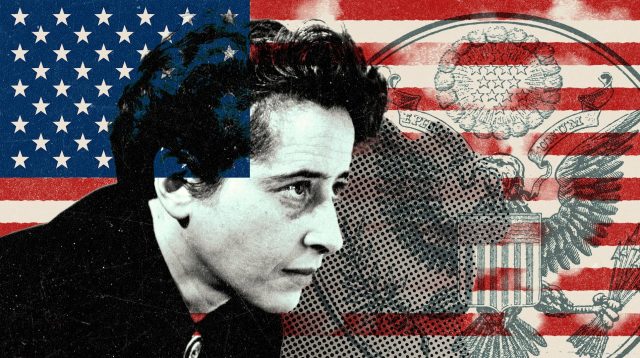






Over recent years, few writers have been quoted as incessantly as Hannah Arendt. Or rather misquoted — for though Donald Trump’s first presidential win catapulted Arendt’s 1951 book on totalitarianism back into the bestseller list, her fans have largely wallowed in anachronism. Avoiding her most arresting insights, they have instead reimagined Arendt as a kind of Resistance liberal, offering warnings of what happens when “politics as usual” is shamefully disrupted.
“Once again,” wrote Anne Applebaum in her new introduction to the re-publication of Origins of Totalitarianism in 2024, “we are living in a world that Arendt would recognize.” Which makes Arendt’s own response to America’s 200th anniversary so useful now, as Trump’s cage-filled 250th celebrations reach their climax. For the truth is that the philosopher’s own example actually proves she was far more thoughtful about her present than her contemporary followers are of theirs — even if her own hunt for usable versions of American patriotism ended up fomenting its own mistakes.
The most critical Arendt ever got of the United States was in a public lecture in Boston, 50 years ago, to mark the 200th birthday of her adopted land the year before it was celebrated. It wasn’t, she reflected, an anniversary that inspired much confidence in the future. Nor was the problem one disastrous politician, even one as nefarious as Richard Nixon. It was, rather, where capitalism and empire were taking the country, as Arendt looked out at “an increasing disarray in the very foundations of our political life”.
In Southeast Asia, America had gone down to ignominious defeat. The attempt to prop up South Vietnam after the “peace” in 1973 had only led to more war, and the emergency airlift of anyone who could make it out from the roof of the United States embassy in 1975. (Arendt gave special attention to the now almost forgotten “Operation Babylift”, which spirited thousands of orphans out of Saigon before the city fell.)
At home, Nixon’s resignation in 1974 came with soul-searching about how executive mendacity and secrecy undermined trust in government. Indeed, the Pentagon Papers publication had revealed — Arendt suggested — that the agonizing loss in Vietnam wasn’t half as bad as the fact that it took so long for Americans to register the truth about the war, since modern “public relations”, and not just age-old concealment and lying, had obscured their failures.
Instead of celebrating anniversaries simplemindedly, Arendt concluded, it was time to confront how badly the American experiment had gone awry. The crimes, mistakes, and sins of the immediate past were like chickens coming home to roost, in the phrase made famous by Malcolm X and which Arendt chose as the title of her speech when it was published in the New York Review of Books.
Arendt claimed that returning to their beginnings could inspire Americans in crisis to overcome their blunders in the mid-20th century. The deeper past of the American founding, she suggested, offered a chance of transcending them. Let us, she admonished, not “forget these years of aberration lest we become wholly unworthy of the glorious beginnings 200 years ago”. In this, she channeled the spirit of her earlier classic On Revolution, which had presented the American Founding as a modern reprise of austere Roman republicanism. She disdained what many people, then and now, take to the beating heart of the American project: whether law, liberalism, or rights. Rather, Arendt thought, America had once exemplified political action for the sake of collective freedom, a value she worried was dying in the modern world.
Amid the celebrants of her day, Arendt certainly refused to look away from the anxiety and depression that the following two centuries had produced. Yet she, too, was stumbling — not so much because of her misunderstandings of the 1770s, as because she confused the stakes of the Seventies. Five decades on from Arendt’s speech, America ended up in the age of Trump — as a direct consequence of the forces unleashed in her day. But she didn’t see them coming.
In her piece, for instance, Arendt mourned “the erosion of American power” following the Vietnam fiasco. But when she mounted the Boston lectern to celebrate the Founding, she didn’t imagine that the Democrats and Republicans alike would move to renew America’s global power over subsequent decades: including its military muscle. For the Democrats especially, the catastrophic defeat of peace candidate George McGovern in 1972 cast the die. From Mogadishu to Kabul, other failed wars, and countless casualties, invariably followed.
The militarism of an American hegemon rehabilitated in the 50 years since Vietnam, alongside the greater damage it wrought around the world, left too many disaffected voters, displeased by the ignominy of their country’s record. It also left an opening for Trump to run twice as a peace candidate — even if he finally and unceremoniously betrayed that promise. All this is a reminder that, as great a theorist of the imperial origins of totalitarianism as she was, Arendt never did glimpse the possibility that America itself had been, or could indeed become, an empire.
Arendt had other ideological blind spots too. Her political theory had always resonated with the ideal of participatory democracy in things like the Port Huron Statement, the 1962 manifesto propounded by student activists. Yet she always preferred to recognize the political action stemming from the deep past of the American Revolution, or Greece and Rome before it, and perhaps in some evanescent modern situations like the French resistance or the Hungarian uprising of 1956.
In her lecture, Arendt raised doubts about her American modernity and its consumerist economy, its mendacious ad-men and image-managers. They were, she said, exactly what made the American Founding indispensable, because it demonstrated public-mindedness beyond private gain or pleasure.
Unfortunately, though, Arendt’s failure to anticipate a renaissance for war was matched by a misrecognition of economic transformation. She did not anticipate that the economic instabilities of the Seventies were giving rise to the neoliberalism of the era since. She acknowledged the economic events, inflation most notably, that defined her decade when the 250th ceremonies were held across the country. Yet in her flawed belief that failed wars are fueled by inflation — a consequence, perhaps, of her German background — she missed the deeper geopolitical reasons for her age’s economic malaise. Both the first oil shock and Nixon’s decision to float the dollar transformed America’s long-term fortunes, even as the neoliberal response to Seventies-era inflation soon redefined the national economy.
Even more than the return of American militarism, meanwhile, the economic choices beginning in the Seventies produced the most damaging aspects of our own time. It was the American carnage of neoliberalism, after all, that permitted Trump to run against his own party and then the Democrats for betraying the people in the name of “elites”. (Never mind that practically Trump’s only legislative accomplishment is a gargantuan tax cut he gifted to the rich in his first term and renewed in his second.) Talk about chickens coming home to roost!
“We may very well stand at one of those decisive turning points of history which separate whole eras from each other,” Arendt wrote, in one striking moment of clarity. “The dividing lines between eras may be hardly visible when they are crossed; only after people have stumbled over them do the lines grow into walls which irretrievably shut up the past.” When she asserted that people can confusingly stumble into a future so starkly different from the past that it makes their own confusion unintelligible, she was right not least about herself.
Indeed, beyond prompting skepticism of the restoration of American “normalcy” that Resistance liberals today so confidently counsel, Arendt’s greatest value is less about the dangers of prophecy — even if it’s striking that she was hardly the Cassandra of her own age. Rather, she reminds us how easy it is to miss what’s happening under our noses, and pretending that our past, even when we celebrate it, is where the cure for the rot can be found.
Samuel Moyn is the Chancellor Kent Professor of Law and History at Yale University. His most recent book is Liberalism against Itself: Cold War Intellectuals and the Making of Our Times (2023).
 samuelmoyn