




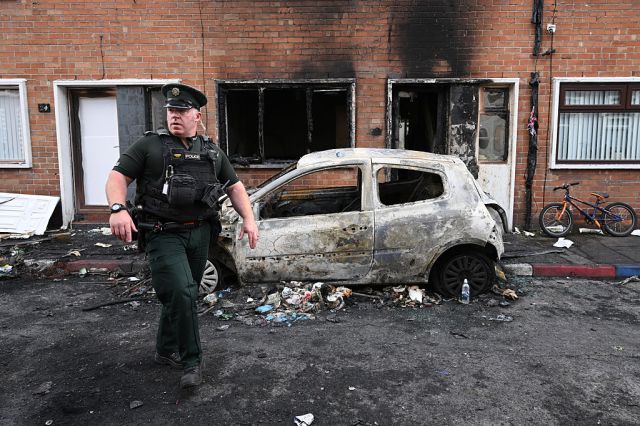
There's only so much the nudge unit can do. (Charles McQuillan/Getty)





After a night of unrest in Belfast and elsewhere, the family of Stephen Ogilvie, the man hospitalized by an attack on Monday night, issued a statement via the Police Service of Northern Ireland. In line with similar incidents threatening “community cohesion”, the Ogilvies pleaded for calm, commenting: “We have many migrants who make a deeply valuable contribution to our country, including in our healthcare system and hospitality sector and we depend on them to make our country work.”
The statement was laced with officialese: and Ogilvie is reportedly from Rathcoole, a predominantly Loyalist housing estate north of Belfast. Was the suspiciously polished family statement, many wondered, issued by the Government on the family’s behalf? And if so, why? Social media, unsurprisingly, decided “the State” dictated the Ogilvies’ response. Victims of controversial killings involving ethnic minorities, it was alleged, are manipulated by government spinners. And so the scene was set, digital barricades erected, culture warriors firing barbs across no-man’s-land. It’s hardly the favored territory of officialdom, with police comms teams too often flailing in the septic tank of 24/7 social media.
What, though, is the truth? Are families pressurized to give statements sympathetic to official narratives? How seriously does the Government take threats concerning racial tension? And, as Britain enters another potential summer of unrest, are police forces prepared?
First, the specifics of the family statement. Given the severity of Ogilvie’s injuries, a police family liaison officer — or FLO — would be assigned to support them throughout the investigation. Police FLOs are widely considered to be a success story, offering support to victims during distressing circumstances. Nonetheless, they are also detectives with a hotline to the Senior Investigating Officer. Furthermore, victims’ families do receive advice on issuing statements. Statements might be discussed over cups of tea, FLOs explaining how they might impact future criminal proceedings. All parties are likely to have been briefed by force comms officers, keen to dampen down contentious issues. Note how, for example, Henry Nowak’s father gave a full statement — one criticizing police actions around his son’s death — only after Vickrum Digwa’s trial.
It seems likely, then, that the Ogilvies’ statement would have been “managed” via the FLO and the wider PSNI. This is standard practice. Suggestions the security services might involve themselves in such matters, in my experience, are wide of the mark. Given the uniquely fraught circumstances Northern Irish officers operate under, not to mention the forthcoming marching season, any public statement would attract the interest of a three-ring circus of community and political groups. Added to this is the Sinn Féin majority administration’s pro-immigration policies, making the party vulnerable to allegations of being “soft” on issues of race. This is why John Boutcher, the (English) PSNI chief constable, tiptoes daily across a minefield of political sensitivities. This isn’t to say there wasn’t some authenticity to the Ogilvies’ statement, nor that the family’s contribution wasn’t heartfelt, but their words seem almost certain to have been polished.
Is the Ogilvie case, then, an example of comms management particular to post-Troubles Belfast? Or does the British government routinely control public sentiment in cases involving potential disorder? My experience working in counterterrorism suggests it does, albeit subtly, even if things have invariably evolved. Techniques pioneered to prevent post-terror attack riots are deployed against vaccine-skeptics and those on the “radical Right.” The Government clearly is spooked: only this week, Liz Kendall, Secretary of State for Science, declared the Government would urgently seek to update the Online Safety Act so that it requires services “to take quicker action to remove illegal content circulating during times of crisis.”
Even during my police service, I witnessed how genuinely petrified senior police officers and civil servants are of wide-scale public disorder. The 2001 Oldham riots, involving three nights of racially motivated violence, focused their minds. The context, by 9/11 that September, was that of Muslim communities targeted by the far-Right after any terrorist incident. During the aftermath of the 7/7 bombings in 2005, working in counterterrorism intelligence, I saw police commanders repeatedly ask the same question: how do we stop Muslim communities from going up in flames? How do we stop another Oldham? Liberal-minded officers, such as Brian Paddick, were accused of cravenness. Others sounded like colonial governors, fretting over restless natives. That was then. Now, we have pro-Gaza independent MPs exercising de facto control over police operations.
Central government is painfully aware of these problems. The United Kingdom, were it a car, would be a Cold War-era Trabant, its engine spluttering as an era draws inexorably to a close. This isn’t to say the powers-that-be haven’t mounted a spirited defense, updating the creaking two-stroke engine with a digital-management system. Post 7/7, the Government established the Research, Information and Communications unit, known as RICU. A relatively small unit, independent of the security services, RICU works with local authorities and media contractors to create and disseminate content. To counter Islamist narratives, RICU’s communications aim to “effect behavioral and attitudinal change.” These techniques are also employed elsewhere, as was evident during the Covid pandemic and in the aftermath of last summer’s anti-immigration protests. Now, though, public information and sentiment strategies intended to combat Islamist terrorism have been targeted at those threatening official narratives around “diversity” and “community cohesion”. During the same protests, the “National Security and Online Information Team”, a body within the Department for Science, Innovation and Technology, asked online platforms to moderate content critical of government narratives.
Then, after the post-Southport riots, came the Home Office’s awful “rapid analytical sprint” report. Only 18 months old, the “sprint” has aged like milk. It posited a new offense of communications that inflict “psychological harm”, demonstrating Labour’s ongoing obsession with controlling language. It urged the police to increase their use of since-abandoned Non-Crime Hate Incidents. Perhaps most telling of all, though, is RICU’s use of “controlled spontaneity” after terrorist incidents — the kind of tactics the Home Office are likely to use in order to counter anti-immigration sentiment. In that vein, a veteran contingency planner told Middle East Eye that “this job has changed significantly from planning for organic, people responses to tragedy, to being told: ‘We would like the people to do that, how do you get them there? A lot of the public’s responses are spontaneous, of course. But a lot are shaped. The [British] government doesn’t want spontaneity: it wants controlled spontaneity.” Controlled spontaneity involves bussing in peace-preaching imams. Putting up posters in railway stations. Facilitating vigils. The panoply of “Don’t look back in anger” theatre, inspired by the public’s (genuine) response to the 2017 Manchester bombing.
Admittedly, controlled spontaneity sounds a tall order in a city like Belfast, yet the mindset remains similar. Seize the initiative. Frame narratives. Control. But official narratives have become suspect, especially in racially sensitive cases. For the Government, the potential for widespread disorder explains the urgency of its internet-control agenda. Why? The alternative is unthinkable. Due to austerity, UK police forces are short of personnel, training, and equipment, with the consequence that their ability to keep order has been seriously diminished. For example, after the Stephen Ogilvie stabbing, the PSNI was forced to fly in 200 extra officers from the mainland to support its operations. At the recent pro-Palestine and Right-wing “Unite the Kingdom” demonstrations in London, the Metropolitan Police fielded 4,000 officers, but only with reinforcements from as far afield as Wales. Luckily for the Met, the demonstrations were largely peaceful.
This, ultimately, is why the Government devotes so much of its political bandwidth to messaging, communications and sentiment management: its capability to police public disorder has atrophied. An officer with a Home Counties force recently told me how senior officers are currently “wargaming” their response to any repeat of Southport-style unrest this summer. “We aren’t the Met, we don’t have dedicated public order officers,” he said. “We’ll be relying on PCs taken from other duties, guys with only basic shield training.” And the mood music in police HQ command floors? “Grim. They’ve run out of money. They simply don’t have enough people available.” His message was clear: if England “kicks off”, it’s every force for itself. As they head off on holiday this summer, this will prey on the minds of chief officers and Home Office mandarins. All this after the performance of Hampshire police during bushfire demonstrations in Southampton was mixed.
The UK’s police “mutual aid” arrangements, as seen at the London demonstrations earlier this year, assume supporting one or two major incidents. Multiple outbreaks of serious public disorder would almost certainly collapse the system. “Basically,” said the officer, less prosaically, “we’d be fucked.” And what, I asked, of the last resort? Calling in the army? He laughed. “They haven’t got enough people either, have they?”
This, in the end, clarifies the relative importance of subtler measures. British governments pride themselves on their ability to negotiate. To parley their way out of problems, while assuming the UK remains a high-trust society. A society with a functioning social contract, the glue keeping the Trabant of state legitimacy on the road. This is why, when cuts are required, legislators axe the state’s more coercive arms — the military and policing.
Yet now that public trust has eroded, along with the social contract, legitimacy is surely next. The Government, though, will continue with its displacement activity, fretting over internet misinformation and polishing statements made by grieving families. A frontline consisting of internet monitors and family liaison officers, armies of “performative spontaneity” coordinators urging us not to “look back in anger”.
The Trabant that is the UK state trundles along, held together with little more than duct-tape and good intentions. Such apathy typifies the mindsets of senior police and civil servants, until the predictable happens. With luck, next time, disorder will again be contained. Reviews will be commissioned and public inquiries launched. Lessons will, allegedly, be learned. And, somewhere, another violent man will cross a border unchallenged. Then another statement will be burnished, until the Trabant’s engine finally sputters and dies for good.