




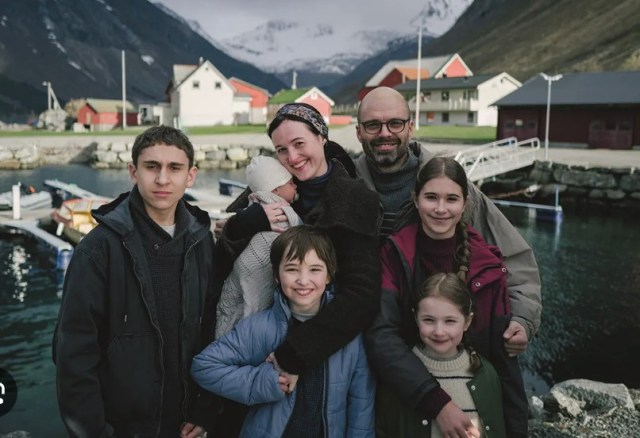
The Gheorghiu familiy in the movie 'Fjord' don't find their Norwegian neighbors to be very tolerant. Credit: Cannes Film Festival





Fjord — the inspired-by-real-events drama that wowed last month’s Cannes Film Festival, earning the Palm d‘Or — explores the limits and paradoxes of liberalism. Does liberalism require tolerance for religious conservatives and others who don’t share its basic assumptions? Do progressives “other” some minorities (even as they embrace and celebrate others)? Are there substantive moral commitments behind liberalism’s supposedly neutral procedures?
The genius of the film, by the celebrated Romanian director Cristian Mungiu, is that it poses these questions without ever forcing simple, didactic answers.
Early on in the story, we know evangelical Christianity is going to be a theme. We hear a Norwegian rendition of “Amazing Grace” sung at a church gathering, and we learn the origin story of the film’s lead couple: the Norwegian Lisbet (Renate Reinsve) was on a humanitarian Christian mission in Romania when she met Mihai Gheorghiu (Sebastian Stan). They now have five kids together and, after years of living in Bucharest, have moved to Lisbet’s picturesque hometown in western Norway, where Mihai takes a job as a technician at the local school.
The couple’s Christian mores soon draw censure from many in the local community. The kids go to church every Sunday and study the Bible every day using a points-based system (you lose points if you misbehave or forget your daily portions). Unlike their peers, the Gheorghiu children aren’t allowed to use YouTube, dance, or own smartphones. Clashes erupt, both at the school and between Gheorghius and their next-door neighbors, the Halsbergs, with whom they have a complex relationship.
Mats Halsberg (Markus Tønseth), who had initially made a point of warmly welcoming the family, is discomfited by their Christianity (he forbids Mihai from playing “Amazing Grace” on the piano at the local school where he works, even without the words). But his Swedish wife, Mia (Lisa Carlehed), whose outsider perspective perhaps renders her more understanding, gets along with Lisbet, who joins her in taking care of Mats’s wheelchair-bound father, Ake. The children get along, too. Elia Gheorghiu (Vanessa Ceban) forms a particularly close relationship with Noora Halsberg (Henrikke Lund-Olsen), a teenage rebel whose wild ways are in sharp contrast to Elia’s obedience to the Almighty and her parents.
We might expect an arthouse European film to indict the conservative Christian family at its center, mocking the members’ backwardness and showing their dark side. Mungiu himself has a venerable history of confronting religious obscurantism. His Palm-winning 4 Months, 3 Weeks and 2 Days (2007) tackled the draconian anti-abortion laws in Romania. Beyond the Hills (2012) portrayed an Orthodox convent accusing two women in an intimate relationship of being possessed. R.M.N. (2022), too, paints a picture of a local church in Romania as a regressive institution.
But Fjord takes us on a wholly different path. When officials at the school notice bruises on Elia and her brother, they act swiftly and bring in Norway’s famously zealot Child Welfare Services. Within a day, all five children (even a still-nursing infant) are taken away from the family and placed in foster care. The film thus becomes a courtroom drama, as the Gheorghius throw all they have at a chance to get their children back.
Without surrendering to didacticism or painting a heroic picture of the family, the film gently takes the Gheorghius’ side, pointing out the gaping hypocrisies of the supposedly progressive Norwegian host society. The progressive townspeople, the film suggests, are animated by prejudice: against religious devotion, against the traditional mores of Romanian society.
We live in the age of self-righteous ideological silos, in which partisans of one side don’t bother to learn much about those of the other, often making do with cartoonish views of them. Social progressives and Leftists must be familiar with this phenomenon, having long critiqued the act of “othering” minorities. But liberals and Leftists can be equally prone to “othering” minorities they don’t approve of, as Fjord shows.
The film doesn’t sugarcoat the Gheorghius. Portrayed stoically and firmly by Stan, Mihai is not a particularly likable character, often appearing as dogmatic and mildly authoritarian. There is also no denying that the Gheorghius use corporal punishment as a routine part of parenthood, although the methods of discipline are never quite revealed. The specifics are lost in translation between three languages — English being the lingua franca between all sides — but it seems to be mild spanking, and certainly nothing harsh enough to leave bruises. Having seen how physical the games Noora plays with the kids are, we can assume those to be the cause for the bruises. Noora herself tells her parents as much.
With Mungiu’s typically masterful storytelling, the film shows us all the subtle and not-so-subtle ways in which the Norwegian progressives harbor prejudice toward these newcomers, because they are the “wrong” type of immigrants, the “wrong” type of minorities. The school is happy to hold formulaic and anodyne celebrations of the indigenous Sami People. But faced with a different minority, it reacts very differently. Any mention of the Bible at school is taken to be verboten “evangelizing,” which seems less like separation of church and state and more like the state enforcing certain ideas and barring others.
The prejudicial treatment also mars the courtroom proceedings. A teacher testifying about the bruises casually lets slip that it’s normal for children to have bruises at that age, since “they are children after all.” It is thus not the bruises-as-evidence, but a very pointed reading of them that impelled the school to act against the family. The prosecutor, meanwhile, uses old Romanian proverbs to portray Mihai as prone to violence. The prosecutor’s assuredness of being right in his viewpoint smacks of the sort of absolutism for which progressives usually reproach the religious Right. At several points during the proceedings, Mihai seems to be on trial for his religious beliefs, not whether he has smacked his children. The family’s mere taking part in church services — fraternizing with the wrong kind of locals — is treated as suspicious in court. Only certain forms of “integration,” it seems, are approved for immigrants.
The film also tries to show how the supposed progressives are blind to shortcomings on their own side and virtues of the other. Banning YouTube might be draconian, but can anybody argue that unrestricted access to social media and smartphones has been great for kids? We see how the Halsbergs are clueless about parenting Noora (whose shenanigans include faking a suicide by gently cutting her wrist, jumping out of windows, and dangerously taking out boats at all hours of the night). Lisbet’s devoted caring for Ake achieves what the secular experts have failed to do: getting him to talk after long days of dementia-induced silence. Perhaps the Gheorghius have something to teach their new society.
Even so, the film can’t be read as a sign of Mungiu turning to the Right. Nor is this film an indictment of liberalism. In fact, if liberalism is to be defined as a philosophy of individual rights, due process, and tolerance of difference, Fjord stands as a vindication of liberal philosophy. It criticizes the illiberalism of the Norwegian system (Mungiu says the film opposes all forms of “fundamentalism” and “extremism”).
At several points in the courtroom drama, we gasp at how little due process is observed. When the children are interviewed by the officials, there are no lawyers or psychologists present. The court that rules on the decision to take the kids has little institutional separation from the child-welfare agency. Even the lawyer acquired by the family seems too invested in the system to think it might have made a mistake. After one court session, she refuses to represent the Gheorghius. In this close-knit community, there seems to be an incestuous intimacy between various sources of authority, seriously undermining the principle of judicial independence.
The film’s real heroes, if you ask me, are some of the side characters. Mia, who holds a law degree but hasn’t practiced in ages, agrees to represent the family and works diligently on its behalf, despite grumbling by Mats. At a memorable moment in the trial, the prosecutor reminds her that she wouldn’t fare so well in a Christian conservative society. “If I were there, I’d defend minorities, too,” she says, showing a dedication to equality and individual rights that the uber-liberal prosecutor could learn from.
Then there is the budding friendship between Noora and Elia, which includes breaking all sorts of rules (Noora smuggles a phone to Elia, thus keeping in touch with her even when she is taken to a foster family). By painting a touching image of teenage amity between two girls from wildly different ideological backgrounds, Fjord arguably casts them as the real heroes. In treating each other as humans and friends first, they seem to rise above the ideological rifts that have ripped their community apart.
Mungiu’s film has now brought him his second Palm, making him one of the most decorated filmmakers alive. He is unquestionably the lodestar of Romanian New Wave, which in the past two decades has awed European and global cinema. The film inevitably will also be seen in an intra-European context. In the more than two decades since Romania joined the European Union, its people have encountered all manner of stereotypes. Here we see a Romanian auteur confidently critiquing Nordic political culture, by some lights the pinnacle of European civilization. His roots as a citizen of a formerly Stalinist country have endowed him with a healthy skepticism of state power. This year at Cannes, the fellow New Wave auteur Radu Jude did something similar with his Diary of a Chambermaid, offering acerbic satire in a story about a Romanian nanny working for a family of progressive French intellectuals in Bordeaux.
If these films can show us something, it is the value of a non-didactic cinema that doesn’t rush to confirm our priors, but pushes us to rethink them. It’s what art does best.
