




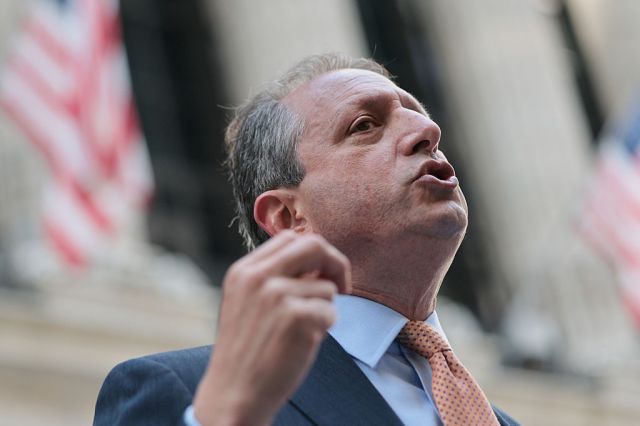
Brad Lander is the front-runner for New York's 10th Congressional District. Credit: Getty





“Most people, even supporters of Israel, view it with some revulsion,” Brad Lander tells UnHerd. “There were war crimes that went way beyond a legitimate prosecution against the perpetrators of Oct. 7.”
The former New York City comptroller and Zohran Mamdani ally is running to replace Rep. Dan Goldman in the state’s 10th Congressional District, spanning Lower Manhattan and parts of Brooklyn. By every “normal” measure, Goldman’s should be a safe seat: the two-term lawmaker faces no scandal, takes conventionally center-Left stances on every issue, and is, of course, furiously anti-Trump; indeed, he rose to fame in the 2010s as the lead counsel in President Trump’s first impeachment trial.
Yet Goldman is trailing Lander by 34 points, according to a recent Emerson College/PIX 11 poll.
Goldman, then, is effectively doomed. Why is that? If, on issues like health care and housing and the economy, there aren’t great differences between Lander and Goldman, they do diverge significantly on Israel and the fate of the Palestinians. And it’s here where Lander, who is proudly Jewish like Goldman, points to the future of the Democratic Party.
He might, in time, come to embody it fully.
To be sure, the lopsided nature of the polls isn’t just about “revulsion” at Israel, which is overwhelming among Democrats and Independents and growing among Republicans under age 50. Lander just ran for mayor, served as Gotham’s chief financial officer, and represented significant chunks of the district for 12 years as a member of the city council. Lander, in other words, is no ordinary insurgent. Goldman has much shallower roots in the district.
Then, too, Lander sits to Goldman’s Left, and the district is among the most liberal in the country. While Goldman notably refused to endorse Mamdani for mayor in the general election, Lander proudly co-endorsed and campaigned with the democratic socialist. The mayor, in turn, has endorsed Lander in his congressional race.
Lander holds several positions on Israel that, several years ago, would have been considered taboo. He opposes all military aid to Israel until the Jewish state complies with international law, particularly in regards to the occupation of the West Bank. He backs the Block the Bombs Act, which would curtail weapon sales to Israel. And he’s labeled the war in Gaza a “genocide,” defying a still-powerful Israel lobby that insists the mass-casualty horrors of the operation were a necessary response to the Oct. 7 attacks.
“With young people,” Lander says, “it really is a disconnect between what they can see with their eyes and what received political wisdom is trying to tell them.”
Lander, however, is willing to break from the furthest-Left flank of his party, which has become explicitly anti-Zionist. He believes in two states for two peoples, with one that is explicitly Jewish. Unlike his friend and ally Mamdani, Lander doesn’t back the Boycott, Divestment and Sanctions movement, though he doesn’t censure it, either.
Goldman, by contrast, represents the Democratic Party’s past. On Sunday, he participated in the Big Apple’s Israel Day Parade, marching steps away from Benjamin Netanyahu’s hard-line finance minister, Bezalel Smotrich, who has vowed to “bury” Palestinian statehood and recently threatened to evict a Bedouin village in response to an International Criminal Court indictment; Lander gave the parade a miss.
The awkward proximity to the likes of Smotrich cast into sharp relief the unenviable position of pro-Israel Democrats, like Goldman, forced to defend a very different Israel than the one their parents championed.
An heir to the Levi Strauss fortune, Goldman has grown critical of Netanyahu but is unwilling to back the blanket suspension of military aid that Lander is calling for. He is not voting for the Block the Bombs Act. He is, at least, supportive of restrictions on offensive weapons but still backs funding for the Iron Dome missile-defense system.
In 2023, Goldman voted to censure his Democratic colleague Rashida Tlaib (D-Mich.) for using the phrase “from the river to the sea, Palestine will be free.” A year later, Goldman backed a GOP-led effort to undercut a lawsuit lodged by South Africa against Israel on charges of genocide. Goldman rejects the term.
“Goldman has made it clear he is always going to vote for US military aid to Israel,” Lander tells UnHerd, “regardless of how much it violates international law or Palestinian human rights.”
Maddy Rosen, a spokeswoman for Goldman, defended the congressman’s record.
“Brad’s hypocrisy famously knows no bounds, which is why he’s blatantly lying about Dan’s record to deflect from the fact that he invested New Yorkers’ taxpayer dollars in Israel’s largest weapons manufacturer as comptroller,” she said. “The military aid that the US provides to Israel already requires Israel to follow human-rights law. When Israel has not, as with the West Bank, Dan has supported withholding weapons from that region and is a co-sponsor of Rep. Nadler’s West Bank Violence Prevention Act.”
Still, there are going to be more Lander-style Democrats in the House. American democracy often works on a lag, with politicians trailing public opinion. They do, though, eventually catch up. A Pew survey taken last month found that a stunning 80% of Democrats and Democratic-leaning independents take an unfavorable view of Israel, up from 69% in 2025 and 53% in 2022. These are generational numbers: the youth have an even dimmer view, and their opinions will likely only harden with age. This is why more and more 2028 Democratic presidential candidates are swearing off AIPAC cash altogether. Netanyahu’s decision to drag Washington into a war in Iran seemed to be the final straw.
“Americans don’t want to keep providing unconditional military aid to Israel after watching the genocide in Gaza … and yet Democrats and Republicans in Congress keep voting for it,” Lander tells UnHerd. “The numbers are increasing of Democrats who are saying no. We should not vote for additional US military aid to Israel.” And there will be “Republicans,” he predicts, “who will be voting that way, as well.”
That remains to be seen, especially with AIPAC and Republican Jewish groups’ successful demolition of Thomas Massie. What Lander may be right about, though, is that Republican voters are becoming less reflexively pro-Israel, if evolving at a slower clip than Democrats. What’s disappearing from the electorate, broadly, is any particular affection for the Jewish state. Gen-Z conservatives, especially those who take MAGA’s America First credo to heart, are far less likely to back Israel than older generations, and there probably will come a point when Republican members of Congress begin to reflect those views. How long that actually takes is anyone’s guess.
What’s clear is that, for the Democratic Party, there is no going back to the status quo ante on Israel. The next Democratic president won’t indulge Israeli leadership the way Joe Biden did. A Democratic House or Democratic Senate won’t speedily authorize billions in unconditional military aid. House Democrats, at least, will be sounding a lot more like Lander.
“There was sympathy for Israel on Oct. 7 that might have been built upon in such a different way, if Israel had a different leader and different political coalition,” says Lander. “It wasn’t, and here we are.”
