




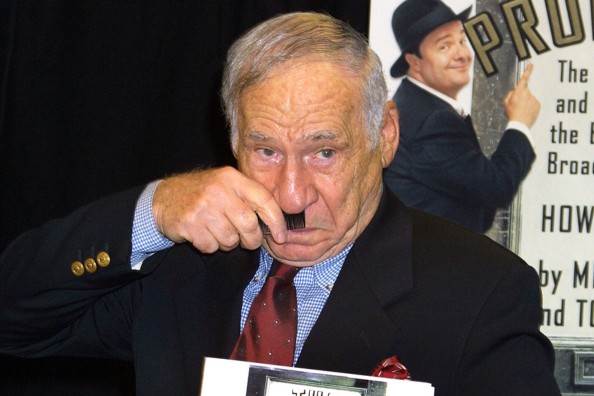
The scolds couldn't stop him. (George de Sota/Getty)





No filmmaker better captures the spirit of America at its best than Mel Brooks. His life and work embody its can-do confidence and joyful exuberance, its promise as a melting-pot that welcomes all-comers with open arms.
Born 100 years ago this weekend, on a kitchen table in a Brooklyn tenement, just in time for the Depression and the golden age of American comedy, Melvin Kaminsky, the son of Polish and Ukrainian Jews, inherited a powerful love for life. He was raised by a single mother who worked a 10-hour shift in New York’s garment district. (His father died when he was two.) Short, scrawny, and with a nose that someone once compared to “a small mudslide”, Brooks told Playboy that he could hang around with older boys because “they were afraid of my tongue. I had it sharpened and I’d stick it in their eye. I read a little more than they did, so I could say, ‘Touch me not, leper!’ ‘Hey! Mel called me a leopard!’ ‘Schmuck! Leper!’ Words were my equalizer.”
That’s true of comedians in general. But it was Jewish ones who perfected the fine art of using wit — which Aristotle defined as “cultivated insolence” — as a weapon of defence. Don Rickles, Joan Rivers (born Molinsky), and Jackie Mason (Yacov Moshe Maza), also children of immigrants and contemporaries of Brooks, made their careers out of humor honed to a razor’s edge over centuries in the Diaspora. (A typical Mason joke: “Are there any Poles in the audience? No? There must be. They just don’t understand the question.”) A few years older than Rickles and Mason, Rodney Dangerfield (Jacob Cohen), “Mr I Can’t Get No Respect”, revealed the socially anxious underbelly of their aggressive routines. But Brooks, who at the age of nine told his uncle that he was headed not for the garment district but for show business, is cut from different cloth.
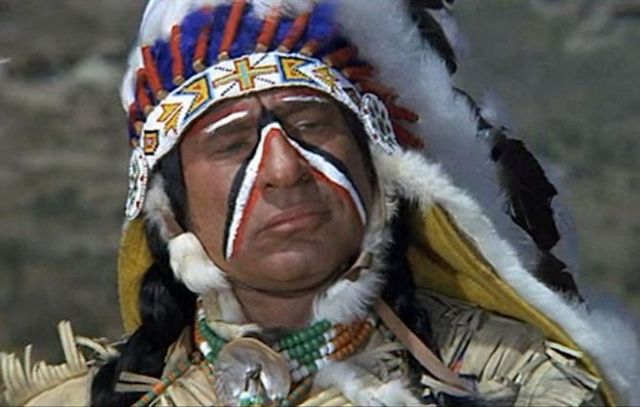
Brooks can be as outrageous as anyone: The Producers’ vaudeville production “Springtime for Hitler” made the film untouchable by major studios. Yet if his humour is distinctly Jewish — in Blazing Saddles, he appears as an Indian chief who speaks Yiddish — it is also as big-hearted and self-assured as the country that gave him his break. Whether it was a natural inclination to gratitude, or serving his country at the Battle of the Bulge, or rising from poverty to the silver screen by way of the Borscht Belt, Brooks came to love America, and to reflect that love in his art.
Consider Blazing Saddles. Nothing captures the American belief in gritty individualism, justice, and a fair deal for the little guy more than the Western, where the white hats give the black hats what’s coming before they ride off into the sunset. Brooks, whose writing team included the legendary comedian Richard Pryor, turns that idea into a piece of biting social commentary — one that condemns present-day racism while offering a hopeful vision of Americans’ capacity to live up to the nation’s ideals. The story’s protagonist is Bart, a black convict played by Cleavon Little. As the opening credits roll, the title song informs us that Bart “conquered fear and he conquered hate, / He turned dark night into day, / He made his blazing saddle / A torch to light the way.”
Blazing Saddles doesn’t exactly break the fourth wall, because there is none from the get-go. In one early scene, a boss taunts his chain gang of railway track-layers: “When you was slaves, you sang like birds. Come on! How ’bout a good ole n****r work song?” Backed by a chorus of black convicts, Bart sings a fine a capella version of the 1934 Cole Porter tune “I Get a Kick Out of You”, and then watches with amusement as the befuddled cowboy bosses — “Hold, it, hold it! What the hell is that shit?” — dance like imbeciles while singing “Camptown Races,” a minstrel song that parodies slave music, to show what they had in mind. Taggart, who oversees the whole operation, comes riding up fit to be tied: “What in the Wide Wide World of Sports is goin’ on here? I hired you people to get a little track laid, not to jump around like a bunch a’ Kansas City faggots!” It’s a brilliant (if unintended) reversal that foreshadows the plot as a whole — Taggart is as racist as anyone — in which bigots learn to respect, and even cherish, the objects of their former hatred.
Like Huckleberry Finn, an anti-racist book full of racial slurs, Blazing Saddles doesn’t have a mean bone in its body. In fact, it’s a retelling of Twain’s great American novel of friendship between outcasts, with Gene Wilder’s Jim (a washed-up alcoholic gunslinger) in the role of Huck, and Bart in the role of Jim. These two characters — nothing but a lousy pair of deuces, socially speaking — become fast friends when Bart, who’s been appointed sheriff of Rock Ridge by the state’s attorney general in a scheme to seize their land, is greeted with open hostility by the town’s all-white residents.
But the pair ultimately win over the townspeople, setting up a genuinely democratic drama. They lead a popular coalition of Rock Ridge settlers, and black, Irish, and Chinese track-layers, to outwit a motley band of common criminals, Klansmen, Nazis, Hell’s Angels, and (this being the year after the Yom Kippur War) Arabs on camels, paid for by the wealthy and powerful. In Blazing Saddles, a classic tale — the triumph of the wily underdog against organized injustice — turns out to be equally Jewish and American. In the end, the townspeople beg Bart to stay on as sheriff, but he and Jim head for greener pastures. They get into a chauffeured limousine and drive west, toward the setting sun. It’s a story of civic amity worthy of America’s 250th, a reminder of national aspirations that are sorely in need of renewal.
“I’m a serious human being who is a humorist,” Brooks told Playboy. “The greatest comedy plays against the greatest tragedy. Comedy is a red rubber ball… if you throw it against the hard wall of ultimate reality, it will bounce back and be very lively.” Brooks’ signature combination of edgy humor, deep generosity, and a tragicomic sensibility shaped by wide reading — Gogol, Conrad, Dostoevsky, Tolstoy — was already apparent in his first film, The Producers, released in 1967. The protagonists are Max Bialystock (Zero Mostel), a Broadway producer, and Leo Bloom (again Gene Wilder), an accountant, whose name is a nod to the eponymous wandering Jew of Joyce’s Ulysses.
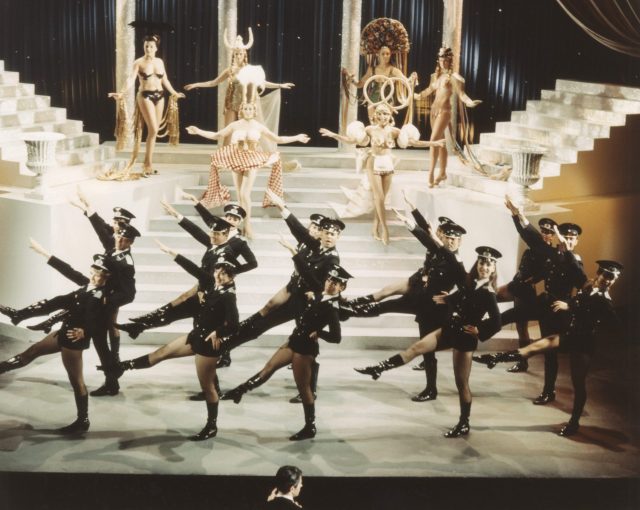
Many people think that it was in very bad taste for Brooks to make a film full of goose-stepping, Sieg-Heiling characters in Nazi uniforms little more than 20 years after the Holocaust. Maybe so: but Brooks subtly indicates that he is by no means insensitive to Jewish suffering. Joyce’s Leopold Bloom is targeted by Irish antisemites, while the Polish city of Bialystock was home to 50,000 Jews at the start of the Second World War; 800 were burned alive inside the Great Synagogue when the Germans torched it in 1941, while the rest died on the streets, in the ghetto, or at Treblinka.
These hints had to suffice, and not just because the film is a comedy: American survivors just wanted to forget the past, and began speaking publicly about their experiences in the Holocaust only in the Seventies. But in 1967, Americans were fully prepared to ridicule the Nazis; the popular television series Hogan’s Heroes had been doing just that for two years. Little wonder “Springtime for Hitler” brilliantly mocks the Third Reich by having a spaced-out acid-head perform the role of Hitler (did Brooks know that der Führer was sustained by a steady diet of opiates, cocaine, and amphetamines?) and a black hipster that of “Little Joe” Goebbels.
Brooks’ big heart is there again on full display in The Producers. Bialystock talks Bloom into participating in his con of massively overselling shares in “Springtime for Hitler” — a play so bad that he is convinced it will fail on its first night — to little old ladies he pretends to love. The scheme backfires, and both men are sent to prison. But neither the little old ladies, who attend their trial, nor Bloom, who seems to bear in himself all the anxieties of Jewish trauma have regrets. He explains that “No one ever called me Leo before… even in kindergarten they used to call me Bloom. I never sang a song before, I mean with someone else… This man, this man — this is a wonderful man.”
It’s a plea for kindness and compassion that is all-too-rare in comedy today. That’s because the world in which Brooks came of age no longer exists. His generation was educated in the school of hard knocks: first the Depression, then the war, with its triumphs and horrors. And if the slump taught self-reliance, that existential fight against the Germans and Japanese taught patriotism and civic responsibility. To many veterans, it revealed what really matters in life: family, friendship, community; gratitude and kindness. Brooks’s distinctly American comedy — democratically capacious, high-spirited, goofy, magnanimous, tinged with Jewish pathos — perfectly expressed this sensibility.
Shortly after the bicentennial, however, Americans began losing faith in their great experiment in ordered liberty. The schools stopped teaching civics; the idea of the melting-pot ceased to form young souls, and national pride declined. No longer united by common ideals and aspirations, our sense of humor has become smaller and more brittle. And with the reassertion of a wary tribalism, Brooks’s marriage of Jewish and American comedy seems but a distant memory. In Blazing Saddles, Sioux warriors attack a wagon train in which Jim (then a boy) and his family are travelling far in the rear, a wry comment on how black Americans were sent to the back of the bus in the Jim Crow south. Brooks, the Yiddish-speaking Indian chief, lets them go, marvelling “They darker than us! Woo!” The scene, which wittily presents Jews as aboriginal Americans while emphasising their solidarity with black Americans during the civil rights movement, wouldn’t work today. Some black Americans view Jews as oppressors, and few Jewish Americans still understand Yiddish. Like other Americans, Jews have increasingly embraced progressivism, which turns people into humorless scolds — especially when jokes contain offensive language. These developments have pushed Brooksian comedy to the brink of extinction.
What remains in a world without humor is absurdity, the incongruity at the heart of any joke. But absurdity in itself, shorn of the meaning our common human endeavors and shared concerns bring to it, isn’t funny. It can’t lift us up, because it isn’t going anywhere. Brooks is always going somewhere; his comedy is beloved because its honesty about who we are, and its hopeful vision of who we might be, satisfies our craving for authentic human meaning.