




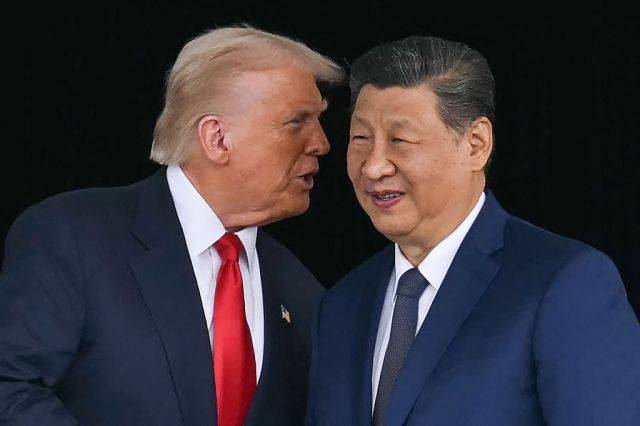
This week's summit is all about Taiwan. Andrew Caballero-Reynolds/AFP/Getty Images





When President Donald Trump lands in Beijing today, for his first state visit to China since 2017, he will be hoping that the conversation on cable news is about soybeans, Boeings, and an extension of his trade “truce”. Yet in Beijing’s mind, this meeting is all about Taiwan. Every trade item on the agenda exists to create leverage on the Taiwan issue.
Beijing has a clear theory of victory for the summit: it wants the international press to report that Trump is selling out Taiwan. Chinese leader Xi Jinping has told American interlocutors directly that Taiwan is the “most important issue” in the US-China relationship. His goal for this summit, and for the next one in Washington later this year, will be to persuade Trump to move towards a broader accommodation on the Taiwan issue. But even if Trump refuses to budge, Xi wants to create a narrative that his US counterpart is giving way on Taiwan. If that narrative gains steam, even if it isn’t true, it could drive Taiwan to the negotiating table out of desperation.
Xi’s first request is reportedly tiny and inconsequential. He wants Trump to say that America “opposes” Taiwanese independence, not just that it “does not support” it — a line the US has taken since the Clinton administration. Practically, there is no difference between these two positions. The essence of the longstanding American position is that both Beijing and Taipei must be deterred from changing the status quo unilaterally. The United States has never had any interest in declaring support for Taiwan’s independence. But if Trump is seen as tweaking his communication of the One China Policy under duress — even slightly — Xi hopes to make it seem that more substantial concessions are coming down the road.
Xi has his eye on Taiwan’s January 2028 presidential election, when he hopes that a candidate more interested in dialog with Beijing will come to power. Taiwan’s ruling Democratic Progressive Party (DPP) is hoping for a fourth consecutive term. Xi, though, is seeking to engineer a restoration of the Kuomintang (KMT), which agrees in principle (with its own interpretation) that Taiwan is part of “One China”. Xi can do business with the KMT. He will not negotiate with the DPP. His goal: erode Taiwanese voters’ faith in the United States, so that they turn away from the DPP.
The broader point is that Xi’s main vector of coercion right now is political, not military. The West has long envisioned a Taiwan crisis as a 2027 amphibious invasion. This risk remains real, as China acquires new military capabilities. But an invasion would be challenging and fraught with danger, especially given the turmoil in the People’s Liberation Army (PLA) leadership. Xi would rather take Taiwan for free, if he can get it.
In case Trump refuses to give Xi what he wants, China is preparing options short of war to assert control over Taiwan. The most concerning scenario is known as the “quarantine”, or indirect control option. This would not be a blockade. It would not seek to force Taiwan’s immediate surrender, or to stop the flow of goods in and out of the island. Instead, Xi would assert that, as a matter of law, People’s Republic of China (PRC) customs authorities should be able to control who and what comes and goes to “Taiwan province”. He could move towards this outcome incrementally, for instance by asking that airlines entering and leaving Taiwan submit passenger manifests for approval, or that cargo ships entering and leaving submit to spot inspections. The goal would be to undermine Taiwan’s economic autonomy while persuading private companies and the United States to accept this as a new normal. In time, if Taiwan still refused to negotiate, he could use these new tools to apply targeted economic pressure. If Taiwan capitulated, Xi would then gain effective control of the island’s semiconductor manufacturing base. The United States could in principle destroy those facilities, of course — but not without paying an enormous economic price itself.
Trump’s public communications do not suggest that he understands why a quarantine would be dangerous. He is also preoccupied with other issues. He is negotiating against the backdrop of the Iran war. Thanks in part to quiet backing from Beijing, Iran has chosen to drag out negotiations rather than make a deal. Its chokepoint coercion play in the Strait of Hormuz is working: the US Navy was unable to prevent Iran’s closure of the Strait; the insurance market has not recovered; oil futures still carry a war premium; strategic petroleum reserves are running low. Trump needs a deal to reopen the Strait and stop the energy crisis from crushing the US economy. He may also think he needs Xi’s help to solve the Iran problem.
To be sure, Trump will go to Beijing strong in significant ways. The artificial intelligence boom continues, with US labs decisively in the lead. Beijing was surely in of awe many aspects of the US military campaign against Iran: the special forces operations, the impeccable air-to-air refueling campaign, the use of AI for intelligence collection and targeting. China’s leaders are keenly aware that the United States retains structural, qualitative advantages in the military domain that their country has not yet matched. They also recognize that the core of the American state, including many of Trump’s senior advisors, see the Chinese Communist Party (CCP) as the primary adversary. And they expect that US opposition to China’s rise is structural, and that Washington will adopt increasingly extreme tactics as China continues to rise. Xi does not want a confrontation with America now; if he did, he would not have invited Trump to Beijing in the first place.
Xi does not seem to be in a rush. The National Party Congress is approaching next autumn, when he will need to reshuffle key leadership posts and secure a smooth transition to a fourth term. A stable relationship with the United States works for him, at least for now. But this may change in early 2028, when Taiwan holds its election. Then, if Xi senses weakness in Washington, he may feel empowered to push — with a quarantine, if necessary.
It is not too late for Trump to salvage the summit. Xi is deterrable, and a well-planned summit could signal that the United States is resolved and prepared to resist him without provoking him. But this will require exceptional discipline from the American president. The quarantine is preventable, but it cannot be deterred by military hardware alone, nor by speeches about democracy. The United States must show that it has an integrated counter-strategy that combines military readiness, economic leverage, and allied coordination.