




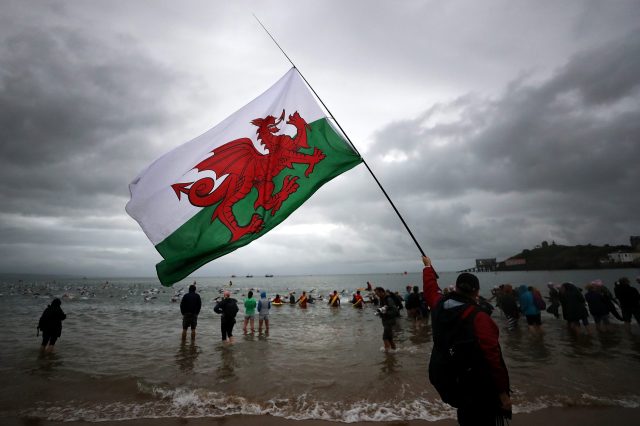
Would it serve Wales better to turn the spotlight on itself instead? (Bryn Lennon/Getty Images for IRONMAN)





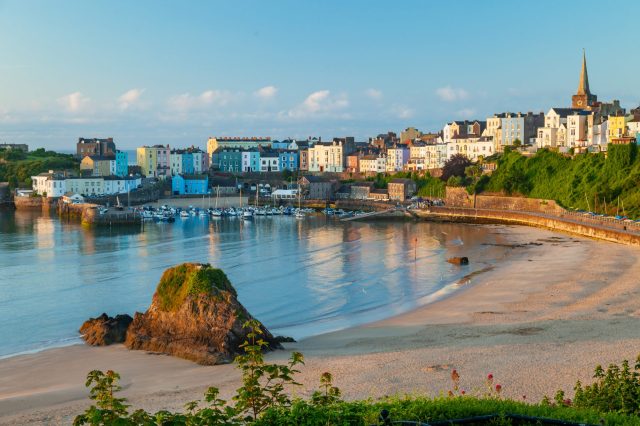
Like most seaside towns in the off-season, Saundersfoot has a touch of the melancholy about it. Gone is the phalanx of families and sunworshipers who overrun its long sandy beach each summer, replaced by a smattering of wrapped-up dog walkers and a lone metal detectorist. Even the seagulls seem subdued, circling forlornly above the tide.
This handsome village, nestled on the Pembrokeshire coast of West Wales, isn’t dead, exactly, more in a state of semi-hibernation. Nowhere is this more true than up a narrow hedgerow-lined road a short walk from the center. Here sit several stone cottages and bungalows, with names such as Sandalwood and Green Bank, their windows shut, their curtains drawn. Key safes, like limpet mines, cling to porch walls, while neatly assembled recycling bins stand undisturbed at the bottom of empty driveways.
All the telltale signs of holiday lets and second homes, before the summer surge. Some are for sale. Sure enough, it’ll be a different story come June, as Saundersfoot transforms into a bustling honeypot. Its shops, bars and restaurants will welcome these part-time residents with open arms, as a vital source of funds in a county short of cash. Yet even here in Pembrokeshire, long known as “Little England Beyond Wales”, these seasonal arrivals are resented too — their coming prompting fights over land and identity that could yet spark a political flashpoint.
All coasts and countryside, it’s easy to understand why anyone would want to own a home in Pembrokeshire. And, compared to British idylls such as Cornwall, it remains cheap. According to the latest data from the Office of National Statistics, the average price for a detached house here is £308,000; a similar-sized property in Falmouth or St Ives might set you back £100,000 more. No wonder Pembrokeshire has some 4,300 second homes. Only Gwynedd, home to Snowdonia, has more in Wales. In Saundersfoot and nearby Tenby, Pembrokeshire’s most popular tourist resort, one-in-four properties are reckoned to be second homes or holiday lets.
But investors in getaway properties here are starting to question whether they really are welcome. Using discretionary powers allocated by the Welsh Labour government, Pembrokeshire County Council slapped a 200% council tax premium on second homes in 2024, effectively tripling their rate. Though the charge was subsequently lowered to 150%, and is due to fall even further this year, it has spooked second homeowners, who are now looking to sell up. That’s shadowed by changes elsewhere in Wales. In Gwynedd, for instance, the council proposed legislation that would require homeowners to apply for planning permission to convert residential properties into second homes — though it was later forced to backtrack after residents and businesses complained.
To be fair, the idea of a second home tax — mandating that owners of non-primary residences must contribute to the local economy beyond visiting their local fish shop in the summer — doesn’t appear wholly unreasonable. For hard-up Pembrokeshire County Council, whose latest budget revealed a funding gap of £27 million, that extra money could go some way to tackling real problems of housing and local services. “This isn’t an abstract policy debate,” says Josh Phillips, a Labour candidate for the Ceredigion and Pembrokeshire constituency in the looming Senedd elections, and who himself grew up in Solva, a picturesque Pembrokeshire fishing village with a high concentration of second homes. “It’s about whether people’s children will be able to live anywhere near where they grew up.”
Phillips, a former publican, understands the economic value second-homers bring. Yet he’s nonetheless tired of seeing the “hollowing out” of villages where houses lie empty for months at a time. Herein lies a crucial distinction between empty second homes on the one hand — and those with visible signs of occupancy on the other. Speak to people in Pembrokeshire and, without exception, they have no time for totally vacant properties, blaming them for everything from falling property prices to vandalism to vermin infestations. In January, the Pembrokeshire Council backed a last-ditch proposal that would force the sale of properties left empty for over a year back to the community.
From afar, the debate around Pembrokeshire’s second homes can seem framed in anti-English terms, given how many second homeowners come from across the border. Though plenty hail from Cardiff too, it’s an easy assumption to make. I speak to one English former second-homer outside Tenby who tells me his family ended up selling a few years ago, after being made to feel unwelcome in the village. As he puts it: “I don’t think it helped that we were from Kensington.”
That’s arguably echoed by a rise in nationalist activism, with second homes a predictable focus. Cymdeithas yr Iaith, a campaign group, claims Welsh speakers have effectively been priced out, turning their villages into “holiday parks”. It brings to mind a recent story about the coastal hamlet of Cwm-yr-Eglwys, which, reportedly overrun with second homes, had just one remaining Welsh speaker.
The truth, though, is that the origins of that moniker “Little England Beyond Wales” extend far beyond the modern age of tourism. The phrase first featured in a 16th-century text by the topographer and historian William Camden, who discovered a distinctly English-speaking culture upon his arrival in the region.
Camden was specifically referring to southern Pembrokeshire, whose Anglicization began with the Norman Conquest of the area in the 11th century, followed by the later arrival of Flemish settlers. Indigenous Welsh speakers were forced to move to the hilly country in the north, then kept in check by a boundary of castles built by the Normans and Flemish, known as the Landsker Line (deriving from the Norse for “divide”). This is why most place names in the south of the county, such as Saundersfoot, Haverfordwest and Milford Haven, are English sounding, a vivid contrast with the Maenclochogs, Crymychs and Trefdraeths further up the coast.
Hints of this history remain. Compared with neighboring Ceredigion, and Gwynedd to the north, Pembrokeshire is not a traditional voter base for Plaid Cymru. Nor is it synonymous with Labour like the former industrial valleys of South Wales, where “The Internationale” once rang out from miners’ welfare halls. Instead, the county swung between Labour and the Conservatives for decades before increasingly turning blue. The Tories prevailed in the last Westminster and Senedd elections here, buoyed substantially by the rural vote. (The county council, for its part, is made up of a hodge-podge of independents).
Now, though, rising frustrations with the national Conservative and Labour parties — and Westminster politics in general — are likely to impact the looming Sennedd election: potentially changing policy around second homes. Reform, which is standing candidates in Pembrokeshire, has pledged to increase Wales’ housing supply to tackle the issue. A party spokesperson tells me that it also intends to “take a wrecking ball to a number of anti-tourism measures” implemented by its rivals. Such is the frustration that even Plaid is in with a shot. After winning a council by-election seat in February, the party now also hopes to snatch a Pembrokeshire Senedd seat or two, its manifesto promising to “work with local authorities” on second homes.
Yet look past the politics of holiday homes — or even just politics generally — people here clearly have more humdrum worries too. In a back room of Pembroke Rugby Football Club, signed Wales shirts pride of place in a glistening glass cabinet, club chair Richard Jelley says the county’s biggest problem is a lack of jobs for young people, which has contributed to a brain drain. While the tourism industry is all well and good as a provider of seasonal employment, he says, it’s not enough to keep working-age people around, with many leaving to seek opportunities elsewhere, often in Cardiff or Bristol.
Jelley points to the closure of the Murco oil refinery in Milford Haven in 2014 as an inflection point for the county’s fortunes. The refinery had supported thousands of local jobs, which effectively went overnight. “We used to have two thriving senior sides here, but now we just have one,” says Jelley, a compact 60-something with a shock of fair hair. “That’s because the kids get to a certain age, there’s no work, and they move away.”
This supports the argument that the proliferation of second homes and struggles of younger people might be more a case of correlation than causation. Wyn Harries, a school governor from Crymych, close to the Ceredigion border, makes a similar point, pinning the blame of depopulation of his rural part of the county firmly on “years of neglect” by a Welsh government stuck in the urban bubble of Cardiff Bay. “Their policy,” argues Harries, “is that people in the countryside shouldn’t be allowed to prosper,” adding that if there were decent rural jobs, the second-home issue would “resolve itself”.
In his 2019 book Wales: England’s Colony, the historian Martin Johnes argues that Wales’ identity has fundamentally been shaped by its relationship with its larger neighbor over the centuries, from its conquest in the 13th century by Edward I and subsequent annexation under Henry VIII, to parliamentary laws governing the use of the Welsh language in schools. This has led to a tendency, Johnes writes, to “blame England for everything that is wrong with Wales”.
Would it serve Wales better to turn the spotlight on itself instead? After all, devolution was meant to help the country steer its own path. Yet Cardiff Bay — or, more specifically, Welsh Labour, which has held a tight grip on the reins for the past 27 years — might well be accused of being as indifferent to the plight of the people in Pembrokeshire as their counterparts in London, contributing to the sense of alienation so clearly felt by locals. They’re frustrations sure to remain whoever triumphs in the Senedd next month, or whoever buys up the pretty cottage down the lane.