




(Chris Jackson/Getty Images)





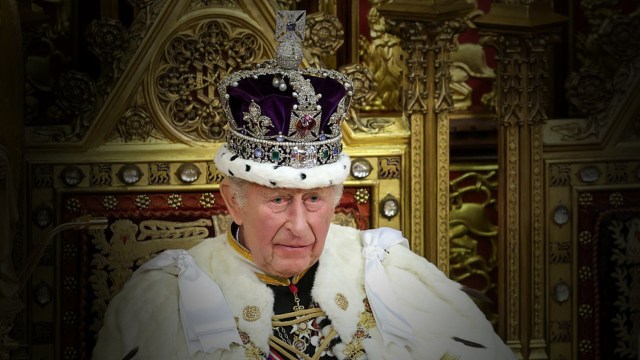
On Wednesday morning, Charles III knew he wasn’t the story. As he sat in the House of Lords, wearing the imperial crown and the robes of state, the monarch read out the Government’s legislative agenda to an audience whose minds were fixed solely on Labour regicide. He was lucky. On his way to the State Opening of Parliament that day, riding down Whitehall in a carriage and looking out at the crowds, the King might have glimpsed signs spelling out three words: Did you know?
What did Charles know? The protest was the work of Republic, a pressure group whose aim is the abolition of the British monarchy. In a statement issued later that day, the organization’s head, Graham Smith, said that “it’s inconceivable that Charles knew nothing about allegations against Andrew”. Though the King stripped his brother of various baubles last year, culminating in the loss of his prince title, a cloud of suspicion lingers; the Palace has had to deny that Charles personally contributed to the £12 million settlement paid to the late Virginia Giuffre, who alleged that Jeffrey Epstein trafficked her to the former Duke of York for sex.
The Andrew scandal has brought about the monarchy’s most exacting test since the death of Diana, but the Windsors’ future may not lie in their own hands. Instead, it depends on the whim of their subjects. After France got in early by lopping off the head of Louis Capet in 1793, a wave of European countries abolished their respective monarchies over the course of the 20th century. For Russia, it took a revolution; Italy and Greece settled for democratic votes on the matter. Republicanism has never been a sufficiently popular position in Britain for a referendum to seem imminent. Yet Britain may still join the ranks of republics, for public opinion is steadily turning on the Royals. Even worse for the Windsors, the trend shows signs of acceleration on both the Left and the Right.
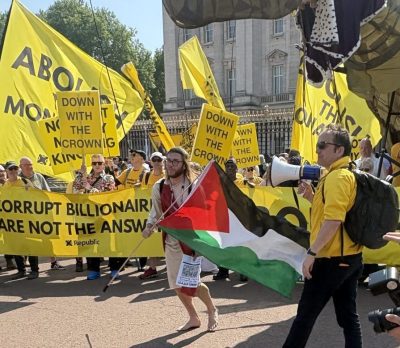
“Make some noise for the arrest of Prince Andrew!” Four days earlier, the new Roundheads were gathered in the shadow of Nelson’s Column to celebrate Republic Day 2026. Compère Eshaan Akbar was attempting to rally the hundred or so protesters, who, in response, offered half-hearted whoops, unsure whether to boo the disgraced duke or cheer his downfall. Among the ubiquitous yellow “Not my King” placards were tote bags declaring that “The only kings and queens we need are drag.” An elderly man held in one hand the Irish republican Starry Plough banner, in the other a sign blaming His Majesty for the 1972 Bloody Sunday massacre. One girl, no older than 11, wielded a placard reading: “Save foxes, hunt the King”. A young man dressed as Jesus, barefoot and wearing a realistic-looking crown of thorns, enthusiastically waved a Palestinian flag.
On the evidence of this rally, which was followed by a march on Buckingham Palace, the anti-royal movement had been subsumed into the “Omnicause”. Akbar introduced a musical interlude from Nasty Fishmonger, a four-piece band who play “fist-raising hardcore folk”. They had traveled, naturally, from Bristol. Towards the end of their set, their guitarist shouted: “Down with the Crown, free Palestine, free Iran, free Ukraine and free yourselves.” Robin Wells of Fossil Free London followed them on to stage, where she railed against the broader “polycrisis” of war, climate and the cost of living.
Linking Buckingham Palace to the atrocities taking place in Gaza might seem like a stretch, until one recognizes that the prevailing depiction of Charles on sections of the British Left is as an imperialist scion. “I don’t know if you know what the Royals did in South Asia,” Akbar said. “It wasn’t good.” He welcomed to the stage the breakfast-show commentator Narinder Kaur, who devoted much of her speech to the “theft” of the Koh-i-Noor diamond from a “10-year-old Sikh king”. She took a surprising jab at “Charles II” for paying off Epstein victims, a hitherto underacknowledged failing of the Merry Monarch.
Otto English went even further back in time to attack the institution. “Henry VIII was a mass murderer who killed two of his wives,” cried the author. “That gets brushed aside like it’s nothing.” Charles, by virtue of his royal office, has inherited these crimes. The Omnicause, on current form, is the future of activism, bringing together a string of social-justice issues which cohere into a simplified worldview. The monarchy’s ancient crimes, according to this view, map neatly onto present-day racism and wars of expansion, and maybe there’s even room for some protesting about fossil fuels there too.
In The Enchanted Glass, his 1988 study of the monarchy, the Scottish historian Tom Nairn observed that Britain’s “real distinction was to lose an empire without trauma”, suggesting that the eventual move towards a republic would play out similarly. Yet imperial trauma has become a greater threat to the monarchy in the generation since Nairn’s book was published. Caribbean governments have demanded reparations and apologies from the King for his ancestors’ role in the transatlantic slave trade, while support for the monarchy is considerably lower among ethnic-minority Britons than it is across the UK as a whole. At the Republic march, the Nigerian-born writer Kelechi Okafor took the stage to make accusations of imperial displacement: “Because Britain was there, I am here.”
Not even the King’s noted climate advocacy is a point in his favor for Republic and its supporters. “Charles is a hypocrite,” Graham Smith told me as we walked down the Mall later in the day. “He has one of the biggest carbon footprints in the country.” For others present, the monarch was interchangeable with the Right-wing populists in Parliament. “Especially with Reform winning all those seats,” Akbar said of the previous day’s local election results, “we need to challenge privilege.”
But are the populists of Reform loyal to Charles? At surface level, support for the monarchy remains high among Right-wingers. According to last year’s British Social Attitudes survey, 82% of Conservative voters and 77% of Reform UK supporters back the Firm. Reform’s “policy brain”, Danny Kruger, told an event last month that the monarchy, far from being mere “ceremonial flummery”, truly “matters to the common life of our country”. On St George’s Day this year, as part of a series of patriotic education initiatives, Reform pledged that, under a Nigel Farage government, every state-funded school in England will have a portrait of the King in “an official communal space”. Another Reform MP, the somewhat blunter Lee Anderson, has previously encouraged republican campaigners to “emigrate”.
Yet the conservative tradition of reverence for institutions is now in conflict with a new emotional current on the Right. A hybrid of progressivism and liberal proceduralism, many Right-wingers now believe, has taken over public bodies and cornerstones of British culture. The Civil Service, the National Trust, the museum sector: all victims, it would seem, of Lanyard Britain™. Charles’s critics on the Right argue that he has taken the Crown further into this “woke” territory.
According to this critique, the Crown’s stated political neutrality is a lie. Since ascending the throne, Charles has pushed for climate ententes with France, lobbied Nvidia’s Jensen Huang about AI regulation, and held meetings with European politicians against the backdrop of his widely reported discomfort with Brexit. The role permits the monarch, as Bagehot wrote, “the right to be consulted, the right to encourage, the right to warn”. Do the King’s actions fall within these bounds?
Such concerns predate the King’s reign. In the Eighties, the ex-minister Norman Tebbit sarcastically suggested that Charles’s sympathy for Britain’s unemployed might derive from his own job status, also warning the heir to the throne against proposing “socialist” solutions to urban problems. For many years, the late Queen’s eldest son characterized himself as a “dissident” working, by way of those notorious spidery memos, against the cynical machinations of Whitehall. A few months before his mother’s death, while the Tories were still in power, Charles called the mooted Rwanda scheme “appalling”. Farage, the man who may yet become Britain’s prime minister, has called Charles an “eco-loony” and labeled his views on climate change “stupid”.
Nevertheless, in the last decades of Elizabeth II’s reign, Right-wing arguments for British republicanism were rare. Only a few Conservative MPs — such as Ken Clarke, George Walden and Anthony Beaumont-Dark — were willing to criticize the Royal Family. Right-of-center newspapers, for all their lurid coverage of toe-sucking and tampon role-play and “Squidgy”, were not inclined to mount substantive challenges on the institution of monarchy. Even Rupert Murdoch, a lifelong Republican, largely played ball.
Now, however, there are more overt stirrings of dissent on the British Right. Rupert Lowe’s Restore Britain project has a distinctly Cromwellian bent, as evidenced by the name of the party’s exclusive members’ club and the leader’s much-mourned pet dog. Restore generates much of its policy from what has loosely been termed the online Right — by no means a unified bloc, but nonetheless an influence on national Right-wing thought. Mainstream conservative commentary often follows the lead of online-Right trends and coinages: neologisms such as “Yookay” and “Boriswave” have transitioned seamlessly, if at a delay of a few months, from X to the pages of the Telegraph. If we can assume that the bugbears of this subculture tend to make it eventually into the briefing notes of Nigel Farage and Kemi Badenoch, we should take heed of what the cohort is saying about the future of the monarchy.
In March, a pseudonymous contributor to an influential Substack, Pimlico Journal, made a case for Right-wing republicanism, accusing the King of “multicultural paternalism” and the explicit promotion of “diversity” in his speeches. Elizabeth II, meanwhile, “never saw it fit to comment on the systemic sexual abuse of white British girls by Pakistani rape gangs”. The piece stated that the monarchy was “not just indifferent to, but actively complicit in the obfuscation of crimes against our country and its people of the most serious nature”. Even if one overlooks the ideological biases of individual rulers, the author suggested, “to conflate dynastic patriotism with British nationhood is a grievous political mistake”.
For J’Accuse, another popular Substack on the Right, the Crown “has been explicitly part of the center-left establishment in Britain for decades”. This has become entrenched under “Woke King Chuck”, whose coronation was “an orgy of diversity and other woke crap”. Where Left-wing Republic campaigners consider the King an avatar of imperial plunder and oppression, the anti-monarchists of the online Right see him as a hapless facilitator of postcolonial surrender. A 2023 J’Accuse article posited that if he were to repatriate colonial-era objects from British collections, it would be an “egregious offense against the British people”. According to this line of thought, “the jewels of Empire are not Chuck’s to apologize for or give away”, as “they belong to the nation”.
Could a referendum on the monarchy take place during a future Reform or Conservative government? As we walked towards Admiralty Arch, a few steps ahead of a 15-foot papier-mâché dinosaur (Republic’s mascot, Chuck the Rex) and a few behind a man shouting into a megaphone that the Metropolitan Police is full of paedophiles, I put this to Graham Smith. “If the public feeling is there,” he answered, pointing to the 1999 Australian referendum on becoming a republic, which was introduced by John Howard’s Right-wing government. British republicanism doesn’t have to be a unified movement to succeed. For Smith, and for the other protesters on the march, the process towards abolition seemed inevitable.
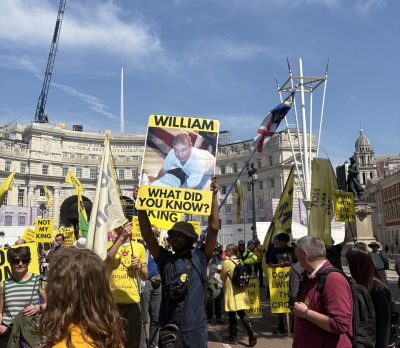
Since the King is 77 years old and has been treated for cancer, focus has turned, unsurprisingly, to the line of succession. Prince William consistently ranks among the most popular members of the Royal Family, and is held up by his defenders as a modernizing influence on the dusty Windsor set-up. Yet when Republic’s activists held up banners reading “What did you know?”, the implication was that the current Prince of Wales has also been guilty through his silence. William is far more political than criticisms of his lack of intellectual curiosity might indicate. In 2021, his allies briefed the press that he felt uncomfortable about the late Queen’s acquiescence to Boris Johnson’s 2019 request to prorogue Parliament. William, they insisted, would “robustly challenge” his prime ministers once he reached the throne. If so, trouble may loom.
But time is not on William’s side. According to polling from earlier this year, only 23% of Britons aged 18-24 support the monarchy. There is little sign that this cohort will become more reverent with age, as support for the Crown only rises to 28% for the 25-34 age group. If Charles’s liberal platitudes are off-putting for Right-wing voters, they equally count for nothing with young progressives who see only hypocrisy in his calls for a fairer world. Immigration-induced demographic changes are also creating a population with less keenly felt ties to the Royal Family. When pride in, or even knowledge of, a shared past is evaporating, what hope does the man on the postage stamps have?
Anti-Windsor feeling can build gradually, and then gradually some more, until, finally and almost noiselessly, the Royal Family ceases to serve as a national ossature. In 2021, Barbados cut ties with the British Crown. The then-Prince Charles, speaking at the ceremony as guest of honor, decried the “appalling atrocity of slavery” and told attendees: “I have heard your voice in the world grow louder.” Other voices will accumulate. Jamaica, independent since 1962, has taken steps since Charles’s accession to become a republic. The Prime Minister of the Bahamas has proposed a referendum on the monarchy. Belize has removed Elizabeth II’s face from its banknotes.
After the Caribbean nations, Australia may decide to hold another vote on its ties to the royals. In an age of Quebec nationalism and resistance to foreign powers, Canada could follow. The Windsors’ kingdom will shrink, leaving Britain as the last major redoubt.
When the real world threatens to close in, the royals retreat into ceremony. On Wednesday morning, as the royal carriage trundled down the Mall, through the hail, a crowd of tourists looked on. They didn’t cheer the monarch, only exchanging murmurs of curiosity. Which one of the figures through the rain-flecked window was Charles? Did he wave? But, before they could answer, the procession had moved on. All that remained was what the royal horses had left behind. The show over, the visitors walked away from Buckingham Palace and towards the next museum on their list.
