




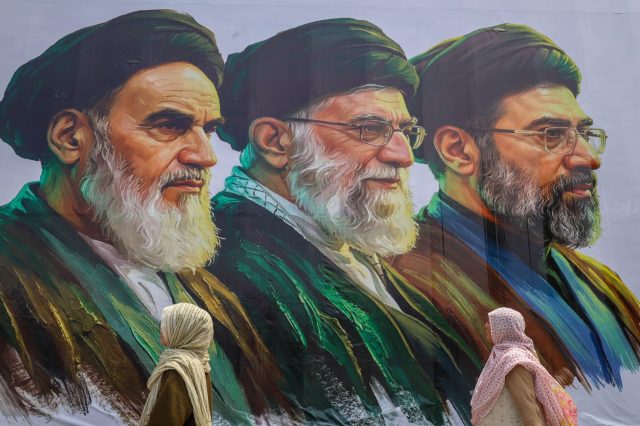
(Firdous Nazir/NurPhoto/Getty)





For the spiritual head of a militant theocracy, Ali Khamenei was a remarkably prolific poster on social media. At the start of February, as pressure from Washington started to build, he — or anyway a lackey — began issuing a flurry of stark political statements on X. “What is the issue between the United States and Iran?” Khamenei asked his followers. “The issue can be summed up in two words: The United States wants to devour Iran; the Iranian nation and the Islamic Republic [sic] prevent this.”
15 minutes later, he posted again. It was obvious, the Ayatollah claimed, what President Trump was really after: “Iran possesses numerous attractions: Its oil, gas, rich minerals, and geographic location are attractive. The US wants to seize control of this country just as they controlled it before.” Soon after, he was back online once more. “Iran stands firm and will continue to stand firm, and — God willing — will put an end to the United States’ mischief and harassment.”
As it turned out, Khamenei himself would not stand firm, dying weeks later in a devastating US-Israeli airstrike. Yet those frantic February posts remain much more than a strange internet footnote. For in his talk of mischief and control, the former Ayatollah hit upon the great fear of Iran stretching back not decades but centuries — that the country has been manipulated, exploited and undermined by outside forces, especially the West.
Of course, fingering external enemies as evil is one of the oldest tricks in the political playbook. In autocratic systems, though, the value is exponential. Anyone, anything, any time can be declared to be a threat to the stability and even viability of the regime. As such, the ends always justify the means. Hence the attacks on protesters across Iran at the start of the year — assailing them as Zionist agents — and hence the bloodbath that followed.
Amid the usual despotic cynicism, though, it’s also true that Iranian fears have often proved justified. In the most immediate sense, after all, President Trump has fulfilled many of the warnings that the late Ayatollah articulated. Less than a week before the US and Israel began their attacks, Steve Witkoff, the President’s favorite negotiator, wondered why Tehran hadn’t “capitulated”. There’s plenty more where that came from. A month into the conflict, Trump told the Financial Times he would have taken Iran’s oil but for “some stupid people” back in America, while the recent seizure of an oil tanker in the Gulf led the President to positively gloat. “It’s a very profitable business,” he said. “We’re like pirates.”
Even if only semi-serious, such threats chime with how Iran has viewed outsiders for many hundreds of years. If the US, and Israel today face special ire — there’s a reason they’re respectively known as the “Great Satan” and “Little Satan” — Britain, France, Russia have all been feared too. And, again, there have historically been good reasons for this disdain.
From the early-19th century onwards, Persia (which was renamed Iran in the Thirties) found itself repeatedly caught between stronger imperial powers seeking political influence and commercial advantage. Its relations with Russia were particularly thorny. Defeats in the Russo-Persian Wars of 1804-13 and 1826-28 led to the humiliating Treaties of Gulistan and Turkmenchay, by which Persia lost vast territories in the Caucasus, including what is now Georgia, Armenia and Azerbaijan. The memory of these defeats cut deeply, not least because they exposed how militarily and financially weak Persia had become.
It did not help that the ambitions of others were growing too. For London, Persia mattered above all because its location on the approaches to India, the jewel of the British Empire. Anxieties in Britain rose as Russia advanced south through Central Asia, triggering constant fears that India itself might one day be threatened. Persia was a key location in what became known later as “the Great Game”, as British and Russian agents, bankers and diplomats became fixtures in Tehran — offering loans and gaining influence that might one day prove vital if arms ever had to be twisted.
Ironically, though, these varied foreign incursions can partly be understood by Iran’s domestic failures, with its leaders consistently reluctant to create an economic model that was both sustainable and fair. Instead, power and wealth have been concentrated in the hands of the few — a characteristic shared by the old Qajar dynasty, the Pahlavis who supplanted them in 1925, and indeed by the Islamic revolutionaries who took power in 1979. This, in turn, has encouraged rulers to take the easy way out: relying on short-term foreign assistance, with all the opportunities for meddling that implies.
In the late 19th century, for example, Persia’s rulers repeatedly borrowed heavily from French or British banks, or else sold concessions that provided short-term financial relief at the expense of long-term sovereignty. One classic example was the grant of a monopoly over the production, sale and export of tobacco to a British army officer, in return for a fixed annual fee and a share of profits. Signed in 1890, this wasn’t just a bad deal on its own terms, but also led to riots and eventually to a massive compensation fee paid in return for canceling the concession.
Or else there were the rights signed away in 1872 to Paul Julius de Reuter, an Anglo-German entrepreneur, encompassing not only the “the mines of coal, iron, copper, lead and petroleum” across the whole of the Persia, but also options to build roads, public works and other infrastructure projects. As an incredulous Lord Curzon put it, this represented “the most complete and extraordinary surrender of the entire industrial resources of a kingdom into foreign hands that has probably ever been dreamed of, much less accomplished, in history.”
For British officials like Curzon, Persia was an important piece on a foreign policy chessboard — one becoming more complicated still at the start of the 20th century. Russia’s intentions remained a concern, even as a newly unified Germany began circling too. Little wonder Britain did its best to keep Persian leaders happy, in 1902 even investing Shah Moẓaffar od-Dīn with the Order of the Garter.
Soon enough, this symbiotic relationship between Iran, its resources and the wider world would take on even greater significance — with the discovery of oil in 1908. First struck by William Knox d’Arcy, in yet another foreign concession, it quickly became clear that the mineral wealth that lay under Persian soil was the greatest prize of all. Certainly, efforts to access and control Iran’s oil not only helps explain the history of the Middle East, but also both world wars. In 1914, for instance, the Royal Navy was able to set to sea safe in the knowledge that the British government had bought a (secret) controlling share in Anglo-Persian, the holder of the oil concession in Iran. And if Anglo-Persian was crucial in the Royal Navy’s operations against the German Imperial Navy, it remained so 30 years later against Nazi Germany, where Hitler’s lack of gasoline ultimately stopped him launching offensive operations.
As Iranian petroleum came to dominate world affairs, meanwhile, efforts to influence, manipulate or otherwise control the country became ever-more brazen. At the end of 1915, the British representative in Tehran made clear that London had a particular candidate in mind to become prime minister — with the chosen princeling duly appointed a few days later. After the Great War finally ended, Britain tried to install “advisers” to run both the military and the treasury, prompting outrage not only in Persia but elsewhere too, where Shah Ahmad Shah Qajar was denounced in furious terms. He was a half-centimeter-tall midget, said Le Figaro in a piece that widely circulated in Tehran, a man “had sold his country for one centime”.
By 1925, even the British had given up on Ahmad Shah, installing a cavalry officer named Reza Khan in his place. The founder of the Pahlavi dynasty was the right man at the right time, according to a report sent back to London from Tehran by Foreign Office officials. He was a “powerfully built, well set up, big boned man, well above average height”; best of all, though, he “does not waste time in exchanging the delicately phrased but perfectly futile compliments so dear to the Persian heart”.
Such shenanigans would only become more intense. In 1941, concerned at the pro-Nazi sympathies of Reza Khan — who purportedly oversaw the renaming of Persia to Iran as a nod to the “Aryan” principles expounded so loudly by Hitler — the British forced him to stand down in favor of his son Mohammed Reza: an immaculately turned-out playboy with a love for French crime novels and fast cars.
Not, of course, that Iranian leaders always accepted pressure or interference from outside. Even before Mohammad Mosaddegh nationalized his country’s oil supply in 1951, there had been repeated attempts by Iranian reformers to push back against foreign domination. For instance, outrage at corruption, foreign concessions and economic weakness had forced the Qajar monarchy to accept a constitution in 1906, one that established an elected parliament and attempted to remove the state finances from the Shah’s whims.
Such efforts though proved illusory. As the case of Mossadegh showed, outside powers were always able to muscle in on Iran’s affairs. Though chaotic to the point of ineptness, a CIA-backed coup nonetheless deposed Mossadegh in 1953, condemning the former prime minister to prison and house arrest until his death in 1967. This episode became key for later generations of Iranian radicals, who saw his fate as emblematic of the ill-designs of outsiders, as well as the complicity of Shah Reza Pahlavi. The latter had initially fled to Rome in terror, before returning home after Mossadegh’s fall, as tone deaf as ever about his reputation in Iran.
Rather than finally reforming his country, indeed, the Shah kept up the old tradition of kowtowing to foreigners while wallowing in domestic authoritarianism — creating opportunities that Ruhollah Khomeini understood perfectly. A highly effective speaker, the cleric began making firebrand speeches condemning the poverty of regular Iranians, even as the Shah and his friends prospered. As far back as 1964, Khomeini announced that US President Lyndon Johnson should know “that in the eyes of the Iranian people [the Shah] is the most repellent member of the human race” — a harbinger of the kind of comments that became commonplace in revolutionary parlance over the decades to come.
After Khomeini took power as Iran’s Supreme Leader 1979, he continued the same theme. “All our problems come from America,” he said. When threatened with sanctions by the Carter administration, meanwhile, he dismissed them as pointless, ironically twisting his country’s economic primacy back on its exploiters. “The world needs oil,” Khomeini proclaimed. “The world does not need America. Other countries will turn to those of us who have oil, and not to you.”
This history — this complex dance between Iran’s leaders, their domestic enemies, and foreign interlopers — helps explain the Islamic Republic’s positioning down to today. Khamenei may now be dead, but the Islamic Republic continues to see shadows of malign intent everywhere. As such, the regime’s insistence on strict discipline, on unflinching loyalty, and on a constant search for traitors, became a hallmark of a system that believes — rightly or wrongly — that it’s being undermined by the grand strategies of pernicious outsiders.
As is so often the case in revolutionary systems, that has helped drive the centralization of decision-making, but also power the Islamic Revolutionary Guard Corps (IRGC): whose specific aim has always been to protect the revolution and its principles. At the same time, this long legacy tells us why Tehran has dedicated so much time, money and effort to build up proxy networks across the Middle East. Dismantling Hamas, Hezbollah and other militant groups has, of course, been a decades-long strategic priority for Israel and the US — even before the October 7 attacks. Again, though, from Tehran’s perspective, developments like the IDF’s brutal campaign in Gaza aren’t just moral outrages: they’re attempts to cripple Iran and compromise its sovereignty.
These attitudes also explain one of the reasons why Iran has put so much effort into having a nuclear-enrichment program. While analysts disagree on the ultimate willingness of the Islamic Republic to actually secure weapons-grade capabilities, no one doubts that being able to do so — and quickly — represents a threat in itself. That, of course, is precisely why Tehran has been reluctant to surrender what it considers as a key card in maintaining its independence.
And so we have a classic standoff: not only in Hormuz, but also over enrichment and indeed the very fundamentals of Iranian sovereignty. Like all countries, Iran needs the ability to defend itself. Here in Europe, it is hard to find voices claiming that defense spending should go down; most accept that in a fragmenting and increasingly competitive world, resilience comes at a price. In Britain, the debate centers on how much to spend and on what. Iran’s calculation is more acute when the United States, Israel and several Gulf states openly favor reducing its military capabilities to near-zero. In that context, the line between security and vulnerability becomes a thin one where the measures Iran sees as necessary for survival are precisely those that others regard unacceptable.
The regime in Tehran has clearly understood this better than the US. As a colleague put it recently, the US has been fighting wars of choice for the last half century. For Iran, though, this latest challenge from Washington’s war machine is existential, fitting into the familiar pattern of confrontation.
What, then, comes next? Well, because the Islamic Republic views pressure through this long historical lens, it is unlikely to respond to confrontation by becoming more conciliatory. On the contrary, Tehran will probably double down on the very tools it believes have preserved Iranian sovereignty for decades: asymmetric warfare; rebuilding proxy networks; boosting missile programs; investing in cyber operation; maintaining the strategic ambiguity surrounding nuclear enrichment, even if it accepts a time limitation in the short term.
Economically, too, Iran is likely to deepen efforts to build sanction-resistant trading systems with China, Russia and others, rather than reintegrating into a Western-led order it fundamentally distrusts. And, of course, the Strait of Hormuz itself has become a cipher for Iranian leverage. Of course, Iran’s leaders know perfectly well that there is no chance of defeating the United States in a straight military fight. But they also know that disrupting shipping, suffocating flows of oil, urea and helium gives Tehran a seat at the table where it can negotiate, if not from a position of strength then at least one where it has real skin in the game. The future posture of the Islamic Republic is therefore unlikely to rest on trust or compromise, but on deterrence, disruption and the conviction — shaped by two centuries of intervention and humiliation — that vulnerability invites exploitation.
That still leaves one more irony. For all the Islamic Republic’s rhetoric about resisting outsiders determined to plunder Iran’s wealth, many ordinary Iranians today see the country’s resources being monopolized by domestic elites instead. In one sense, the current regime resembles the compromised governments of the past — ones unwilling to introduce social or economic reforms, and which centralized power and wealth in the hands of a minority. Estimates vary, but analysts often suggest that entities associated with the Revolutionary Guards control anywhere between a fifth and a third of the Iranian economy, their interests spanning construction, energy, telecoms, ports and banking, not to mention smuggling networks and illicit sanctions-busting trading.
Perhaps that is the central tragedy of Iran’s modern history: that a country with such deep traditions, and such a proud view of its past, has spent so much of the last 200 years trapped between pressure from without and failure from within. Foreign powers have repeatedly sought influence, leverage, access and control; Iranian rulers, whether kings or revolutionaries, have responded by tightening authority, concentrating wealth and invoking the language of national survival. All the while, resistance to foreigners always leads back to the same place: a corrupt establishment where loyalty is key.
The result has been a cycle of suspicion and coercion that has proved extraordinarily difficult to break. Seen in that light, the present confrontation is not simply about enrichment, ballistic missiles or even the clerical regime itself. It is about memory, sovereignty and the accumulated weight of history. That does not make Tehran’s actions virtuous, nor Washington’s fears illegitimate. But it does help explain why threats, sanctions and overwhelming force have failed to break the Islamic Republic’s resolve. For many in Iran, the issue has long ceased to be about this or that government; it is about whether the country can determine its own future without capitulation to the demands of others.