




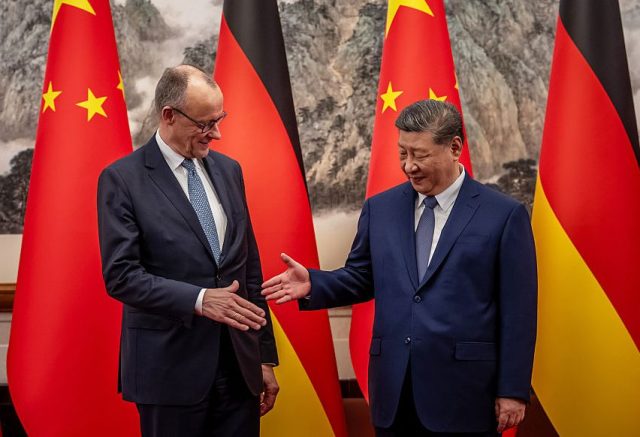
Does Europe have too many players on the field? (Michael Kappeler/Pool/Getty)





I often think about the EU as a confused football team. There are too many players on the field. Some of the players do not know which team they are playing for. They are cheered on by fans from the stands — many from the UK, who would love to be on the pitch themselves.
Some of these spectators give the players and their team manager some really bad advice. They cheered Team EU when they were battling Donald Trump over his trade tariffs. I will never forget the headline in The Economist the week after Trump imposed his tariffs in April last year. Under the tag “Trade Fight Club”, the headline read: “The EU’s response to Donald Trump’s tariffs seems to work.”
What actually happened is that the EU, wisely, chose not to fight. Ursula von der Leyen famously caved in when she signed a humiliating trade deal after making a pilgrimage to the Trump Turnberry resort in Scotland three months later. The occasion was cringeworthy from start to end, including the obligatory thumbs-up group photo with Trump. But the EU delegation had no choice.
Six months later, the European Parliament briefly contemplated an insurrection, but stopped when it peeked over the cliff. In January, after Trump threatened to invade Greenland, and when the US Supreme Court declared Trump’s tariffs to be illegal, Brussels suspended the ratification of the EU-US trade deal. But after Trump threatened the German car industry with even higher tariffs, the MEPs, too, caved. Last week, they voted it through.
Right now, the EU trying to play a similar game with China, and is getting similarly bad advice.
The Europeans are angry about how China plays. Sabine Weyand, the EU’s outgoing director general for trade, compared the Chinese strategy to putting a stinking fish on the negotiating table. She was referring to new Chinese threats, like export controls on rare earths, or a ban of the sale of semiconductors to the EU. The EU is dependent on both. Whenever the EU tries to impose some retaliatory tariffs on China, that stinking fish returns to the table.
The EU has a point here. China’s economic policies are the biggest source of global economic imbalance right now. China’s exports are booming, but China represses domestic consumption. You can see this in EU-China trade data over recent years. Chinese exports to the EU have been going up, and Chinese imports from the EU are actually falling. And this year, it has all got dramatically worse. From January to April, China’s trade surplus with the EU went up by 26% compared to the same period in 2025. What happened is that US tariffs led China to divert some of its exports from the US to Europe.
China’s currency, the yuan, does not float freely like the dollar, the euro or the pound. China keeps it steady against the dollar. When the dollar weakened against the euro after Trump came to office, so did the yuan. That means Chinese products are even cheaper than they were before. And European goods are even more expensive.
Kaja Kallas, the EU’s often-undiplomatic chief diplomat, likened Europe’s situation with China to that of a patient battling cancer. “If you have a very difficult disease, if you have a cancer, you have two choices. Either increase the morphine or you start chemotherapy.”
Europeans should be careful not to be too sanctimonious. This is essentially a barfight between two mercantilists. The EU has been playing the same game. During the euro crises of the last decade, the EU, too, devalued its currency and started to run large trade surpluses against the rest of the world. The EU’s lament has a certain “I stole it first” quality.
Right now, China is winning this trade war, just as Trump won his own trade war against the EU. The reason is the same in both cases. The EU is too dependent on both of them — on the US for defense, and on China for critical imports. The EU is not in a position to retaliate. This is not due to a lack of policy instruments. Some have never been used, like the “Anti-Coercion Instrument”, which would give the EU discretionary powers to retaliate against China without bureaucratic obstacles.
The reason the EU cannot do this is not just a matter of political division, or weakness, but because of economic dependencies. We caught a glimpse last week, when the EU did the very opposite of what its cheerleaders demanded. Rather than imposing new tariffs on China, it lifted them. As Bloomberg reported, the EU had previously imposed sanctions against Yangzhou Yangjie Electronic Technology, a semiconductor company, but decided to lift them after German car makers warned about supply chain chaos.
This pattern keeps repeating itself. The Europeans really wanted to stick it to Trump. And to the Chinese too. But they could not do it, because the European car industry employs a reported 13.2 million people in the EU, according to data collected in 2022.
The seeds of this dependence were sown in the 2000s and 2010s. The European car industry, aiming to optimize its supply chains, committed the critical error of making itself reliant on China. As so often, Europe chose short-term gain over long-term resilience.
The first signs of stress became apparent during the pandemic, when the German car industry suffered an acute shortage of semiconductors from China. At the time, everybody was talking about supply chain diversification, but nothing much has happened. After the pandemic, industry returned to business as usual.
China has several other strangleholds in this sector. Car batteries are one example. This is a technology in which China is years ahead of the Europeans. China has an almost total monopoly for rare earth magnets, which are critical ingredients for all electric engines. Your windshield wipers would not work without them, nor would your F-35 fighter plane. Solar panels are another market that China has cornered.
The way many people think about globalization is antiquated. We no longer live in a world of factories that build goods from scratch, and from local products. Rather, modern trading relationships are a complex network. European-made cars are full of Chinese components. The bilateral trade balance that everybody gets so upset about does not tell you what you need to know. They do not capture these network effects and all their inter-dependencies. The important question is not how much China sells us, but how many Chinese imports are used in our exports to the rest of the world, and whether we have alternative suppliers. Measuring network effects is a technically complex task, as electrical engineers know only too well. The global economy is no less complicated than an electric network, and yet we are measuring it with the equivalent of an abacus.
Even Trump had to compromise over his tariffs against China, for the US was dependent on China for rare earths. Thanks to outsourcing, the US has a much smaller share of industry in its the economy than the EU does. Its industry is also less dependent on China for inputs, but its defense industries need rare earth products from the People’s Republic. The dependency goes both ways. China, too, is dependent on Western markets, of which the US and the EU are the largest.
The EU differs from the US only in that its inter-connection with other economies is stronger, and the cohesiveness among EU countries is weaker. You can have as many international trade economists, think-tankers, and journalists supporting Team EU as you wish. If Friedrich Merz and Giorgia Meloni turn up to a key summit and say no to tariffs, the game is over before it even started. This is not a matter of political will, but one of economic reality; Merz or Meloni have no other choice.
Instead of hyperventilating about China or Trump, then, the EU would be better off solving its underlying problems of supply-chain dependence. Japan managed to reduce its dependence on China for rare earth, after Beijing imposed an export ban following a 2010 dispute over islands in the East China Sea. Instead of pondering yet another discriminatory trade instrument the EU will never use, why not chart out a binding 10-year plan to reduce supply dependencies?
The EU thought about this too, and came up with the Critical Raw Materials Act in 2024. In a report published last month, the European Court of Auditors said the regulation is well intended, but the implementation is lacking. Its devastating verdict was: “The targets established in the Act set the course for member states and for industry, but are non-binding, only cover strategic raw materials and lack justification.”
My advice would be to solve the problem, adopt strategic patience and ignore the hyperventilating fans. The football equivalent of a trade war for which you haven’t prepared is an offside trap gone wrong: all the players push forward, except for one who has second thoughts and suddenly stops.
Some people like to think that in football, the best team wins. We all know this not to be true. The winning team, rather, is the one that keeps their nerve under pressure.
