




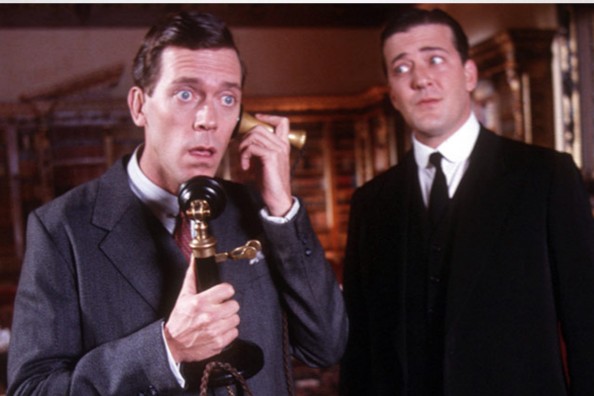
Hugh Laurie and Stephen Fry in Jeeves and Wooster, 1990. (Getty)





A recent scientific study of professional speakers finds that two fifths of them told no jokes, and of the jokes they attempted two thirds fell flat. In an insight of Einsteinian profundity, the researchers also discovered that audiences laugh less when they think they’re not expected to. Men are more likely to use humor than women, telling about a third more jokes than they do, and men also have a 10% higher possibility of provoking laughter. One wonders why these studies call themselves scientific, given that on a good day even Mr Mountbatten Windsor could carry them out. You just have to count the jokes and do some simple arithmetic. It’s a lot tougher for the physicists who have just discovered a new proton which exists for only one millionth of one millionth of a second. One blink and you’ve blown the whole experiment.
For a joke to fall flat may be a calamity, as in the old Bob Monkhouse quip: “They laughed when I said I wanted to be a comedian. Well they’re not laughing now.” People and things falling flat, however, can be a source of high comedy. A good deal of humor is based on deflation and debunkery. A cohort of legendary British comedians (Tony Hancock, Frankie Howerd, Kenneth Williams) trade on sudden swoops from the sublime to the mundane — from the civilized tones of the cultivated middle classes to the blunter idiom of the populace. With their bathetic descent from posh to profane, these performers are a kind of class conflict in their own person. One thinks also of Monty Python’s “Summarise Proust” contest, a television game in which competitors were given two minutes to summarize Proust’s 3,000-odd page novel, first in evening dress and then in a bathing costume.
There’s a rich English tradition of savage debunkery, from Alexander Pope and Jonathan Swift to Evelyn Waugh and Martin Amis. The sudden puncturing of grandiose rhetoric, the urge to demolish and disfigure, are familiar features of English writing, as they are in the literary culture of Ireland. Flann O’Brien’s superb fiction plays off abstruse metaphysical speculation against the threadbare platitudes of pub talk, while James Joyce’s prosaic Leopold Bloom is a counterweight to his philosophically-minded Stephen Dedalus. The United States, a nation which likes to affirm and is nervous of negativity, has a less impressive history of satire.
Speaking of Irish writers may remind us of just how little English stage comedy there would be without Irish émigrés. From Congreve, Steele, Macklin and Goldsmith to Sheridan, Shaw, Wilde and Brendan Behan, the London theatre has been dominated by Irishmen who washed up in the metropolis with little but their wits to hawk. Treading a thin line between insiders and outsiders, they could turn this hybrid status to fruitful comic use. They were insiders enough to grasp the manners and conventions of English society, yet distanced enough to have a quick eye for their absurdities. Wilde was an Irish Republican but also a parody of the English gentleman, while Richard Sheridan was a Whig Member of Parliament who secretly fellow-travelled with the revolutionary United Irishmen. Brendan Behan, who once remarked that he was a drinker with a writing problem, used to be hauled on to BBC television after the pubs had closed in order to demonstrate what lovable drunks the Paddies were. Shaw, a less inebriated exile, warned his fellow Irish writers against becoming court jesters to the British. It was, in fact, far too late: the Anglo-Irish Oliver Goldsmith performed precisely this role in 18th-century London literary circles.
Why does swooping from the sublime to the ridiculous make us laugh? The answer for Sigmund Freud in his deeply unfunny study of jokes is that we invest a high amount of unconscious energy in sustaining our noble ideals or social inhibitions. When these are suddenly deflated, we economize on that energy and release it in the form of laughter. Jokes liberate us momentarily from the reality principle, allowing us to indulge the pleasure principle instead. This is one reason why sexuality is a fertile source of humor, involving as it does both high romantic feeling and the lowly genitals. Few human activities are at once so exotic and so banal. How can the question of who copulates with whom lead to such murder and mayhem? Human beings are pitched between flesh and spirit, and humor reminds us of the double act that we are.
Most humor involves some sort of incongruity. We laugh when something seems out of place, when things go off the rails or are thrown out of kilter. Which is to say that a lot of humor springs from the baffling of expectations. Humor returns the kind of response we don’t anticipate, as with: “What do you call the useless bit at the end of the penis? The man.” We invest psychical energy in keeping the world orderly and predictable, and any sudden dissonance allows us to relax the unconscious strain which this involves. Even Charles Darwin, not a man given to giggling, thought that laughter was caused by the incongruous or unaccountable. “You’ve got to stop masturbating,” a doctor tells a patient. “Why?” asks the patient. “Because I’m trying to conduct a medical examination,” replies the doctor testily. This involves slipping from one frame of reference (masturbation in general) to another (masturbation here and now), which is a form of incongruity.
A quick slide of meaning or shift of perspective may be enough to be comic, as with Oscar Wilde’s “I live in constant fear of not being misunderstood”, or Dorothy Parker’s response to being told that people at Halloween duck for apples: “There, but for a single consonant, is the story of my life.” She also remarked that “the transatlantic crossing was so rough that the only thing I could keep on my stomach was the First Mate.” The decadent fin-de-siècle poet Ernest Dowson once declared that “absinthe makes the tart grow fonder”. With such deft changes of single words we are in the realm of wit, as with Wilde’s “The young people of today have no respect for dyed hair”. Even punctuation can make a difference. “The batsman’s Holding, the bowler’s Willey,” announced a cricket commentator, a phrase in which everything turns on a comma. Sexual jokes are funny because they allow us for a moment to lift our repressions and indulge in the unspeakable, while knowing that no real harm is likely to result from this.
“I’ve got them down to ten,” bawls Moses to his people as he descends Mount Sinai with the Ten Commandments, “but adultery’s still in.” A lot of humor depends on laws and prohibitions, since without them we would have nothing to transgress, and transgression is usually pleasurable. Deviating from a norm can take the form of eccentricity, especially in England. The English love what they call “a character”, like the Oxford don I once knew who used to stand in a pub with a cavalier air and a parrot on his shoulder. (His cavalier air was shaken only by his obvious fear that the bird might crap on his shoulder.) People who stick ferrets down their trousers or ride to work on a baby rhino are likely to be honored by Buckingham Palace. The upper class in particular are transgressive, since they regard themselves as superior to codes and conventions, even though they often set them themselves. Brian Howard, one of the louche Evelyn Waugh set, was once arrested by the police in an illicit drinking den in Soho. When asked for his name and address, he replied: “My name is Brian Howard, I live in Berkeley Square, and you, Inspector, I suppose, come from some dreary little suburb.”
While the middle classes cling timorously to the rules, the upper classes proclaim their privilege by kicking over the traces, combining the glamour of rank with the effrontery of not giving a damn. In this sense they have something in common with the criminal, as we have recently witnessed. The British admire devil-may-care aristocrats, which is why they’re so fond of the second-rate poet Lord Byron; but they also champion those curmudgeonly types who thwart the government’s plans for a new airport by clinging stubbornly to their two acres of land. Individualism in the United States means the boldly enterprising spirit; in Britain it’s more a matter of idiosyncrasy.
It’s surprising that politicians don’t use humor more often, given that it’s one of the most superbly effective means of communication. Not many comedians are politicians, though Eddie Izzard has revealed ambitions in that respect. Some politicians are comedians, however — not in the sense of inspiring laughter but in being the object of it. Keir Starmer wouldn’t even make a decent straight man, let alone a comic. Harold Macmillan could throw off the odd witticism, as when he remarked that every man should go to bed with a Trollope. Those of us who remember the Labour MP Denis Healey know that he was good for a knees-up. Boris Johnson, by contrast, is that rare member of the human species, a man who is fundamentally frivolous. Most frivolity is skin-deep, but Johnson’s is a massively serious affair which goes all the way down. There’s nothing more profound about him than his superficiality.
Jokes are political in the sense that they prefigure an alternative form of life. Like art but unlike capitalism, they aren’t primarily concerned with profit and power. Instead, they represent a sharing of life purely for its own sake. It’s true that some of them can be more functional — breaking the ice, mocking an adversary, abusing an immigrant, showing what a clever guy you are — but the finest jokes have no more point than a kiss or a wave. They represent a small piece of utopia in a darkening world.