









It’s the end of an era in Texas. Tuesday’s Republican Senate primary saw the truculent Attorney General Ken Paxton triumph over establishment stalwart John Cornyn. The Trump-loyal GOP base chose Paxton, notwithstanding his earlier indictment for fraud and his wife’s accusations of adultery. In doing so, voters bucked the likes of Rick Perry, George W. Bush, Phil Gramm, and Karl Rove — the genteel architects of the state’s Republican takeover 30 years ago. That old order has been fully cast aside, and the Texas GOP is a different party today: gruff, angry, pseudo-populist.
Given this seismic shakeup, and Paxton’s polarizing past and personality, many are wondering if Texas — Texas! — can go blue. The answer is yes, but only if Paxton’s opponent, Democrat James Talarico, rejects the failed ideas that led to the Democratic Party’s decline in the state — and instead embraces Texas populism and the state’s surprisingly radical history.
Talarico himself is a different kind of Democrat. A young state representative and seminary student, he has garnered attention for his progressive brand of Christianity, which blends spiritual uplift with fulminations against the billionaire class. He has also raised boatloads of money and is surprisingly nimble with media, both traditional and digital.
But money and media savvy aren’t enough. Since Democrats lost control of Texas some three decades ago, a string of theories has tried, and failed, to envision a comeback. The latest one was “demographics as destiny”: the race-essentialist idea that as Anglos ceased to make up the majority of the population, the state would automatically become Democratic. Trump dashed those hopes, sweeping the state in part by winning over working-class Hispanics and African-Americans.
If Talarico has any shot at winning Texas, he will need to reverse this trend. He has some great examples to learn from. In Tarrant County, union leader Taylor Rehmet flipped a seat in the state legislature in an area that Trump won by 17 points. Rehmet’s secret? He ran a class-focused campaign, eschewing the culture war entirely in favor of speaking to the needs of Texas workers.
But there is an even deeper tradition of working-class politics in Texas, going back to the mid-19th century.
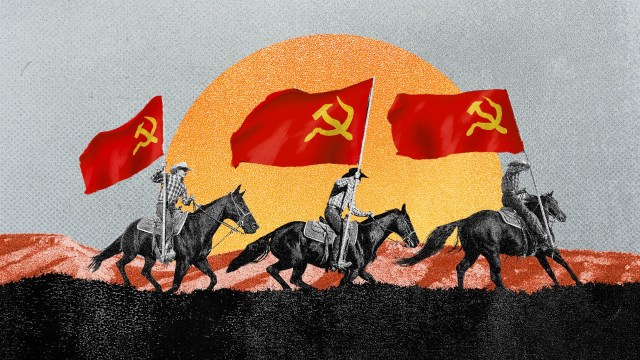
When people think of politics in Texas, they assume “rock-ribbed” conservatism by default. But this is the result of a years-long political project to recast the history of the Lone Star State in the Right’s image. The reality is much more interesting. This is a state where cowboys mounted collective action to fight the privatization of the open range; that was once home to one of the largest socialist parties in the nation; and where a farmer-labor alliance almost toppled the capitalist elite. Texas is red, yes, but the color means more than one thing.
Following the Civil War, Texas was economically decimated. The state government sought to attract business and finance to Texas with friendly policies, cheap land, and sweetheart deals. Major interests like the railroads took advantage, jacking up freight costs and cracking down on organized labor. A new set of Northern and European landowners entered the scene, like the Capitol Syndicate, a coalition of Northern businessmen and foreign capital, including the Earl of Aberdeen, who financed the Texas Capitol in exchange for 3 million acres of prime real estate in cattle country.
Barbed wire, then a new invention, was used by a rising class of large landowners to choke off the “open range.” In alliance with the ruling political class in Austin, the new barons banished many Texas “nesters” off their lands. While corporate power swallowed land in Texas, the banks and the merchant class got to work on Texas farmers. Debt became a fact of life for many Texan farmers under the crop-lien system: cash-poor farmers who needed funds at the beginning of the growing season were trapped in a web of debt, as the merchant and banking classes conspired to buy cotton at low prices and keep interest rates astronomically high. It wasn’t uncommon for farmers to pay 100% to even 200% markups on needed goods. This usurious system led many Texans into the humiliating position of serving as tenant farmers on land their families once owned.
But Texans didn’t take these changes lying down. Instead, they launched a full-on revolt against corporate power — and even the very institution of private property. From striking cowboys in the Panhandle to the Fence Cutting Wars against the scourge of the “devil’s rope” to the Great Southwest Strike led by the union leader Martin Irons — Texans in the late 19th and early 20th centuries went to war against what used to be called the “money power.” Populism was thus born in Texas.
The Southern Farmers’ Alliance developed when Texans began asking themselves a simple question: why was it that “those who work most get least, and those who work least get most?” The cotton farmers who initially made up the movement soon struck up an alliance with industrial workers in the railroad system. They were united against the “shameful abuses that the industrial classes are now suffering at the hands of arrogant capitalists and powerful corporations,” as a movement statement put it. This farmer-labor alliance led to the founding of the People’s Party, often called the populists, which would soon become the second major party in the state, competing directly with the Democrats.
Populism today is a much-abused term, often just used to highlight politicians who use an us-versus-them style, even as they pursue the same-old market-friendly agendas. But real populism, especially in Texas, was much more than just a rhetorical approach; it was a revolt against the way in which capital subjugates all higher pursuits to the profit motive. It was a movement that demanded dignity for working people, who faced daily humiliations from the bosses, the banks, and a dismissive media.
These populists were very aware of the conflict they were fighting. Take, for example, this statement in the official paper of the movement, The Southern Mercury: “There has always been a bitter and irrepressible conflict between the capitalist and the laborer, and this relentless struggle will continue as long as wage labor exists, because the capitalist always seeks to enslave the laborer.” That’s Marx in a Stetson.
Thomas Nugent, one of the early leaders of the Texas populists and its candidate for governor, condemned the new system emerging in Texas not only for the poverty with which it afflicted the farmers, but for the spiritual indignities it engendered. He decried “plutocratic capitalism,” noting that the system “robs genius of its glory, makes of intellect a drudge and a slave, and utilizes the achievements of science to raid the stock markets and enlarge the margin of profits.”
In a three-way race for governor in 1894, Nugent came in second place, overtaking the Republican Party as the main opposition party in Texas.
The populists were as defiant of the ruling Democratic Party as they were of the bankers, the landlords, and the railroads. Their ambitious platform took direct aim at the elites. On the labor front, they demanded legal recognition for trade unions, a ban on the use of unfree convict labor, and the establishment of the eight-hour working day, among other reforms.
They also called for the railroads and communication industries to be brought under common ownership for the benefit of all. And they insisted on government action to curb the unfair land giveaways to the rich and powerful — beginning with restrictions on foreigners from owning land, aimed at the growing class of European capitalists who’d acquired large holdings.
The corporations and railroad syndicates would likewise be forced to relinquish the land that they were not using for productive purposes. It was only right, the populists argued, as the government of Texas had betrayed the people, “stealing the guise of heaven in which to serve the purpose of hades, they have … squandered almost all the available public domain, the heritage of the people of this and future generations.”
Far from a protest movement, the populists were successful at winning office in Texas. In a matter of a few years, they were able to send 22 state representatives to the legislature, along with two state senators. As a minority, they found themselves effective in working with the more progressive-minded faction of the Democratic Party.
The rise of a political movement representing the working class prompted accusations of “socialism” from the era’s newspapermen. Nugent turned the intended slur into a badge of Christian honor, writing in the main populist newspaper: “If sordid and foolish men call this socialism, let us not be disturbed. Such socialism is so near akin to genuine Christianity that we can well afford to welcome it.”
Fearful of a future in which politics pitted the masses against the elites, the Democratic Party engaged in a campaign of outright fraud to destroy the populists. After Nugent’s death, the populists organized a compelling campaign for governor in 1896, falling short of outright victory by only a few thousand votes. They were not beaten honestly. Across Texas, Democratic goons threatened voters with violence, with one thug bragging that standing outside of the polling place had deterred all of the black voters from casting a ballot. Ballot boxes were stuffed, and populist votes were not counted. In the following years, Texas would institute a series of “voting reforms,” designed to limit the black vote and the vote of poor whites and thus ensuring that the populist project would no longer threaten the state’s comfortable elites.
In many ways, the Texas of today mirrors that of the time of the People’s Party. The Lone Star State is fast becoming a playground for out-of-state billionaires trying to run away from tax obligations, labor protections, and democratic oversight. Their power, combined with the steady erosion of the working class’s hard-won achievements, is downright degrading. Texas, for example, leads the country in preventable deaths at work. And while under Texas law, dogs kept outside must have access to plentiful potable water, no such restrictions exist for those working outside. In fact, the Texas legislature has made rescinding local ordinances for water breaks for Texas workers a top priority. In Texas, we treat dogs better than we treat working people.
Texans must revive the questions asked by the Texas populists: “Why does he who works most get least, and he who works least gets most?” If James Talarico is searching for a model for how to win Texas, he should not look toward demographic fantasies peddled by “progressive” race essentialists, nor a return to the HR-style politics that have dominated Democrat politics since the neoliberal turn of the 1970s.
A fight for dignity and for economic populism is much needed in the Lone Star State. While his denunciations of oligarchy are promising, Talarico should plant his feet in the Texas soil and reclaim our long-held populist and radical traditions, demand dignity for working people, and run on an explicit pro-working-class agenda. Not just in rhetoric but in practice.
This essay was adapted from the author’s new book, The Myth of Red Texas.
