





'I wondered how many Virginias there really are.' Jim Watson/AFP/Getty Images





There’s a passage in Henry David Thoreau’s collection of mid-19th-century essays, Cape Cod, in which the writer describes peninsula lobstermen hauling traps. “You commonly see them catching lobsters… from small boats just off the shore,” he writes, “or rather, the lobsters catch themselves, for they cling to the netting on which the bait is placed of their own accord, and thus are drawn up.”
More than 150 years later, Thoreau’s self-catching lobster has become the unlikely symbol of America’s partisan electoral excesses. “The lobster”, in this case, is the nickname critics have given Virginia’s 7th Congressional District, a district so egregiously gerrymandered that it assumes the shape and nature of the eager invertebrate.
With the midterm elections fast approaching, Republicans and Democrats across the US have been locked in a rare mid-decade redistricting battle. It began last summer when Texas lawmakers, encouraged by President Donald Trump, redrew congressional maps to strengthen the Republican majority in the US House of Representatives. California responded in kind by altering its map to add more districts favoring Democrats, neutralizing Texas’s gains. Now, a slew of other states, including Missouri, North Carolina, and Ohio, have joined the fight.
When it comes to inventive map-making, though, Virginia is in the lead. In recent months, the General Assembly has advanced a constitutional amendment allowing it to redraw a congressional map it hopes will deliver 10 out of 11 congressional districts to the Democrats this November (as it stands now, Virginia’s congressional delegation includes six Democrats and five Republicans). In order to achieve that goal, map-makers split Virginia’s deep blue Washington, D.C. suburbs five different ways, merging them with more provincial localities to overwhelm conservative constituencies. Enter the lobster, the 7th Congressional District, a creature with a tail anchored in Northern Virginia and claws that stretch into rural parts of the Piedmont and the Shenandoah Valley. Looking at the map, it’s impossible to miss.
Though the redistricting amendment earned narrow approval from Virginia voters, it still faces significant legal challenges. A Tazewell County Circuit Court judge ruled that the General Assembly violated procedural requirements in placing the amendment on the ballot and blocked certification of the results. Democrats appealed to the Supreme Court of Virginia, which has allowed the block to remain in place while it considers the case. If the court ultimately agrees that the rules were violated, it could invalidate the amendment and the new map entirely.
With the Virginia Supreme Court decision still pending, I decided to drive across the 7th Congressional District, to try to better understand this strange creature that brings many different landscapes together in a single political territory. I wondered how many Virginias there really are.
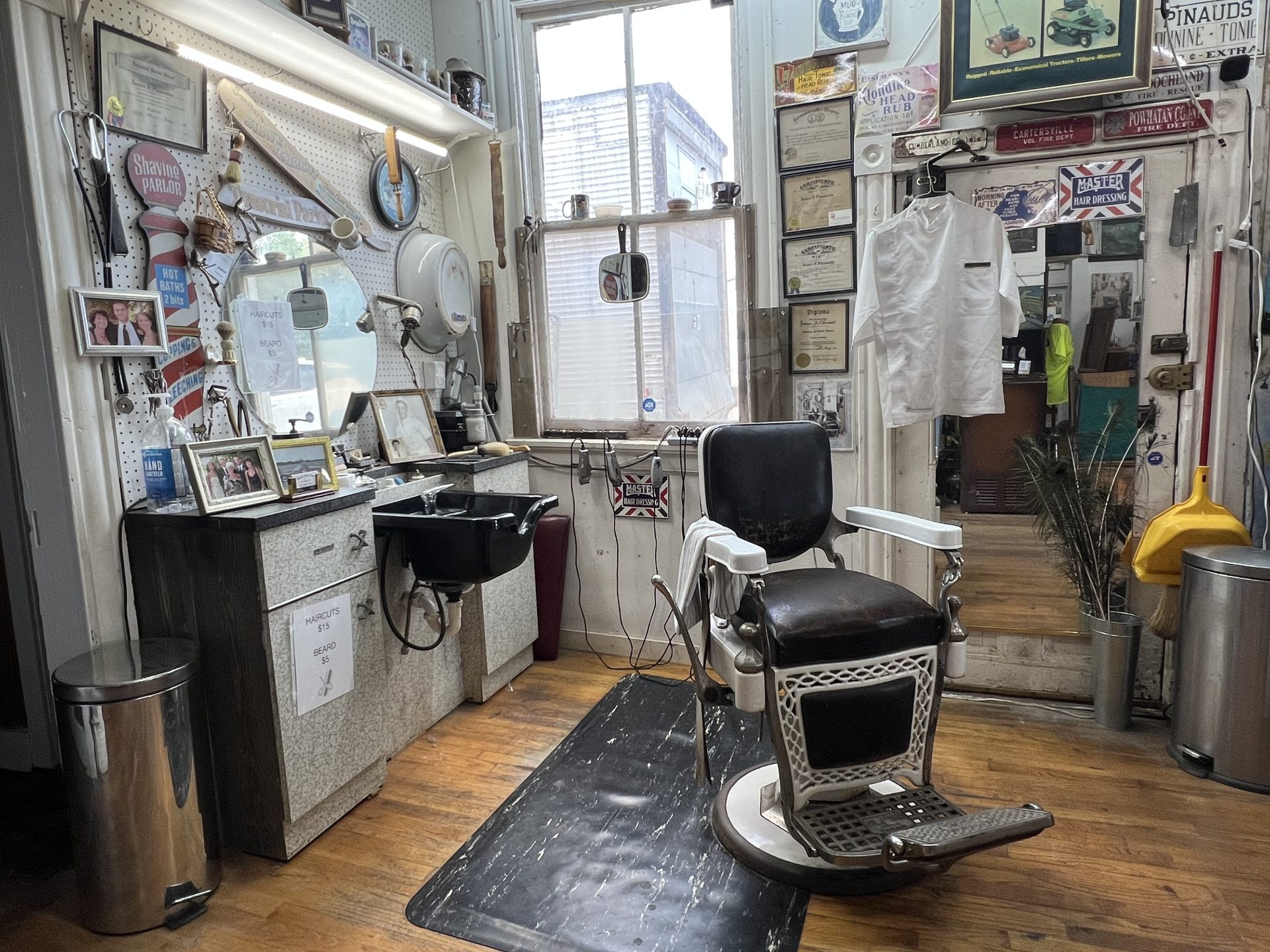
I started my tour in Northeastern Cumberland County, in what might be called the lobster’s east claw. For several miles, I followed an old Chevrolet farm truck down a two-lane road flanked on either side by rolling fields and sprawling farms. At Cartersville, an idyllic hamlet overlooking the James River, the truck pulled into the gravel lot at a general store called Blanton and Pleasants, Inc. I pulled in beside it.
Stepping into Blanton and Pleasants feels a bit like stepping back in time. It’s part convenience store, part hardware, part grocery, and part farm supply. There were racks of healthy starter plants — cucumbers, tomatoes, melons — at the entrance. In a back corner stood a barber’s chair that I took for a relic until a man in his late eighties came in and sat down for a $10 cut.
I asked whether things had changed much in the last few years. The owner answered in a soft Southern accent. “A lot of our farmers are disappearing.” For decades now, the agricultural sector has faced a significant squeeze, driven by economic pressures, environmental regulation and land-intensive energy policy, as well as by industrial development and declining generational participation.
The owner’s sentiment was echoed by Travis Pleasants, a 34-year-old Cartersville native and the grandson of a cattle farmer. After the death of his grandfather, Travis considered leaving farming altogether, because of economic and other factors. “We sold the herd down,” he said, “and sold off the equipment.”
Not long after, Travis started buying land and building an operation of his own. “I went about three years,” he said, “and I just didn’t feel like I could live without doing it.” Now he grows orchard grass for horse farms and, as he puts it, “dabbles” in crops, with about 40 acres under cultivation. Meanwhile, Travis works full time in transportation and logistics and volunteers for the local fire department. “It’s hard to make a living just farming these days,” he said.
As we chatted, the conversation drifted from crops to politics — specifically, to the ways in which the newly drawn congressional district will tie part of Cumberland County to Northern Virginia.
Pleasants worries about the cultural distance between the two. With the new map, a crowded field of Democratic candidates has emerged, many based in the Greater Washington D.C. area — places like Fairfax, Arlington, and Alexandria.
“When it comes down to it,” Travis said, “my representative will most likely come from a place where there are no farms. They’ve likely never lived on a farm, and they probably don’t know much about farming.” He paused. “Are they really going to be able to represent Cumberland County’s interests?”
Travis’s concerns are shared by communities across the 7th District. Driving through Goochland County and into Powhatan County, I pass dozens and dozens of signs with messages such as “Don’t Redistrict Rural” and “Vote NO, End Gerrymandering”. Though rural counties make up almost 90% of the district’s land mass, they account for just around 40% of its voting power. That’s because nearly 60% of the district’s total population is concentrated in Northern Virginia’s urban and suburban counties.
“People are not blind to what’s happening here,” one state representative told me, “and there’s a frustration that I have rarely seen. Even people who are not usually active in politics, people who are focused on earning a living and taking care of their families, they’re just incredibly disillusioned with how this has happened.”
Mark J. Rozell, a political science professor at George Mason University and dean of its Schar School of Policy and Government, has cautioned that the redistricting effort could have long-term consequences.
“There was barely any exurban support for this measure,” he told Virginia Public Radio. “So it really brings out the divide in Virginia politics in a very striking way. Consider when Republicans at some point in the future have power in Virginia politics and they too want to make a mid-decade constitutional change. And we’re into yet again a really negative pattern of polarization in our politics.”
Later the same day, I stopped in Powhatan for dinner at a pub next to a Tractor Supply Co. Inside, I chatted with waves of regulars. Though the county remains deeply rural, it has become a hotbed of residential development, with commuters moving in from nearby Richmond to enjoy the bucolic scenery and the slower pace. There was talk of all the new development, of the ways in which a kind of gentrification is changing the county, for better or worse. Someone fantasized about ways that rural Virginians could turn the new district red, to spite their urban counterparts.
The next morning, I headed north into the lobster’s tail, toward Arlington County. Increasingly, the lush green landscape was interrupted by strip malls and service stations, while the traffic became ever denser. In Fairfax County, pedestrians occasionally darted across the six lanes of traffic to get to some destination on the other side.
With its close connection to Washington, D.C., Arlington serves as a hub for the federal workforce, with roughly 20% of its residents working directly for the federal government, and many others working as contractors, in politics, and in media. The city also draws visitors from across the US and the world. So it took some effort to find someone who was local. I chatted first with a chemical engineer from Texas, a former college basketball player from Los Angeles, and a tobacco farmer from Western Kentucky, all in town on business. Finally, at a restaurant, I met an attorney named David (he preferred to share only his first name) who lives in one of the area’s numerous monochromatic high-rise apartments.
David told me that, while many residents in Arlington County don’t support gerrymandering generally, they see the redistricting effort as a necessary move to counter President Trump’s policy in Iran, which they consider dangerous. “This started in Texas,” he said, “and so a lot of people here feel that this is just a corrective measure.” When I suggested that the map might make people in rural parts of the district feel disenfranchised, the conversation turned philosophical. “I understand where they’re coming from,” he conceded, “but with the two-party system, I’m not sure anyone ever really gets fair representation.”
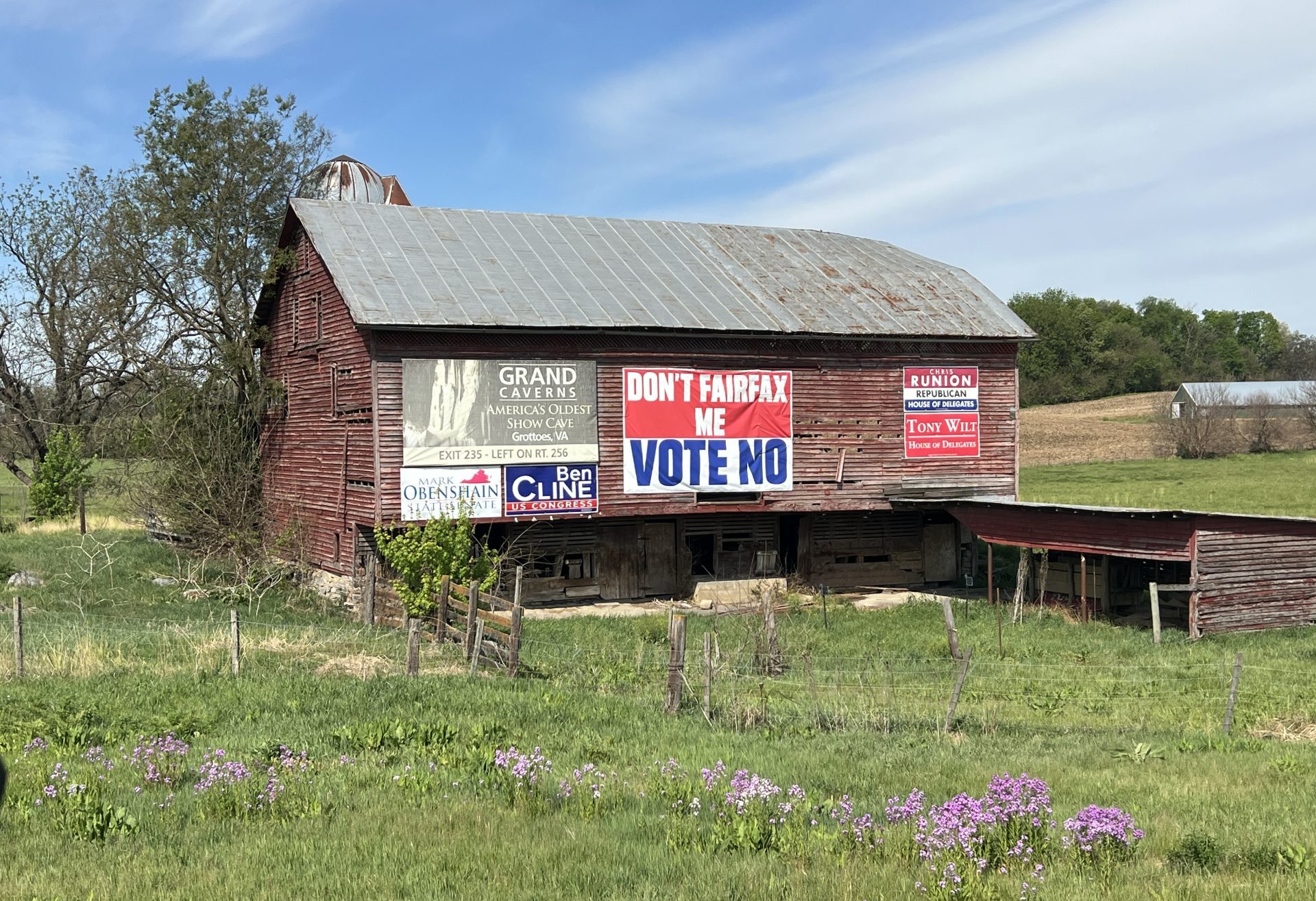
I spent the night in Old Town Alexandria, and the next morning, made my way southwest into a little town called Dayton in Rockingham County, deep in the lobster’s west claw. On the way down the interstate, I spotted a barn with a huge banner that read “Don’t Fairfax Me. Vote No.” Ahead of the referendum, the sign and its message became a symbol of rural frustration with urban and suburban encroachment, both literal and metaphorical.
In downtown Dayton, Mennonite men and women maneuvered through traffic on bicycles, while young women operated shops selling hand-crafted goods and modest dresses. Historic Dayton, with its picturesque farms, is home to a thriving Old Order Mennonite community. While Mennonites are deeply rooted in the Shenandoah Valley, many choose not to participate in elections, preferring instead to remain separate from secular institutions.
Inside Triangle Emporium Antiques and Books, owner Joseph “Jody” Meyerhoeffer told me that folks in the area who do vote tend to be more conservative. “Probably 70%,” he suggested. According to voting percentages in the 2024 presidential election, he’s spot on. “There’s been a lot of development coming in,” he told me, “but I think Rockingham County is still one of the biggest agricultural counties in the state.” It is. In 2022, Rockingham County sold $1.2 billion in agricultural products.
“I grew up on a farm,” Jody told me, “and then I got into this while I was still a boy, and I’ve been doing it ever since.” A kind of self-taught historian, Jody offers not only resources but research services to local authors. “Is your town doing anything for the Semiquentennial?” he asked before I left. “If not, then you should come back and join us here. I’m a member of the Historical Society.”
I left Dayton, driving down a scenic two-lane road toward Augusta County, the final stop on my tour. On either side lay mountains framed against the distant sky. In a little village called Churchville, I wandered into the Necessary Mercantile, a historic grocery that now specializes in local honey, bee-keeping gear, and wild mushrooms.
Shop owner Jack Wilson gave me a tour of the place. Topographical maps hang on the walls; there are shelves at the back that feature books about local history, ecology, and labor. I noticed a copy of Wendell Berry’s Jayber Crow — which explores themes of community, family, and faith through the eyes of a fictional small-town barber — and mentioned that I like the book. “Yes,” Jack said, “I believe that’s my favorite of his novels.”
When the conversation turned to politics, Jack acknowledged that he doesn’t always agree with his neighbors, many of whom are staunchly conservative. “I think gerrymandering is really ugly stuff,” he said, “but I do think something has to be done to curb the President’s most destructive impulses.” He was referring here to the administration’s actions in Iran. Still, he said, he exercises his most fundamental politics in his own community. He specifically mentions having a heart for the farmers in the valley and respect for their attachment to the land. “Doesn’t Berry say that ‘the soil is the great connector of lives?'” Jack asked. “‘The source and destination of all’ is, I think, his expression.”
In a shop across the street, I noticed a massive “TRUMP” sign hanging in a window.
On the trip back home, I thought about David in Arlington and what he’d said about the political divide. In a two-party system, does anybody really get what they’re bargaining for?
Thoreau wonders similarly in Cape Cod, though the catch he imagines is literal and not political. “It is remarkable,” he writes, “that so many men spend their whole day, their whole lives almost, fishing… Better go without your dinner, I thought, than be thus everlasting fishing for it like a cormorant.”