




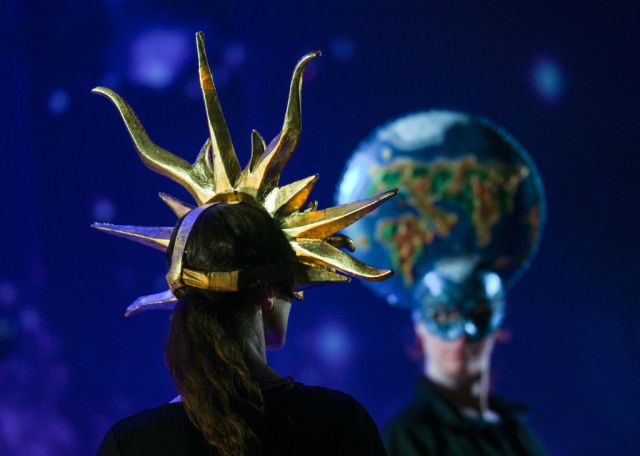
A ballet honors the radical changes Copernicus brought to humanity's understanding of itself. Credit: Getty





President Trump jokingly posts a doctored photo of himself leading an alien in chains out of Area 51, while, on a more serious register, his administration releases a huge tranche of previously undisclosed photos and information about UFOs. Elon Musk muses about human beings becoming an interplanetary species. Bryan Johnson preaches immortality through medicine. Markets panic when Claude’s Mythos AI proves — or appears — to be capable of hacking into some of the globe’s most secure digital systems. And we aren’t even halfway through 2026.
These events might appear only loosely related. Some — like Trump’s X-Files-style memes or Johnson’s obsession with scientifically optimizing his girlfriend’s reproductive health — elicit uncomfortable laughter. Others, especially Anthropic’s claims, have an undeniably disquieting aspect. But all are expressions of a much deeper shift, one that most of us aren’t acknowledging, much less discussing (even if we all feel it): we’re living through a series of stochastic ontological shocks that amount to a Second Copernican Revolution. And we’re far less prepared to meet its demands than the earlier generations who met the first.
The possibility of extraterrestrial life, the expansion of human habitation into outer space, the prospect of enhancing the body and expanding its life span, and the stupendous achievements of artificial intelligence call into question our privileged sense of mastery and belonging in the world.
Our age, in other words, is witnessing the dramatic second phase of the scientific, technological, and philosophical shift that launched modernity beginning roughly half a millennium ago with the discovery that the Earth isn’t at the center of an orderly “chain of being.”
The First Copernican Revolution suggested that, far from being orderly, the cosmos is constitutively antagonistic: roiled by blind, competing forces indifferent to human ends. In doing so, the revolutionaries radically de-centered humanity, dislodging man from his former place of honor in the cosmos.
The ontological picture did not improve with time. Darwin showed that the Homo sapiens is just another species, sharing origins with all others in the relentless struggle to survive and reproduce. Marx suggested that the beliefs we hold dear form the ideological superstructure upholding modes and relations of production that are historically determined; history, in other words, conditions belief.
At the beginning of the 20th century, Freud, who famously called his discovery of the unconscious a new Copernican revolution, revealed the irrational appetites and unconscious drives churning just beneath our polite conventions. Psychoanalysis purported to reveal a picture of the soul that was not unified, rational, or fully conscious — but instead propelled by a hydraulic system of psychic energies formed by the libidinal dynamics of the family; Freud’s theories demolished the Victorian understanding of what it meant to be human.
Freud’s theories of the mind were novel in that they not only stripped away another layer of dignity from the philosophical account of man, but also in registering and taking account of ontological shocks that preceded his thinking: widespread industrialization, globalized capital, the disintegration of the large multinational empires.
Yet the First Copernican Revolution was incomplete, and not nearly as radical as some of its protagonists claimed. Psychoanalysis, for example, rested upon a surprisingly old-fashioned, moralistic account of human personality, leading the later analytic thinker Erich Fromm to conclude that for Freud, “health and virtue are really the same.” Then, too, the First Copernican Revolution coincided with the age of mass literacy, which made it possible for culture to reflect on itself and for individuals to nurture a sense of interiority — “the birth of the subject” was one of the great and few consolations that accompanied the great dislocations of modernity.
In the high-modernist works of Joyce and Proust, to cite canonical examples, the individual psyche is represented variously as polymorphously perverse, anxious, and existential; Joyce’s Leopold Bloom and Proust’s narrator, for instance, are each obsessional, with a fractured sense of time and anthropological belonging; by 1922, the year Ulysses was published, to map the human meant to map the troubling disruptions, distortions, and dislocations that attended human experience and cognition. Modernism, which includes psychoanalysis, is, by these lights, a formal attempt to symbolically bridge the ultra-new with a longer humanistic tradition in which the brain was a soul, and man had a central place in the story of the cosmos. It was perhaps the last secular attempt to do so (though perhaps Carl Sagan would like a word).
“Copernican” revolutions are moments when civilizations acquire new knowledge and new means of mastery, which simultaneously empower what Freud would call the “illusions” that uphold those civilizations. They are naturally fraught.
The shocks that are upon us, in other words, are displacing the human even further from the cosmological story. If there is no singular event like the Napoleonic Wars or World War I which reorients our inner lives, there are and have been a series of fractured crises: the pandemic, the wars in Ukraine, Gaza and Iran, coupled with the sci-fi horizon of aliens, artificial general intelligence, robots. Esoteric or fringe ideas are now normal for social media scrollers or Tucker Carlson viewers; part of being alive in 2026 means wondering seriously if our species is the result of an alien genetics experiment; if AGI will rule the world; or whether biotech will enable lives as long as Methuselah. The normality, even the banality, of these discourses, is a sign that we’ve moved beyond the retrenchments of the literary modernists or the midcentury existentialists, who tried to provide intellectual structures for human beings to make sense of themselves in the wake of centuries of rapid scientific and intellectual revolution. If one or any of the possibilities on the horizon of 2026 are true, or come true, then everything is different forever.
The ontological shocks of the present are the most extreme to date because they threaten to alter the species itself; previous ontological shocks changed the explanatory framework around man, in this decade, and especially this year, narratives are changing, but so is the material of mind and body, and the aspirational trajectory of mankind. ‘Ontological influencers’ like Bryan Johnson urge followers to pursue immortal life. In the old humanistic framework of the West, it was sensible for Odysseus to reject immortality with the demi-goddess Calypso and return home to his aged wife, dog, and son; this wisdom does not seem like it will prevail into the next decade.
Humanistic intellectuals, or anyone who ascribes dignity to the human condition, can’t assume they will prevail unless they take seriously how weird things have become, and will continue to become. Writers, artists, philosophers, undergraduates at coffeeshops, whoever is interested in building a new kind of bridge (like modernism) between the future and the past must be audacious relative to the scale of the manifold transformations at hand.
So, where are the new vocabularies, new concepts, new art forms to help humanity process Year Zero, an ontological revolution that may usher in Biblical lifespans, UFO disclosure, cyborgs, Butlerian jihads et al.? Where are the prophets? For the first time, humanism seems to have failed to catch up to changes in the human. The imminent transformation of the foundations of mind and body, and potentially of our understanding of history (if it turns out we are not the only intelligent life form in the galaxy), has not produced great art or thought, only slop and deferral.
A culture that is preoccupied with dating mores and the manosphere, with the political trends and the lives of pop stars and reality stars and streamers, is derelict both of ambition and duty; rather than acknowledging ontological shock, we are numbing ourselves to it. As a civilization, as a species, and as a global population, we are destitute of secular palliatives, of modes of care and of thought to handle the onslaught of the future. Rather than diluted therapy-speak, we need a new Freud, or new Freuds (or new Marshall McLuhans): new thinker-prophets, to build intellectual bridges to a future that has already commenced.
The comfortable center risks letting the future be defined by technologists with platforms who are invested, literally, in a certain version of the future coming to pass, and by government bureaucrats who may be more interested in controlling unrest than in ameliorating its causes.
And this is a shame. Heightened awareness, new forms of interiority and self-articulation, new means of self-making are traditionally the beneficent byproduct of sudden breaks in the linear unfolding of history. (When we say Shakespeare was early modern, for instance, what we really mean is that the Bard was drawing on intensely new energy that was flowing through London in the wake of intense religious warfare and technological and philosophical change. Ditto Cervantes, ditto Montaigne.)
New ways of life should give rise to new thoughts and new expressions of meaning. Ontological shock can be more than an unpleasant sensation. It can be a provocation, an imperative to reform the ranks and battle a science-fiction future into a dignified truce.