




Harold Bloom was a genius. He could also be handsy with female students. Credit: Getty





Harold Bloom, the greatest literary critic of his age! Look on his works, ye Mighty, and despair: by the end of his long, super-contemplative and rather oddball life, he’d published almost 50 original books, edited hundreds of critical works in his role as general editor at Chelsea House Publishers (a job he undertook to support a disabled son), and read untold millions, nay, billions of words so that you and I wouldn’t have to. And now we have the first published volume of Bloom’s correspondence, The Man Who Read Everything: The Literary Letters of Harold Bloom, which may prove the tip of a pretty massive iceberg — if, that is, enough readers remain in the world to support such a project. Six years after Bloom’s death, and deeper still into an all-screens, post-literate age, he is arguably best remembered for a single phrase — “the anxiety of influence” — and for having allegedly put his hand on Naomi Wolf’s inner thigh.
In his time, Bloom was a kingmaker among poets and fiction writers, who knew all too well that their places on the greasy pole of posterity would be somewhat determined by whether or not he saw fit to include them in The Western Canon: The Books and School of the Ages, his definitive list of lasting books that was a New York Times best-seller in 1994. John Updike, whose oeuvre was even more stupendous than Bloom’s, might have regretted calling Bloom’s writing “torturous” when he saw that his only canonical book, according to Bloom, was The Witches of Eastwick — and so much for his Rabbit tetralogy, hundreds and hundreds of other novels, short stories, poems, essays, and never mind his face on the cover of TIME magazine when Couples was published in 1968. Philip Roth, on the other hand, made a point of engaging Bloom in a friendly correspondence while the latter was working on his list for the Canon, and was rewarded with no fewer than six mentions.
However, by the time Roth’s biographer (me) got in touch with Bloom via email — asking for an interview at Roth’s urging — the number had dwindled to two: “Philip and I have been out of touch for many years now,” Bloom replied to me in 2013. “I continue to regard American Pastoral and Sabbath’s Theater as canonical works of the American imagination. But I believe I have nothing personal to communicate besides my high critical regard for his work, and that is on record.” This was signed “With Regret.” I thought I sniffed a hint of pettishness in this, and was unsurprised to learn, while reading The Man Who Read Everything, that he had indeed taken Roth’s later indifference to heart and considered him “very self-centered.”
Bloom himself was no slouch in the self-centered department, having beaten an uncommonly arduous path from his humble beginnings as a young Talmudist in The Bronx. “There aren’t any reviews of my Yeats, and I guess I’d better not expect any,” he wrote in 1970 to the poet A. R. Ammons, one of the eight recipients of Bloom’s letters who make up the eight sections of the book. “A number of people have told me it is just too difficult to read, which is discouraging. I’m fated to remain an unknown critic.” Anyone who’s plugged away in this line of work knows the same feeling of Sisyphean futility and, after all, Yeats was Bloom’s fifth cumbrous study of English Romanticism, the field he’d intended to till in those days. Eventually, though, all of Western literature became his bailiwick — a massiveness that he alone, perhaps, could undertake: a “monster” of reading, Bloom could swallow books like so many gumdrops and tell you whatever you needed to know about them. And given that he really couldn’t help himself — he lived to read and write or talk about whatever he read — his freakish gifts were lavishly, at last, rewarded in the marketplace: in 2002, he became the last academic in history to get a seven-figure advance for a book, Genius: A Mosaic of One Hundred Exemplary Creative Minds.
Bloom’s latter-day notoriety — as a critic, I mean, not as a would-be lothario — was somewhat due to the main thesis of The Western Canon: namely, that some books are better than others, and a lot of the better kind are written by dead white males. (For what it’s worth, Bloom also believed that Elizabeth Bishop, say, was the best poet of her generation, and Anne Carson the best of hers.) “Shakespeare is God,” he declared, to the dismay of those who thought that Shakespeare, Tolstoy, Kafka, et al., were to be mined for evidence of historical oppression against women, minorities, and other marginalized people, and that aesthetic merit was mostly a canard promoted by “hegemonic” oppressors.
Happily, at the height of his fame, Bloom could afford to address an audience of literate amateurs who simply wanted to know what they should read during their little spans on earth, versus English majors (a dwindling cohort) fixated on race, class, and gender. “What are now called ‘Departments of English,’” Bloom wrote in The Western Canon, “will be renamed departments of ‘Cultural Studies,’ where Batman comics, Mormon theme parks, television, movies, and rock will replace Chaucer, Shakespeare, Milton, Wordsworth, and Wallace Stevens.” Even Bloom, of course, couldn’t have foreseen the further ravages of smart phones, AI, etc., on what used to be called The Examined Life (whereas Roth stopped writing novels, in part, because he thought reading literary fiction was about to become as “cultic” as reading Latin poetry). But in the meantime, Bloom made a point of distancing himself from the Yale English Department; his later title as Sterling Professor of the Humanities made him, as The New York Times put it, “a department unto himself.”
In her introduction to The Man Who Read Everything, editor Heather Cass White points out that Bloom’s transcendent self-assurance was derived in part from his hero, Ralph Waldo Emerson, who wrote in “Self-Reliance,” “to believe that what is true for you in your private heart is true for all men — that is genius.” Evidence of Bloom’s oracular certitude is found on every page of this book, whether he’s telling Ammons that John Ashbery’s first and fourth books of poetry are wonderful but his second and third not so much, or telling Ashbery himself that his poem “Collective Dawns” is “marvelous,” but “Wooden Buildings” is only, well, “good enough” — and so on. “Good enough” was about as damning as the gentle sage allowed himself to be. “The Wilson is good enough,” he remarked to Ursula K. Le Guin, who’d rashly mentioned that she was curling up in bed with Emily Wilson’s new Odyssey translation. “The [Robert] Fitzgerald catches the original somewhat better.” Of course, it went without saying that Bloom had read the original in Homeric Greek, along with all the reputable English versions thereof.
When it came to his signature conviction, the so-called anxiety of influence — which, said The New York Times, “has something to upset everyone” — Bloom was prepared to go to the mat with even his most formidable detractors. Over time he would elaborate the idea in various ways, at forest-slaughtering length, but the gist was that a poet’s work is naturally influenced by the work of eminent precursors, and the anxious struggle to form one’s own vision — and thus ensure lasting fame — is Oedipal in nature and hence, implicitly, between men. “If you mean influence in the literal sens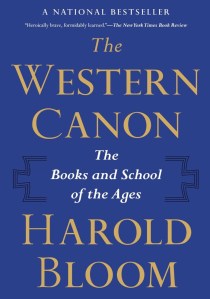 e of the transmission of thought and imagery and the like from earlier poet to later one,” the great Northrop Frye replied in 1969, when Bloom first tried running the idea by his revered mentor, “I should think that this was simply something that happens, and might be a source either of anxiety or of release from it, depending on circumstance and temperament.” One senses a faint bemusement on Frye’s part, even a wish to change the subject, and when Bloom insisted to Frye that “influence anxiety was not an affect in a person, but the relation of one literary work to another,” Bloom’s “heroic precursor stopped listening,” as Bloom himself pointed out many years later (an anxious relation between works? I mean to say, what? Frye might have wondered).
And therein lay perhaps the main problem with Bloom as a writer and thinker: he was damnably hard to understand. “This is one of the most difficult books I have ever read,” a flummoxed C. S. Lewis wrote in 1962, when taxed to review the young Bloom’s The Visionary Company: A Reading of English Romantic Poetry. Bloom himself was quite aware of the problem — “sometimes I wonder why I write such odd things” — but he, at least, knew what he meant to say, and by God he was going to say it, especially to those he considered peers. Explaining to his friend and Yale colleague John Hollander why he’d adopted “crossings” as a term for poetic “ratios, tropes, defenses” and whatnot, Bloom wrote: “I base it on Augustine’s calling post-lapsarian language the ‘region of unlikeness’ and on the Aristotelian-Ciceronian topica, ‘places’ not ‘commonplaces’ (cf. Curtius, etc.) they became or even memory-places (cf. Simonides) …” It goes on like that, and may be perfectly true for all I know, but not the sort of thing to spring on a lad with a morning head, as Bertie Wooster would have it.
But of course, Bloom’s correspondents were largely intellectuals almost as fond of esoterica as he; indeed, Bloom might have met his match in the poet James Merrill, whose masterpiece, The Changing Light at Sandover (1982), was largely informed by 20 years of sessions at a Ouija board with his partner David Jackson, and whose narrators from the spirit world included W. H. Auden, no less. Reading Bloom’s Talmudic reflections on certain aspects of Merrill’s work — “I don’t think that an actual zelem (your astral body or other self) or an actual maggid (other self as ‘instructor’) makes for strong poetry” — I couldn’t help thinking Merrill had found a kindred soul, if a rather too bumptious one. When Bloom went so far as to suggest that Merrill plump for lowercase versus uppercase letters in some instances, Merrill replied a little sternly that “the Authors were in Eternity, and his role was faithfully to take dictation.” Fair enough.
For the lay reader, it can get a little wearying, but the title reminds us that these are the Literary letters of Harold Bloom, and not what he might have written or said to certain of his comelier grad students. Still, I found myself wishing he’d go to Disney World or something, and almost wept with gratitude when he paused in his Laputan musings to complain about his diet (he struggled with his weight): “I’m trying to make it each 24 hours on a steak, three hard-boiled eggs, vitamin pills, water, and cigars.” Such a rare glimpse of the personal was for the benefit of arguably his dearest friend, Ammons, whom Bloom wrote avidly throughout his life. White, the editor, wisely chooses a single 18-month slice of their vast correspondence, shortly after their first meeting — when “their emotional and intellectual engagement was at its peak” — the better to conform to her overall method of arranging Bloom’s letters into roughly chronological chapters that each contain most or all of his correspondence with a given poet or colleague, usually because Bloom was in the process of writing a paper about that person’s work and wanted to air his thoughts and gather information.
For the most part, Bloom used his superpowers for good rather than ill, exhorting his favorite poets to live up to their indubitable genius: “I don’t want you giving anyone, including yourself, the impression that you consider yourself anything less than a very great poet,” he wrote Alvin Feinman, whose first and only book of poetry Bloom had helped publish via Oxford University Press. While Bloom was certainly capable of taking even the greatest poets down a peg or two (“good enough”), one gets the impression that his hyperbolic praise was both heartfelt and an impulse to give pleasure to people whose efforts, let’s face it, are pretty thankless on the whole. “With Miss Bishop gone, you have for me no living peer,” he wrote Ashbery, “—Red [Robert Penn] Warren, Archie Ammons, Jimmy Merrill have written permanent poems, but I would say now that poetically we are in the age of Ashbery, as once it was of Hart Crane or of Stevens.” Bloom’s advocacy was perhaps a poet’s best shot at a kind of slender immortality, so one can imagine Ashbery’s almost broken gratitude (“I feel singularly honored …”), very much in keeping with the mutually fawning tone of these letters.
Love of the work, for Bloom, usually meant love of the author, and no wonder he took it so hard when Roth (for one) stopped returning his letters. “I was deeply in love with Archie Ammons,” he told his friend’s biographer, Roger Gilbert, and we have no cause to doubt it. Bloom tended to sign letters to Ammons and others — once the initial formality had worn off — with “Love” and even “Love and Homage,” and he was generally effusive in his use of endearments. He and Hollander liked to address each other with some variant of “Foo Foo” (“Dearest Foofy”), while favorite students, male and female, were often called “child” and startled with a kiss on top of their heads. The younger poet Henri Cole, whom Bloom found especially promising, met Bloom in person exactly twice in his life; that first time, he’d arrived for Bloom’s 80th birthday and stuck out his hand, whereupon Bloom pulled him close and pressed Cole’s head to his chest. “Noble bard,” Bloom began a long answering-machine message that Cole transcribed for this book, “it is Harold Bloom, calling from New Haven at about twenty of one on … what’s today, child?” A page or so of warm, well-considered praise follows — “I love both you and your poetry …” — until the machine cuts Bloom off mid-paean.
Of course, the line between darling man and lech is a dicey business, especially in academia, and Bloom seemed to become more and more heedless as his fame grew, even finding a little humor in his own raffishness — referring to himself as Bloomstaff, say, in tribute to one of his favorite Shakespearian rogues. In 1990, GQ published an article, “Bloom in Love,” that described in mortifying detail (a tandem bubble bath, etc.) the dalliances he’d allegedly pursued with students throughout his long, long marriage to the stoical Jeanne Gould. At the time, Bloom was still fairly bullet-proof and could afford to shrug off the exposé as “a disgusting piece of character assassination.” He was just as categorical in 2004, when the feminist author Naomi Wolf claimed that he’d groped her thigh 20 years earlier. The Yale Daily News described the “veritable media frenzy” that ensued, but Bloom got off easy; 10 or 15 years later he might have been burned in effigy, if not chased through the streets of New Haven by a mob bristling with torches and pitchforks.
And so a chastened Bloom became all the more devoted to the Life of the Mind. “Like our ancestors,” he’d written Hollander in 1975, “we must study, we must ponder, and then we do the best we can” (he was a great fan of italics) “when we write and teach.… We live in the mind — as [Wallace] Stevens said.” Such a life has its homely pleasures, but it’s a lonely business at the best of times and became even more so, for Bloom, as the people he considered “close friends” such as Ashbery, Ammons, and Merrill — whom, we know from this book, he hardly ever saw in person — died off one by one.
He would never meet his final and most engaging correspondent in The Man Who Read Everything, Le Guin, who was six months older and just as lonely. “May we use first names?” she shyly inquired when they first got in touch. “I’d like that.” After a two-month flurry of delighted emails, Le Guin mentioned that she’d “run out of steam” after an hour and a half of teaching the day before; she died of a heart attack five days later, and Bloom’s own death came the following year. Let the happy few who read these letters remember him as the embodiment of an ardent brand of bookishness that has passed, and less so for his all-too-human failings, which are common enough (alas) in any age.