




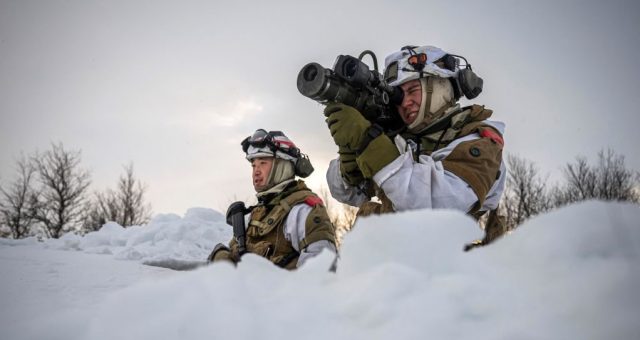
Norwegian troops practicing maneuvers in the Arctic Circle. (Jonathan Nackstrand/AFP/Getty)





Trump has once again sent Europeans scrambling. This time, he has announced the withdrawal of around 5,000 soldiers from Germany as part of a Pentagon decision triggered by the president’s public dispute with German Chancellor Friedrich Merz over the Iran war. The cut amounts to roughly 14% of the approximately 35,000-36,000 American troops currently stationed in Germany, and is expected to unfold over six-to-12 months, returning US force levels to where they stood before Russia’s invasion of Ukraine in 2022. Trump has hinted that further cuts may follow. He has framed the move as a “punishment” for Merz’s criticism of Washington’s handling of the war — including Merz’s claim that Iran had “humiliated” the United States.
This is part of a broader offensive Trump has waged against NATO allies in recent weeks, for their refusal to send naval forces to help open the Strait of Hormuz. He told NATO members that they will “have to start learning how to fight for yourself” because “the USA won’t be there to help you anymore, just like you weren’t there for us”. Trump has also threatened to withdraw troops from Italy and Spain, and has once again raised the prospect of the US leaving NATO altogether. Asked in a recent interview whether he would reconsider US membership in the alliance, Trump replied: “Oh yes, I would say [it’s] beyond reconsideration”.
In this context, Germany’s sweeping rearmament program is widely presented as a positive step in the right direction — Europe finally taking charge of its own security. But does this narrative hold up? And how seriously should one take the US’s threat of leaving NATO? A closer look reveals a very different picture.
Last month, Germany published its first-ever official military strategy, presented by Boris Pistorius, the country’s defense minister. Its core ambition is to transform the Bundeswehr into “Europe’s strongest conventional army” by 2035, and a “technologically superior” force by 2039, with the Federal Republic positioned as the continent’s leading military power and the primary partner for its European allies. To achieve this, the strategy envisages massive rearmament with long-range weapons, extensive deployment of AI, automation and autonomous systems, and a total force — including reserves — of 460,000 soldiers. The reserve is explicitly framed as a bridge to civilian society, signaling an intent towards broader social militarization.
The strategy has drawn sharply divergent reactions. Some hail it as a long-overdue step towards freeing Germany — and by extension Europe — from American military tutelage, given the US’s apparent “disengagement” from NATO. Others view it as a dangerous revival of German military nationalism, one that evokes the darkest chapter of 20th-century European history. Both readings miss the point. Germany’s rearmament is not designed to make the country more militarily sovereign — for better or worse. It is designed to elevate Germany’s role as the “vassal-in-chief” within the US-controlled NATO command structure. In this sense, the Trump-Merz spat should be seen as little more than political theatre.
The document itself makes this plain. One of its key sentences reads: “NATO must become more European to remain transatlantic”. Germany’s role is conceived not merely as that of a frontline military actor, but as NATO’s logistical and strategic hub — the node linking Eastern, Central and Western Europe while maintaining the transatlantic connection to North America. In other words: Germany must rearm in order to sustain American hegemony on the continent. To paraphrase a famous line from the Italian novel The Leopard: “Everything has to change so that everything can stay the same”.
This was made explicit in a recent post on X by Elbridge Colby, the US Under Secretary of Defense for Policy. Colby welcomed Germany’s new military strategy as a vindication of Trump’s pressure on European allies to rearm, framing it as a step towards what he calls “Nato 3.0”. His core argument is that Europe, led by Germany, must now convert the Hague Commitments — where Europeans committed to a landmark defense investment pledge, aiming to spend 5% of their GDP on defense by 2035 — into concrete military capability. He quoted Nato Secretary-General Rutte approvingly: “Air defense systems, drones, ammunition, radars, space capabilities — that is what will keep us safe”. On Germany specifically, Colby presented the new military strategy as proof that Berlin was finally stepping up after “years of disarmament”, noting that rechristened Department of War was already working closely with the Germans to accelerate the transition.
The strategy itself, as Colby quoted it, acknowledges that Washington “is increasingly shifting its strategic focus towards its Western Hemisphere and the Indo-Pacific” and is demanding allies “step up their efforts to safeguard their own security”. Germany, in this framing, must become “an even stronger military ally to the United States” precisely because the US is repositioning elsewhere.
This is simply a restatement of the “division of labor” that US Defense Secretary Pete Hegseth announced at the very outset of the Trump administration. He made clear that the US needed to pivot elsewhere — we now know that meant Iran, and ultimately China — and that Europe would therefore have to assume responsibility for “managing its own security”, meaning the maintenance of pressure on Russia through Ukraine. Europe duly obliged: it has increased its defense spending and has doubled down on support for Kyiv, including through the recently approved €90 billion loan. We are now watching the natural progression of that logic, as Europe assumes the full financial burden for the continuation of the proxy war against Russia.
In short, the US is not “disengaging from Europe”; it is simply demanding that Europe contribute more to Nato, while remaining firmly embedded within the Alliance’s command structure — in short, that it pays more for its own subordination.
This requires a reassessment of Trump’s broader strategy towards Russia. Though he is routinely accused of “appeasing Putin” — with critics citing his cut-off of US funding to Ukraine and his (failed) attempts to broker a peace deal — the reality is more complicated. Washington has long sought to force Europe to decouple from Russian gas and replace it with American LNG, and the war in Ukraine has allowed them to achieve just that — so much so that one has to wonder if America’s decades-long strategy in Ukraine, from helping topple the democratically elected government in Ukraine in 2014, to drawing the country firmly into Nato’s informal orbit, wasn’t designed precisely to lure the Russians into war. The bombing of the Nord Stream pipeline should always be understood as part of this strategy. This becomes even clearer in light of the latest US National Security Strategy, published in November 2025, which designates “American energy dominance” across oil, gas, coal and nuclear power as a top strategic priority, explicitly framing the expansion of American energy exports as a means to “project power”.
This logic illuminates not only the US’s military campaigns against Venezuela and Iran, but also why, in order to keep Europe dependent on American energy and severed from Russian supplies, Washington has a structural interest in keeping the proxy war going. It’s therefore easy to conclude that the US was never genuine about its intentions to make peace with Russia. The only difference today is that the war is now being waged not only through Ukraine, but through Europe itself.
In this light, the ostensible US “threats” to leave Nato — and the European establishment’s rearmament program, Germany’s above all — are revealed as components of the same strategy: keeping Europe subordinated to American geopolitical priorities. The new German military strategy is nothing more than Berlin fulfilling the role Washington has assigned it: holding the line against Russia while the US turns towards the Indo-Pacific and the Western Hemisphere. This is not nationalism, military or otherwise, but its opposite: the undermining of German and European core interests at the hands of a transnational elite.
In this context, Germany should be understood as the anchor of a new Europeanized Nato core, comprising Germany, France, the UK — and Ukraine itself (even if formally outside of the alliance). This too reflects a longstanding American design. In his 1997 book The Grand Chessboard, the influential Polish-American diplomat Zbigniew Brzezinski predicted that “Franco-German-Polish-Ukrainian political collaboration… could evolve into a partnership enhancing Europe’s geostrategic depth”, adding that “America’s central geostrategic goal in Europe can be summed up quite simply: it is to consolidate through a more genuine transatlantic partnership the US bridgehead on the Eurasian continent”.
This should dispel any remaining notion that what we are witnessing amounts to a move towards German or European strategic autonomy. It is no coincidence that Germany’s new military strategy identifies Russia as “the most serious and immediate threat” to European security — a claim that forms part of a broader European narrative warning of an inevitable war with Moscow in the coming years. At face value, this anti-Russian posturing might appear to reflect a distinctly “European” stance, one seemingly at odds with Washington’s public position. But this is largely an illusion. Not only has the European transatlantic establishment thoroughly internalized America’s strategic priorities, but the Nato command hierarchy makes the real chain of authority plain.
Real operational control of the proxy war against Russia remains firmly in Anglo-American hands. At the top sits the Supreme Headquarters Allied Powers Europe (SHAPE) in Mons, Belgium, which translates political decisions into military objectives. The Supreme Allied Commander Europe (SACEUR) — always an American general, dual-hatted as commander of US European Command — runs it alongside a British deputy. A German general coordinates staff work as Chief of Staff, but effective decision-making stays with the top two.
Below SHAPE, operational command splits into two tracks: three Joint Force Commands (JFCs), the true theater commanders for large-scale operations, and three Component Commands covering air (Ramstein, Germany), land (Izmir, Turkey) and sea (Northwood, UK). MARCOM, the maritime command, has traditionally been UK-led, but the US recently took control of it, placing all three Component Commands under US command — a significant consolidation that has gone largely undiscussed. Even when a European officer commands a JFC — such as the leadership of JFC Naples, which recently passed from the US to Italy — the overall strategic direction remains under American control; JFC commanders implement objectives set by SHAPE.
Two further structural dependencies reinforce American dominance. The first is the C4ISR concept of Command, Control, Communications, Computers, Intelligence, Surveillance and Reconnaissance: European allies are almost entirely dependent on US satellite, aerial and maritime platforms for real-time intelligence, surveillance and targeting — which together represent the backbone of Nato warfighting. Indeed, it has been acknowledged even by the Wall Street Journal that Ukraine’s deep-strike operations inside Russia — including, recently, against several oil production facilities — could not be conducted without American intelligence and satellite capabilities. The second dependency, less visible in public debate but potentially more consequential, is the dense presence of American staff officers embedded throughout Nato’s command structure at every level of the hierarchy, giving Washington an institutional grip that no change in command titles can easily displace.
All of this should dispel any notion that the US is not deeply involved in the Ukraine war — or that it intends to leave Nato and truly “disengage” from Europe. Beyond the command architecture, the United States operates numerous bases and military installations across the continent, both within the Nato framework and under exclusive American control, which are indispensable to its global power projection. Ramstein Air Base in Germany — home to around 16,000 troops — functions as the hub controlling military drone traffic on a global scale, while coordinating American air operations across Europe, Africa and the Middle East.
A recent Wall Street Journal investigation confirmed that, despite the public protestations of European leaders, US bases across the continent have functioned as the essential infrastructure for the American war on Iran. As the article put it, “Europe remains the bedrock of US force projection in the world”. Even Nato Secretary-General Rutte recently described the purpose of Nato as being a “platform of power projection for the United States”.
Another element is what analysts call the “hidden dividends” of Nato: contracts and orders for American defense industries. This web of 1,300 agreements among the 32 member states that set standards for Nato weapons and equipment — covering everything from ammunition calibers to fuel-tank diameters — were originally imposed by Washington and overwhelmingly favor the American military-industrial complex.
German and European rearmament, then, in the context of a supposedly more “European” Nato, is not strengthening European autonomy, but further eroding it. Not only does it make Europe complicit in Washington’s increasingly reckless military adventures, as the Iran war demonstrates, but more gravely still, it is pushing the continent towards a potentially catastrophic confrontation with Russia. Moscow is watching and responding accordingly. In a recent speech, Foreign Minister Lavrov stated openly: “A war against us has been openly declared. The Kyiv regime is being used as the tip of the spear. However, everyone is aware that this tip is unusable without Western supplies of weapons, intelligence data, satellite systems, training of military personnel and much more”. Lavrov added that Western leaders are actively preparing their publics for war with Russia — using Ukraine to buy time — and that Russia takes the threat very seriously. One cannot overstate the dangers of the path we are treading.
A final observation is warranted. The French historian Emmanuel Todd has argued that much of what passes for nationalism in the West today — from Germany to Japan — is in fact a form of “imaginary” nationalism: vassalage towards the US dressed up as sovereignty. He contrasts this with “real” nationalism, a genuine sovereignty-oriented politics that is today largely absent. German neo-militarism, as argued here, falls squarely into the former category. But this does not mean that a “true” German nationalism — with its attendant aspirations towards continental hegemony — could not resurface. The militarization of German society and the hardening of anti-Russian sentiment are real and deepening phenomena. There is a historical precedent, after all. A century ago, the Anglo-American establishment tolerated the Nazi military build-up as an anti-Soviet bulwark — only for the German monster to eventually slip its leash. The domestic German context today is obviously very different — and of course one may argue, and hope, that a “true” German nationalism would recognize that the country’s genuine interests lie in peace rather than war. Even so, the parallels are impossible to ignore.
Thomas Fazi is an UnHerd columnist and translator. His latest book is The Covid Consensus, co-authored with Toby Green.
 battleforeurope