




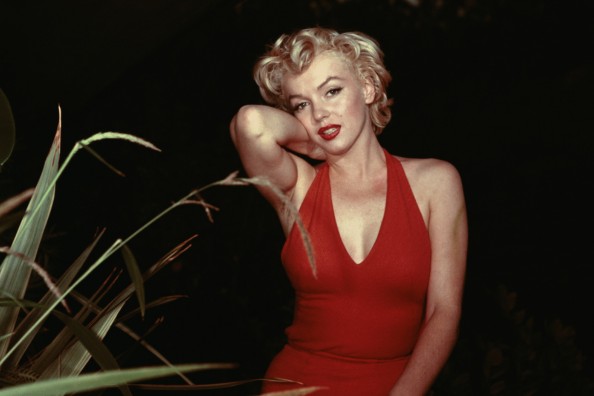
Norma Jeane Mortensen, circa 1954. (Baron/Hulton Archive/Getty Images)





With stunning regularity, a breathless artiste sounds a klaxon: they humbly wish to inform you that they have discovered the Real Marilyn Monroe. Here, finally, is Marilyn unguarded: Marilyn unclothed, Marilyn flirting, Marilyn caught unaware. Here is your chance to get to know the real Marilyn — and all that that entails. The centenary of her birth offers ample opportunities. Maybe the Real Marilyn will appear in The Marilyn Monroe Century: From Norma Jeane to Icon, a collection of little-seen photographs bound in a neat coffee-table book. Maybe Real Marilyn will make an appearance in a new exhibition at the National Portrait Gallery that includes personal effects and a grisly painting of our megababe on the mortician’s slab (provocative!). Or maybe RM is skulking around the back rooms of the BFI, where a new retrospective promises to showcase “the depth of talent behind the big-screen legend”.
The idea that there is some Real Marilyn — some living, breathing person hiding within the iconography — has been reliably deployed since Monroe’s own heyday. Indeed, it was a magician’s trick used in her first interview with Life magazine, published in 1952 a pivotal year in her career.
Monroe was at this point an emerging star, widely admired for her roles in All About Eve (1950) and The Asphalt Jungle (1950). However, her fledgling career had been nearly derailed by the revelations that she had posed for nude photos in her former life as a model; the photographer Tom Kelley had flogged the images to a calendar for a quick buck without her agreement. So the 20th Century Fox executives decided on a radical PR strategy: Marilyn would admit the whole affair, saying she needed the money to pay rent.
On the magazine’s cover — the first of six in a 10-year span — Marilyn backs up against the wall, eyes nearly shut, lips parted; she looks like you’re about to drunkenly kiss her at a party, like she’s not realized her ruched top is slipping down her shoulders. The promise is the same as in modern-day celebrity content: revelation, exposure, intimacy.
In the interview itself, Marilyn is scolded for having “posed for calendar art when she was broke”. By way of illustration, the article reproduces the nude in full color. The captions contain an in-joke: above the nude is a black-and-white image of “Marilyn clothed”; “her taste in music is distinctly highbrow”, the copy snorts. Below, a big black arrow points to “Marilyn unclothed”. Not so highbrow then, were you Miss Mortenson? The reader is satisfied. They get to be titillated by the nudes; they also maintain their moral high ground; and they get to laugh at Monroe’s pretensions. They’ve got an eyeful of the Real Marilyn, in spite of all her airs and graces. Meanwhile, Monroe has swerved the scandal and saved her career. The interview was also the source of her best-known quip, a gag about wearing only Chanel No 5 to bed.
So this “sturdy blonde named Marilyn Monroe”, as the Life profile calls her, was already mastering a public-private Dance of the Seven Veils, a sort of PR striptease which is by now baked into the grammar of female celebrity. Her publicity coup was no doubt familiar to Kris Jenner, the momager of Kim Kardashian, who was alleged to have leaked her own daughter’s sex tape; half a century later, in 2007, the effect was precisely the same. But latter-day celebrities are Marilyn’s heirs, whether explicitly or not. In 2022 Kardashian wore Monroe’s “Happy birthday, Mr President” dress to the Met Gala, the subject of much indignation from Marilyn-watchers. In 1985, Madonna channeled the Monroe of Gentlemen Prefer Blondes (1953) in her Material Girl music video; later she would adopt a punkier version of Monroe’s peroxide crop. Both women were the subject of erotic taboo, closely watched by the press in every romantic clinch — often in a way that overshadowed their work. Madonna said of Monroe that she “became an adjective”; as such her persona could be put on and taken off, a shibboleth for “Hollywood”, “sexiness”, or “blonde”.
These same signals are used today by Sabrina Carpenter, who winks at the Fifties as another blonde, corseted coquette. Carpenter has built a brand on the kind of breathy euphemism that made Marilyn so irresistible; the difference is that today, we credit celebrities like her with being in on the joke. On film and in the media, Marilyn often seemed to be surprised by her own outrageous sex appeal; in reality it was carefully curated and her apparent unworldliness was just as much of a construct. But then, the whole business of celebrity was far less complicated in the Fifties. Public personas could be utterly managed and exposure was mediated through agents. In the age of social media, celebrities cannot be as perfect as Marilyn: they are overexposed and multidimensional; they are real. After #MeToo, we are more comfortable with stars who appear to “own” their sexiness; Marilyn’s status as object rather than subject makes us uneasy.
What does it mean to know her, then? For Andy Warhol, Monroe was all surface, all abstraction. This was his contention when he copied a promotional image of Monroe from the 1953 film Niagara dozens of times via silkscreen; he began this series immediately after her death in August 1962. Marilyn’s image was seen spiraling into chaotic replication; the garish Marilyns parodied her virality by making her seem to metastasize, over and over, in freakish copies. The pictures became self-propelling objects. This is not a woman but a meme, Warhol is saying, and the only way we can see her is through the process of imitation.
Marilyn has proved an irresistible subject for writers, too — in the years after her death, Joyce Carol Oates, Norman Mailer, Gloria Steinem, everybody worth their salt had a piece of Marilyn. She was pitched as the ultimate postmodern quandary, or as a case study in sexist scopophilia; framed as a dejected victim of men or a winking puppetmaster in her own defilement. Each writer draws out of Marilyn a sweeping theory about mass media, or feminism, or sex, often taking these readings to onanistic excess. Sarah Churchwell knocked the wind out of the often-nonsense biographies in The Many Lives of Marilyn Monroe (2004), most of them amounting to precisely the sort of pseudointellectualism Marilyn herself was mocked for during her Actor’s Studio era, or when she claimed to enjoy Dostoevsky. Nevertheless, more than 20 years after Churchwell put all this to bed, the Real Marilyns keep coming. Sometimes the revenants come in the form of literary figments, and sometimes real people — Jasmine Chiswell, or “the TikTok Marilyn Monroe“, makes a living out of impersonating her; she lives in Marilyn’s former home in Burbank, twirling and pouting and selling beauty products. The house is haunted, she says, by Marilyn’s ghost; the real ghoul is closer to home.
The obsession with the “realness” of Marilyn Monroe is always voyeuristic. It always involves prurient study of her marriages; of sex and rape; of the Hollywood casting couch which by all accounts was her means of introduction to studio life. She once said she didn’t “want to be sold to the public as a celluloid aphrodisiacal”. So you can only imagine how she’d feel about this posthumous literary meta-eroticization. Her body has continued to be mined for tantalizing lumps of “real” ever since her death.
The specific weirdness of Marilyn Monroe is her fame’s incomparable afterlife. Even as more and more people claim to find the Real Her, the memory of the woman has faded. I’d bet that most Zoomers don’t know what Monroe’s voice sounded like. I wonder how many have even seen Some Like It Hot or The Seven Year Itch. The oddity is that the search for the “real” Marilyn only intensifies as the real Marilyn recedes.
The hunt for the real Marilyn Monroe is part prurience, part catharsis. She is a pseudo-religious icon of a Hollywood heyday; but her status as icon jars with the vulnerable, ordinary, troubled woman who must have lived beneath. Her young, lonely death at 36 from barbiturate poisoning at the age of makes us uncomfortable; her secret pain, the miscarriages and violations, her asylum-bound mother and runaway father all leave a gauzy guilt over her pristine image. But if we don’t see her as real, this protects us from this guilt. In this sense she is more Anne Boleyn than Lady Diana, a historical curiosity rather than a woman in our time. Every biopic, every book, every exhibition is a failed excavation attempt — be under no delusions about that. The search is endless because Marilyn’s image was designed for endless reproduction.
As such, she slips through our fingers. Are we even sure there is a real woman beneath the white gown, beauty spot and fluttering eyes? This too-famous figure squats awkwardly between person and symbol, a category error. Every new attempt to pin her down peels back another layer; every new attempt merely produces a different copy. Really, all these retrospectives are a sort of land-grab: everyone wants Real Marilyn for himself.
