




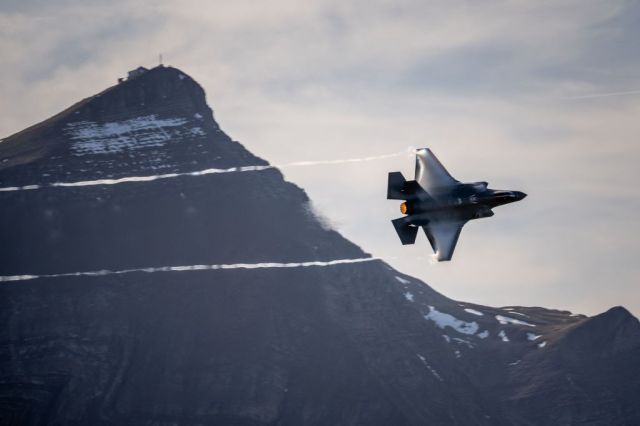
The F-35A is a staple of Western militaries — but it is expensive. (Fabrice Coffrini/AFP via Getty Images)





If the Iran war, as President Trump promises, is soon to be over, the inquests will begin even before a treaty is signed. Was the US right to take up arms? Who, if anyone, was the winner? And what does this asymmetric conflict, with costly American hardware failing to prevent Iranian missiles from menacing a geopolitical chokepoint, tell us about warfighting to come?
An instructive moment came on April 3, when Iranian defense forces managed to shoot down an American F15E fighter over the Zagros Mountains, deep inside Iran. There followed an anxious couple of days as the Islamic Revolutionary Guards Corps and American combat search-and-rescue personnel raced to locate the two surviving aviators. The pilot was picked up within seven hours. The injured weapons-system officer, meanwhile, hid out in the mountains with little more than a pistol for protection. After what one senior military official described as “one of the most challenging and complex in the history of US special operations”, involving four bombers, 64 fighters, 48 refueling tankers, 13 rescue aircraft and hundreds of ground personnel, the stricken officer was eventually picked up by a couple of second-hand Airbus propeller planes, executing a low-tech Plan B. The raiding force had got stuck on a soft runway.
President Trump could claim “WE GOT HIM!” — but like the war itself, the rescue came at an extraordinary cost. Numerous expensively tricked-out special-ops airplanes and helicopters were destroyed in the process, and America seriously hindered its own ability to make any such rescues in future. The escapade compounded what had already been an expensive few weeks for the US Air Force. Days earlier, the service had suffered its heaviest loss since the Vietnam War, when cheap plastic unmanned airplanes powered by commercial electronics raided Price Sultan Air Base in Saudi Arabia, damaging a number of KC-135 tanker planes and blowing a E-3G Sentry airborne radar plane in half. Another lesson from Iran is that the best fighters can be ambushed: hit by infrared-homing missiles at close range, launched from 4×4 vehicles that can quickly blend into civilian traffic.
Taken together, these incidents appear to confirm a narrative about 21st-century warfare that has built throughout the Russia-Ukraine war and is now taken as read by many armchair generals. The days of expensive, high-tech machinery like the F-15E (estimated cost: $100 million apiece) are numbered. The future belongs to unmanned aerial vehicles — or drones, as no one in the military likes to call them.
The death of the fighter jet is not a new prediction. After another US pilot, Scott O’Grady, was recovered after his F-16C came down over a Bosnian mountainside in 1995, advocates for a new class of armed, unmanned air vehicles, or UAVs, quickly found a new slogan: “UAVs don’t have mothers.” It looks as if we’re going to have that discussion again.
Fighters are not only painfully expensive to buy; they cost tens of thousands of dollars per hour to fly and the air-to-air missiles that they carry cost $1 million to $2 million each. We must also consider the amount of time it takes the US Air Force to train people to use these machines: two years for a frontline pilot, five more years to raise them to a formation leader, and a decade or more to “command pilot”. Salaries and benefits have to compete with a healthy airline industry. Major live warfare exercises are not only expensive, but increasingly limited in scope. Air combat is reliant on electronic networks — but this makes it easy for an adversary to eavesdrop, making realistic live training even harder. These are painful costs. Designing and developing a new fighter, however, is more than painful. The US and many of its allies have bet the house on the Lockheed Martin F-35, a project that celebrates its 30th anniversary this November. However, troubles with new computers and software mean that F-35s delivered since September 2023 are still not combat-ready. Research and development for the fighter’s new electronics upgrade was most recently estimated at $16.5 billion — well more than half of the R&D tab for the all-new B-21 bomber, which learned lessons from the F-35 and other programs and has, by all accounts, been far better managed
And because fighters take decades to develop, the adversary will adapt and the world will change. The Eurofighter Typhoon was designed in the Cold War for supersonic missile jousts against Soviet fighters. It’s still being developed and modified, mostly to make it a better bomber — because until recently there was no high-end air threat. Britain, Italy, and Japan are meanwhile getting started on the Edgewing, a new stealth-fighter project under the Global Combat Aircraft Program, or GCAP. One of the challenges: none of the companies involved has started a new fighter project since the early 1990s, so most of the people who did it are long retired.
So it’s no wonder military planners and budgeteers are thinking about motherless unmanned aircraft again. Leading the charge in the United States are tech bros like the Hawaiian-shirt-wearing Palmer Luckey, founder of defense startup Anduril. Luckey talks about using Silicon Valley culture to build lethal new weapons “without bankrupting the United States in the process.” He promises to be able to move from the design stage to the front line in weeks, not decades.
But before you ask whether drones can replace fighters, you might want to ask what a drone is. The question is complicated by the fact that air-force people, by and large, hate the word “drone” — which actually applies to three very different things.
The first type of drone is a first-person video (FPV) drone, which borrows consumer technology to create a high-tech equivalent of an infantry mortar. Cheap enough to be used against individual soldiers, precise, lethal, but limited to the range of the control link and their batteries.
Then there are one-way attack (OWA) drones like Iran’s Shahed — which is not really a drone but a cheap cruise missile. Their airframes are molded plastic shells, and their petrol engines are little more sophisticated than a lawn-tractor motor — but what they do have is precise guidance. Israeli missile-defense pioneer Uzi Rubin said in the 2010s: “If you have an iPad, you have the parts for a guidance system.” Missile designers can get around local jamming of satellite navigation, since everyone can access terrain pictures of the entire world. OWA drones use these and cameras to find their targets.
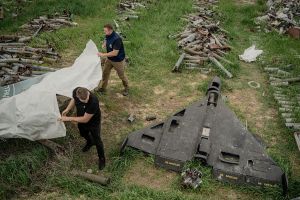
The third class of drones, under active development in America, France, Sweden, and elsewhere, are much larger. They resemble small jet fighters, fly at more than 600 miles per hour, and carry the same weapons as today’s manned combat aircraft.
The three classes pose different threats to the fighter. In June 2025, over a hundred FPV drones were smuggled deep into Russia in ingeniously modified trucks, whereupon they emerged to destroy at least ten aircraft in five locations. Still, repeat successes seem unlikely now that the element of surprise has ceded.
Shahed-type OWA missiles are a threat to fighters because they can do much of their job cheaply and without putting pilots at risk. While there is a running argument over the unit cost of the Shahed and its Russian variants, most estimates suggest that it’s in the tens of thousands of dollars — in other words, about the cost of flying a fighter for an hour. These missiles are not stealthy, but their size makes them difficult to shoot down, and because they are cheap and programmable, dozens of them can “swarm” on a target, striking simultaneously from different directions. They also have a long enough range to reach air bases well behind the lines, so they can directly threaten fighter aircraft on the ground. And if you launch fighters to intercept them, you’re on the wrong side of a “cost-imposition” problem — it costs you more to shoot one of these things down than your adversary paid to launch it.
The “small jet fighter” class of drone has meanwhile been pitched as more of a like-for-like replacement for manned fighters, matching them in range and speed, other than short high-speed sprints. In theory, they should be cheaper over the long-term, too, because a fighter airplane spends most of its flying hours training pilots.
However, military aviators have diligently sought to keep them in their place: they have doubts as to whether they are ready, and fear that budget-cutters will push them prematurely to the front. The US Air Force has named them Collaborative Combat Aircraft (CCAs) to make it clear who’s the boss. Other anodyne names include “remote carriers” or “autonomous collaborative platforms”. The prototypes being tested in the US are about one-fifth the size of an F-35. But that’s an awkward compromise. They’re big enough to need runways, bases, and shelters — but too small to deploy over long distances, except a few at a time in the Air Force’s overburdened cargo fleet.
So right now, the momentum is with the second class of drone — the “cheap cruise missile” group. Dozens of companies are springing up. Some are producing Shahed look-alikes. Others (such as the Netherlands’ Destinus, produced in collaboration with the German arms giant Rheinmetall) are developing their own jam-resistant navigation systems, molding their own airframe parts, and designing their own jet engines.
These weapons will undergo less rigorous testing than precision cruise missiles from established companies (like the American Tomahawk or the Anglo-French Storm Shadow) and will be built to commercial (i.e. less-than-military) standards. That might mean more failures — but at much less than a tenth of the cost. What makes them work is cheap, generic computing. They can navigate when GPS is jammed and identify their targets and pick aimpoints with simple daylight or infrared cameras — inverting the way their costly predecessors were made.
So, game over for fighters? Not so. The fighter is going to do what it’s done repeatedly over its 110-year history: adapt. Fighters from 1915 to the 1940s were pretty simple: one pilot, engine in front, fixed machine guns. Bigger and more complex aircraft emerged in WW2, some with radar and some, like the legendary Mosquito, big enough to carry bombs. The late 1950s brought supersonic speed and guided missiles, and the guns disappeared until Vietnam experience showed that both guns and maneuverability were still needed, resulting in the specs for today’s F-16 and F-15.
So fighters are versatile. The only target that has never been assigned to a fighter is a submarine. Teamed with a tanker and/or a cargo aircraft — itself a modified airliner, not exotic or expensive — the fighter can strike targets more than 1,000 miles away from its base, or deploy itself around the world while a warship is still pulling out of port.
Cheap cruise missiles, meanwhile, are not alternatives to the fighter but, rather, complements to the fighter’s flexibility and reach. Fighters have carried precision cruise missiles since the early 2000s.
As for the specter of large, reusable pilotless fighters, we should be skeptical of the US Air Force’s preference to keep them small and cheap and instead consider where Sweden seems to be headed. (Despite not fighting a war since 1814, Sweden has done an amazing job of keeping up with, and sometimes surpassing, much richer nations in combat air technology.) Saab’s advanced-projects team, dubbed Rainforest, is leaning toward a fighter-sized unmanned vehicle. Sweden is also the acknowledged leader in linking fighters into a network. A group of four Gripen fighters operate as a real-time network, compiling signals from four sets of electronic and infrared sensors, and from airborne radar surveillance aircraft, into common high-fidelity target tracks.
Consider how this might work: if an unmanned aircraft has half the lifetime cost of a Gripen (a reasonable goal), six aircraft could fly in formation, two with crew and four unmanned, with similar sensors, software and weapons, for equal cost. The formation spreads over tens of miles of sky. The uncrewed aircraft may be out in front at low altitude, not transmitting on their active radars, but prepared to launch weapons with a flight time in seconds. Last summer, Saab demonstrated an AI system to execute an air-to-air missile attack, calculating the attack path, missile launch and evasion; the same technology could support command pilots in a mixed manned and unmanned formation.
Having a crewed aircraft in the mix helps to deal with an ethical dilemma: autonomy. The idea of a weapon that searches for targets and uses its own computers to decide who lives and dies still makes people squeamish. I have engaged in simulations where a group of unmanned vehicles was operating with almost complete autonomy, detecting and identifying targets and assigning different tasks to different aircraft. Nevertheless, a high-resolution radar image of the target was transmitted to the human mission controllers so they could authorize the attack. In military parlance, this is known as having a human “on the loop” rather than “in the loop” — but it hinges on the assumption that data can reliably reach the human controller, in the face of jamming.
There is one way to make communications virtually impossible to jam, however: keep them to line-of-sight between two points. That’s where the manned fighter may remain indispensable: operating within a cloud of unmanned adjuncts and missiles that simultaneously provides physical defense and attack, as well as creating, in military parlance, a robust line-of-sight network.
So that next-generation fighter might look very different from today’s aircraft, but the fighter has changed shape many times since the First World War. And that’s why it doesn’t surprise me, and rather encourages me, that the aircraft at the center of the new British-Italian-Japanese Edgewing project looks the way it does.
It’s a big beast, with a broad delta wing that recalls Britain’s famous Vulcan, a 100-ton atom bomber, more than a turn-and-burn fighter. It will hold what is technically known as a metric bleepton of fuel. It’s designed to be stealthy, but it’s going to be more than that — the modified Boeing 757 that’s being used to test its electronics is festooned with big antennas that won’t fit on a small unmanned aircraft, for detection, jamming and even generating beams powerful enough to reset the adversary’s electronics. The engines, for the first time in any aircraft, are being designed from the outset not just to provide thrust for flight, but power and cooling for electronics.
So GCAP is a fighter in the conventional sense — but it’s also a carrier for autonomous weapons, a command node, and a data center. A good time to remember that the most influential and versatile combat aircraft of WW2, the de Havilland Mosquito, was three times the size of a Spitfire and went after battleships.
There is a bigger picture, too. Those battleships took the lion’s share of defense spending up to the Second World War — but only one battleship put on contract after 1940 was ever completed, as an era of military technology based on steel and steam gave way to an age of jet engines, missiles, nuclear weapons, and electronics. That was also a time when defense technology led all other developments and gave us mass air travel, satellites and computers.
We’re now in a time where commercial tech is in the lead, and wars are fought with information as well as explosive weapons. If aircraft like the Edgewing jet are going to replace the thousands of fighters in the world, they will be forced to evolve: and reluctance to accept change will not stop it happening. The Iran war will result in the demise of neither the IRGC, nor the jet fighter, nor the unceasing development of warfare.