








May 15 2026 - 6:00pm
A new Pentagon assessment suggests that China has benefited from the Iran war to America’s detriment. As the Washington Post reports, the US military analysis suggests that Beijing is exploiting the global economic disruption caused by the conflict to cast itself as a more reliable partner than Washington.
This development was entirely foreseeable. Some on the Right argue that the war with Iran has weakened China by disrupting Beijing’s oil imports. To an extent, that is true. But that captures only a fraction of the broader strategic picture. Proponents of Trump’s war overlook the degree to which the Chinese economy has insulated itself from precisely this kind of shock — through vast strategic reserves, diversified energy supply chains, and long-term contingency planning. More importantly, they ignore how the conflict has allowed Beijing to present itself as the steadier global power.
They also ignore the impact that the war has had on America’s standing and influence. Most notably, these voices are loath to even mention the war’s entirely predictable drain on the US Navy and Air Force, and especially its evisceration of key US munition stocks. Those concerns are absolutely critical toward America’s ability to constrain future Chinese aggression.
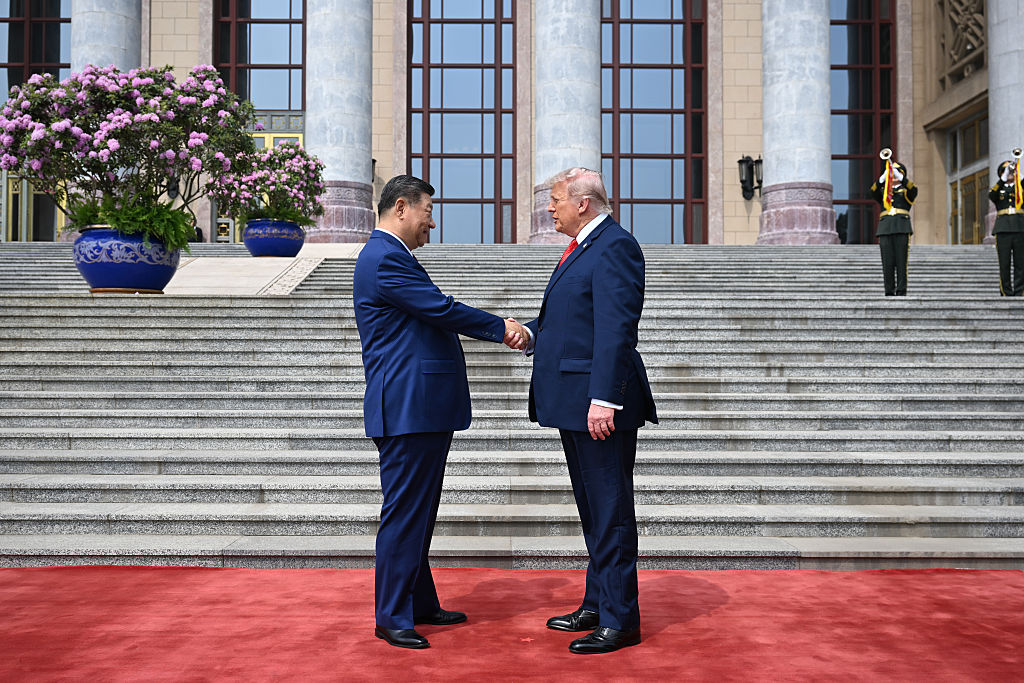
Thanks to the war, critical munitions — especially ballistic missile interceptors — are now in exceptionally short supply. That shortage threatens America’s ability to defend key bases on Guam and Okinawa in the event of a Chinese move against Taiwan, a contingency that Xi Jinping has reportedly ordered the PLA to be prepared for by the end of the decade. For Xi, the conquest of Taiwan is not merely a geopolitical objective but a defining test of both his own legacy and the CCP’s place in the 21st century. Beijing underscored that priority by pairing the warm pageantry surrounding Trump’s state visit with a pointed warning that continued disputes over Taiwan could lead to “conflict”.
Regardless, deterring — and, if necessary, defeating — a Chinese assault on Taiwan is vastly more important to American strategic interests than destroying Iranian missile factories. Yet the war has severely depleted the very munitions needed for such a conflict. Even under the most optimistic replenishment timelines, US stockpiles are not expected to recover to even minimally sufficient levels until at least 2029.
The war has also strengthened China’s global appeal, even with close US partners. The absence of regime change in Iran, the failure of the US-Israeli military campaign to achieve definitive success via a 90%+ destruction of Iranian missile and drone stocks, and the continuing closure of the Strait of Hormuz energy chokepoint all reinforce these sentiments.
Put simply, while Xi may be viewed internationally as an unpleasant but broadly rational and predictable actor, Trump has come to resemble a leader willing to launch a major war with only a vague sense of its strategic objectives. This was not an intelligence failure on the part of the US military or intelligence community. It was a political failure: the President appears to have convinced himself that war with Iran would be another swift, low-cost operation akin to the capture of Nicolás Maduro, rather than the opening phase of a destabilizing regional conflict.
There is hope for the US, however. Ultimately, China’s maximalist global agenda is its own worst enemy. Whether through the ecological devastation caused by its vast distant-water fishing fleets, the economic espionage and political interference campaigns it conducts abroad, its trade-dumping practices designed to prop up an increasingly fragile domestic economy, its disregard for international law, or its increasingly aggressive water-cannon and ramming attacks in the South China Sea, Beijing repeatedly exposes the hollowness of its “win-win” rhetoric.
Once the war in Iran is over, the Trump administration can thus attempt to rebuild American standing by offering greater predictability and support against the excesses of Chinese aggression. That action will remind the world that even if the US is imperfect, an American-led international order is significantly preferable to the capricious if disciplined order Xi aims to impose.
The big open question, then, is not whether America can right the ship. Rather, it is whether Trump can find the humility to learn from his mistakes and recognize that foreign policy demands more than the wheeler-dealer attitude of a real estate mogul. If he can, China’s benefit from this war will be limited to the short term.

Join the discussion
Join like minded readers that support our journalism by becoming a paid subscriber
To join the discussion in the comments, become a paid subscriber.
Join like minded readers that support our journalism, read unlimited articles and enjoy other subscriber-only benefits.
Subscribe