




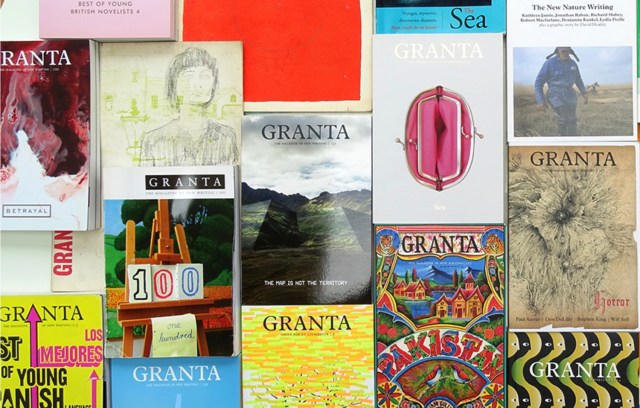
Prize-winning stories published by Granta have come under scrutiny. Credit: Granta





Jamir Nazir, Sharon Aruparayil, John Edward DeMicoli, and Holly Ann Miller are all heroes. Don’t misunderstand me too quickly.
On May 15, the Commonwealth Foundation awarded prizes to five emerging writers — four of whom (named above) have so little by way of an online or print papertrail, someone hip to artificial intelligence might wonder if they even exist. Commonwealth has a partnership with the prestigious literary magazine Granta, based in Britain, which promptly published the stories on its website. Just as promptly, a college professor at Wharton, Ethan Mollick, suspected machine prose. Mollick ran one of the incoherently metaphored stories — “The Serpent in the Grove,” by Trinidadian author Jamir Nazir — through an AI-detection software and found that it was a 100% match for AI-generated text.
Granta’s presumably human staff, the magazine says in a statement provided to UnHerd, did not read the stories beyond a copyedit. Though accusations have so far fallen on the shoulders of the unfortunate Nazir, my investigation into the similar schlock of three other finalists and their odd online histories raises discomfiting questions, as well.
For two of the finalists, DeMicoli and Miller, this contest marked practically their first hint of an internet footprint. Of course, as the traceless 20-year-old would-be Trump assassin Thomas Matthew Crooks proved two years ago, young people are abandoning the internet in droves. And we can all agree it’s likely that social media are on their way out. Besides, the Commonwealth Short Story Prize discovers emerging writers, and is it not brave to choose writers so emergent that there is hardly any evidence they exist, such as previous fiction available to Google, or social-media presences before 2025? No, so far this all marks a healthy, understandable civilizational development. But there are other reasons for concern.
How about that two of the pieces were graded 100% AI-generated on AI-detection software Pangram, and a third was graded 92% AI-generated? Is it possible that Commonwealth has spent nearly a week praising the literary value of AI slop, while Granta threw its brand behind the same?
Commonwealth’s website leaves no room for doubt: these finalists were chosen from nearly 8,000 painstakingly sorted entries. The judging process was “robust,” the organization wrote in a statement provided to UnHerd: “Each story is assessed through a thorough process which involves multiple rounds of readers before progressing to the final judging panel. We select our judges for their expertise, passion for the literary community and strong backgrounds in writing.”
Round after round of scrupulous literary appraisal narrowed down to a select few writers of staggering talent. “Here are five writers who share an immense confidence of tone, announcing themselves from the very first line,” says jury chairwoman Louise Doughty, a novelist whose forthcoming memoir, On This Spot Fell One Tear of Love, bears the sort of title that hints at the faux-profound style the jury was keen to sniff out across the globe.
“The style and content of each work may vary,” her statement goes on, “but what all our winning authors have in common is an ability to take their readers by the hand and lead them into a world where the characters are utterly believable, the prose assured, and the author has something important to say.” In other words, according to Doughty, the finalists are all doughty. Among these doughty and diverse voices are “a young woman whose henna art enables silenced women to speak, and a resourceful young sheep farmer.” Bahhh, get me to that sheep farm!
Doughty did not return UnHerd’s request for comment.
Contrary to her claims of utter believability, many non-professional readers found the assurance that these stories were written by humans utterly and immediately unbelievable. It was not a gambol through the sheepfolds that kicked off accusations about AI, but scenes in a room where the air “clung thick as porridge skin. […] No fan, no bulb, no hum — only the thin light slipping between warped boards and the breath of hills holding their heat like a secret.”
That’s a passage from Nazir’s “The Serpent in the Grove,” and it has the unmistakable cadence of AI slop: not W, not X, not Y — but, poignantly, Z. Anyone who has ever read a news tweet by Mario Nawfal knows this style instantly. If you want to understand why Caribbean Region Commonwealth judge Sharma Taylor calls this writing “sublime — precise yet richly evocative — conjuring vivid, lush imagery with remarkable economy,” let’s tip the scale with a further sampling of Nazir’s prose. “They called her Zoongie. Maybe it was a name; maybe rain took a shape and decided to keep it.” Ah yes, a quandary I can relate to: am I really Vincenzo, or did rain take a shape and decide to keep it? This is one of those Ocean Vuong-styled metaphors that sound like they mean something. Here’s another: “She had the kind of walking that made benches become men.” Now that, ladies and gentlemen, is a metaphor so incomprehensible you know it’s profound.
According to the prize-winners’ page, Nazir hopes readers walk away from his tale “reflecting on the quiet consequences of choices we normalize.” A sentence that also means something, I think. Next to what many speculated was an AI-generated photo in his bio on Granta’s website, we learn that Nazir is a “prolific poet … particularly known for his love of poetry.” However, he’s taken an eight-year hiatus between publications, in which time he’s written pro-AI posts on Facebook, as well as LinkedIn. His last and only other literary footprint is a 2018 self-published collection of love poems, Night Moon Love. Of the eight enthusiastic reviews this book has received on Amazon, four reviewers had never reviewed another product, and the ones who had left reviews usually did so for items such as a junk game or cheap sneakers.
Nazir did not return UnHerd’s request for comment, sent through Facebook.
As for the other winners, Aruparayil has an Instagram account that was launched five weeks ago and a LinkedIn profile that had its first human interaction in 2025 and asks in its bio, beginning in lowercase, “what happens when a psychologist learns to zoom out, studies international relations, and adopts a fascination with startup ecosystems, public health, and venture capital?” Literary gold, apparently.
Aruparayil’s LinkedIn profile may, of course, be real. The sentences in the profile frequently begin in lower case, yet her winning story, “Mehendi Nights,” was written in English (and not translated from a foreign language), and is flawlessly grammatical, nonsensically slop-ridden, and riddled with semicolons — another hallmark of machine prose. Like Nazir and DeMicoli’s stories, which are based on the personification of cities and landmarks (“the limestone remembers” and all that tripe), Aruparayil’s fictional city is one where “even the shadows seemed tired,” and the city itself “had a way of setting things ablaze when it could not understand.” The kind of writing one finds in self-published Romantasy smut on Amazon.
Nonetheless, Aruparayil’s online presence is the most robust of the four prize winners. She was a finalist for two literary prizes for Indian citizens in 2025 (the Deodar Prize and the Toto Awards; her name is on both of these organizations’ websites), and her bio on the Granta website notes that she was nominated for a prestigious PEN/Dau Prize for Emerging Writers and a Pushcart Prize. These last honors, however, may be misleading. Any publication can nominate a writer for a Pushcart Prize or a PEN/Dau Prize. Neither organization announces short lists or long lists, so the real honor is in winning the award, and the nomination in itself is nearly meaningless. Bill Henderson, the founder of the Pushcart Prize, told UnHerd that the organization does not keep records of the “thousands” of nominations it receives each year.
John Edward DeMicoli is the winner from Malta. His bio on the Granta site says that he has published “essays on Maltese culture and heritage” that have appeared in print and online publications. These publications are not named, and no other writing of his comes up in an internet search, either in English or the Maltese language. The bio also mentions a forthcoming novel to be published by Maltese small press Midsea Books, which did not return a request for comment by press time. Holly Ann Miller, on the other hand, has a private Instagram account, and only has one publicly accessible comment on an obscure photographer’s page, rubykawitiphotography. The rest of the comments on the photographer’s photos are generic-seeming comments from other private Instagram pages. Miller, for what it’s worth, was also apparently a runner-up for the 2025 NYC Midnight Short Story Competition and the AAASL Short Story Competition.
In an e-mail to UnHerd, a spokesperson for the Commonwealth Foundation said that it had “confirmed that the writers do indeed exist! They are real people. The Foundation has had discussions with each author.”
Again, this may be so. In a sense, it doesn’t matter if they’re real or not. Let us not repine, but instead laud Nazir, Aruparayil, DeMicoli, and Miller. Recall that I began by calling these personages heroes. Let me amend that a little. What’s possibly happened here is that someone has pulled off a brilliant hoax on the literary establishment — and that person is a hero. He or she has shown the arbiters of taste in the publishing-industrial complex to be frauds, and out of touch with the average reader, who is still able to tell the difference between slop and organic human voice, and who sides with the human, too. Hopefully, it is dawning just about now on the judges of Commonwealth that they can’t tell real writing from AI not because AI is so good at writing, but because they themselves are talentless hacks and slop addicts.
But mark my words, besides hand-washing and under-the-bus-throwing — the second sentence of Granta’s prepared news release is “Granta editors have no control over the selection of the Commonwealth Prize stories, and nor are they involved in choosing the jury” — we are going to start seeing a lot of pieces about how this scandal proves not that the literary gatekeepers are mindless cogs in the publishing-industrial complex, but that AI is so scarily good, it will soon replace all creative jobs anyways. After all, many professional writers have been striding to center stage as of late to declare themselves proud queryers of robots, such as the Washington Post columnist Megan McArdle, who has shared that she she uses AI to “generate pushback on my column thesis, suggest trims when I’m over my word count, sharpen podcast interview questions.” Nobel Prize winner Olga Togarczuk recently admitted to using AI in her writing. Just imagine, how much better would Shakespeare have been if he had had a robot to turn to in creative crises?
What we actually have here is the final cloaca from the merging of two rivulets of spume and drool: the eradication of human literary voice via the publishing-industrial complex, and the three-decade-long imposition of the algorithmic voice of tech conglomerates on human writing and sensibility. In the early aughts, Google co-opted the main profit-stream of publishing: ad revenue. It became much cheaper for companies to advertise on Google search-result pages than in newspapers and magazines. Thus, with ad revenue slashed, such outlets had to start ranking high on Google through a practice called search-engine optimization to stay afloat and be read.

The writer was not hooking a reader anymore with an anecdotal lede, but hooking Google’s algorithm, which prioritizes algorithmic styles of writing, styles of writing that a computer can understand and parse. We have been reading and writing in this medium for three decades, watching the birth of the one-sentence opening paragraph — a contradiction in terms — in journalism, and the extinction of voice and style across all genres. AI writing itself has been trained predominantly on this dumbed-down anti-style, which is why it strains so comically hard for metaphor. In the 1960s, when the inevitability of this future became clear to cultural commentators, the philosopher Marshall McLuhan observed that technology itself had become a medium of perception. After three decades of surveillance capitalism we can conclude that we have entered an environment in which the concept of the “audience” as we know it is no longer made up of humans, but of technology itself.
The only reason AI has a chance of replacing mainstream writing (and hoodwinking “professionals”) is because for the last 30 years, algorithmic rules of writing have devolved the style and quality of most mainstream prose so as to be near indistinguishable from computer-generated writing. It has lowered us to such a point that the gap between man and machine is no longer so far to leap. Thus, in the “post-colonial” endeavor to pick diverse voices, the Commonwealth judges may have picked fabrications of the most malignant, surveillance capitalistic technology the West has ever conceived of. The medium is the message, and in this sense, the judges may have picked the only thing they can understand: the industrial rules of surveillance capitalism. Their cage.
And if all of these finalists are real, and their work is their own, their writing operates by the same rules, and is still trash. Of the five finalists — one of whom is the verifiably real Lisa-Anne Julien, who has been published since 2021 and appears animated and otherwise alert and not-computer-generated in videos — the overall winner will be announced on June 30. For my money, I like Nazir’s work the best.
 BarneysRubble0