




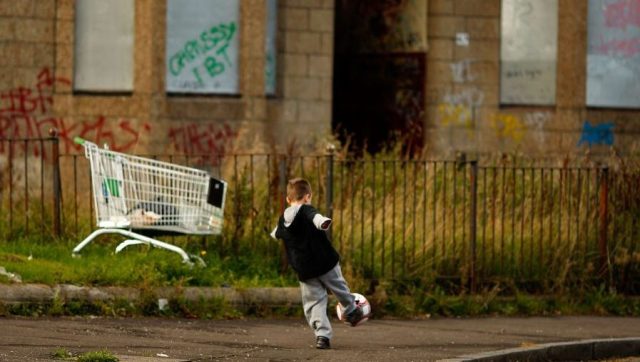
The care sector is broken. (Jeff J Mitchell/Getty Images)





It is hard to think of a more grotesque example of state failure. A 15-year-old girl is taken into protective care to escape sexual exploitation in south Wales. The local authority sends her off to a children’s home 260 miles away in Yorkshire. Then she is moved to a three-bedroom property 50 miles further north near Durham, where she is the only resident. One day, two “carers” tell their boss they are taking the girl for a river walk. Instead, they go to the pub and ply her with wine, cocktails and shots. Then they buy and load up on cocaine — making her take so much that her nose starts bleeding — before sexually abusing her for hours. Afterwards, the rapists clean up the blood and evidence of their depravity.
Their crime was only discovered after the distraught child ran away the following day and was picked up by police. It took her weeks to recover from the physical attacks, while her parents say the mental agonies led to a suicide attempt. Last year, the two employees who abducted her — Liam Ramsey and Stephen Hurst, both in their forties — were found guilty of offenses including sexual activity with a child, intentional strangulation and supply of a class A drug. They were jailed for 11 and nine years respectively. “I was in care to be looked after, taken care of and protected from harm,” the teenager said in a victim’s statement. “These men have done the exact opposite to that. They have sexually abused me for hours and have caused me so much pain and destruction.”
Her words were echoed by the police officer leading the investigation, reiterating how the people who should have been keeping this girl safe were instead “the ones who groomed her, sexually assaulted and abused her”. It has now emerged that those children’s homes were illegal — the girl had been sent there under a loophole that means so-called holiday placements for vulnerable children do not have to be registered with Ofsted if they last no longer than 28 days. Even worse, both men entrusted to look after this at-risk teenager in an unregistered home had criminal convictions, including for violence. Ramsey had been employed despite a previous incident of neglect when he failed to get medical help for a child who suffered a head injury at another unregulated home.
The full details of this sordid saga were published last month by Tom Wall, a journalist with the Bureau of Investigative Journalism. Given the disturbing nature of the case — with such overt and systemic safeguarding failures — his investigation should have sparked a national furor. But given the shocking lack of concern for kids growing up in society’s underbelly and the shameful decay of social care under both Labour and Tory governments, the disturbing revelations caused barely a ripple in the media.
We should be appalled that local authorities are dumping vulnerable children in these unregistered homes, often for months at a time and at a cost to taxpayers of thousands of pounds per week. It is a criminal offense to run an unregistered home. Yet this unfortunate teenager was placed in one such home run by a firm called MAP Adventures, set up by a former army sergeant and claiming to offer “crisis intervention” and “adventure therapy” for children in Britain, Cyprus, Oman and the United Arab Emirates. “Our team is highly qualified,” boasts its website, which is still seeking donations despite the firm having been shut down following exposure of abuse by its staff.
Yet many more children are still being sent into similar unregulated homes: 800 last year, according to a recent report by the Public Accounts Committee, despite the fact that such units provide “no assurance over the quality of care or that children are safe”. Children — often with the most complex and acute needs — have been sent to live in Airbnbs, caravans, holiday camps, hotels, houseboats. These are supposed to be short-term, sticking plaster solutions — better than leaving them in hospitals, police cells or risky family environments. But according to the report, the shortage of regulated homes means the average stay for these often-traumatized youngsters is six months.
Most councils do not even know how many illegal homes operate within their area. A new study by researchers at Anglia Ruskin University, based on interviews with police and frontline social workers, claims that one unregistered home was infiltrated by an organized crime group, which even had a member working as a counselor to feed information back to the gang. One interviewee said they had seen such unregulated properties used as “trap” houses for dealing drugs and stashing weapons, with so little control that “you’ve got people coming and going, children going missing for days”. The report concludes that such places create ideal conditions for exploitation “in which children become highly visible to perpetrators while remaining institutionally invisible to safeguarding systems until a critical incident occurs”.
So this scandalous case of an abused teenage girl serves to symbolize the betrayal of Britain’s most vulnerable by a state that has allowed our Cinderella social care system to steadily shrivel while financial sharks swoop in. It offers one more item in the mounting case against Westminster: another corrosive example of political failure. Note, though, how Wes Streeting did not bother to mention social care in his self-aggrandizing resignation letter as health and social care secretary, while making great play of his claimed health service achievements.
The issue was also sidelined, incredibly, in the recent local election campaigns, even as the surging costs of adult and children’s social care cripples councils, accounting for more than half their spending. Perhaps this is unsurprising given how Conservative and Green leaders have sneered at social workers, dismissing their crucial labors as simply wiping bottoms. Voters also place care low down their list of priorities for local officials — beneath potholes, litter, dentistry and the rise of the far-Right, according to the final YouGov survey ahead of this month’s ballot. Yet in every year since 2010, spending on children in care has grown faster than inflation.
England spends two-thirds more than a decade ago, even though the number of children looked after by the state has risen only 16%. Average annual spend per child was £318,400 in the year ending March 2024, although placements in complex cases can exceed £1 million a year.
A key reason for these soaring costs is the growing and uncontrolled use of private providers, which now run more than eight in 10 homes. While some are exemplary and many are regulated, others are owned by people with questionable experience — such as that former sergeant in the army’s physical training corps. Or Ampika Pickston, a reality TV star and girlfriend of porn baron David Sullivan, who owned a home in Altrincham ordered to close last year by a court on safety grounds. Many more are owned by private equity. These outfits use their usual fiscal trickery: loading up debt on firms while slashing costs and extracting cash behind opaque corporate structures with a mesh of cross-payments and routine use of offshore tax havens. These operators — run by billionaires and multi-millionaires — tend to pay front-line staff a pittance.
Eight of the 12 biggest childcare providers are owned by private equity. So when you hear complaints about the lack of local authority funding, bear in mind that CareTech, the biggest operator that began with a single adult home in Luton, paid one director a seven-figure salary and made £223.2 million gross profits according to its latest accounts. At least £1 in every £6 that it takes from councils ends up in the pockets of bankers and investors. Meanwhile, a damning Ofsted report published last month following an emergency inspection at one of its homes found “serious and widespread concerns” with children “at risk of accidental death”. A child with high risk of self-harm was left with a kitchen knife. Another was burned with hair straighteners, then took an overdose of 16 ibuprofen. Two managers and a staff member have been suspended.
Even the world’s richest family — the al-Nahyan dynasty that rules Abu Dhabi — has alighted on this crisis-ridden corner of our public services to boost its immense wealth, enjoying some of the sector’s biggest margins. Yet it is four years since the Competitions and Markets Authority warned that Britain had “sleepwalked” into a system where the biggest suppliers of children’s homes and foster care made excessive profits while many vulnerable children received dire care. A new analysis by Revolution Consulting exposes how the biggest operators are still creaming off 17.1% margins from taxpayers.
Even smaller players can milk such a badly-controlled system. Take a Stockport-based firm called Your Chapter. It used to be called Care 4 Children but changed its name in 2022 after inspectors found “serious and widespread” safeguarding issues that left young people in its care being exposed to bullying, drug use and sexual exploitation. According to its latest accounts, Your Chapter — boasting a “client base” of more than 100 local authorities — earned £22.95 million caring for 70 children at 22 residential centers in 2024. This enabled it to hand almost £13 million in dividends, interest payments, consulting fees, salaries and rents to three bosses: its founder, his wife and the former managing partner of a private equity firm.
Your Chapter says it invested £15 million of its own capital in properties and is proud to have delivered high-quality residential care, education and therapeutic services to more than 2,000 young people over the past decade. Yet such disclosures provoke fury in the childcare sector. “It is indefensible that companies operating children’s homes can make massive profits while the needs of so many children are going unmet,” said Anela Anwar, chief executive of Become, the charity for children in care and young care leavers. “This is local authority money meant to protect vulnerable children, not bankroll excessive profiteering. The system is being exploited and children being treated as a commodity. The Government must take urgent action.”
So what is the verdict of the children being sent into this expensive system? One 20-year-old man told me he was moved around 93 different placements during nine years in care, detailing some of the abuse and bullying that he suffered. Were any of them any good? “Probably two or three, maybe four or five at most,” he replied. “I don’t see anything good in the others.”
A 19-year-old from Hampshire, who entered the system aged 12, said she was sent to 24 different homes. At one unit she had her fingers broken deliberately by a care worker, who also stuffed a sanitary pad in her mouth after she ran away, while she claims to have seen a six-year-old child dragged down some stairs by his hair. “No-one ever wants to believe a kid over a carer,” she said ruefully. “The system is so messed up. You don’t know what normality is inside it. I didn’t have a decent teenage life, I didn’t make friends, I didn’t get to see my family for months on end, I didn’t even go out. You just stay in and watch television.”
This teenager ended up in prison on remand for four months after assaulting a carer. This is far from unusual: more than one in four people behind bars spent time in care as children. “It sounds really bad but prison is so much better,” she said. “At least I was getting food three times a day while the staff all wanted to talk to you and help you — it felt like luxury compared with some of the children’s homes.”
What a damning indictment of a system that is supposed to protect the most damaged and vulnerable children: life is deemed better inside prison than in a broken care sector. But perhaps more damning still is the fact that the rest of the country — including our politicians — simply does not seem to care.
Ian Birrell is an award-winning foreign reporter and columnist. He is also the founder, with Damon Albarn, of Africa Express.
 ianbirrell