




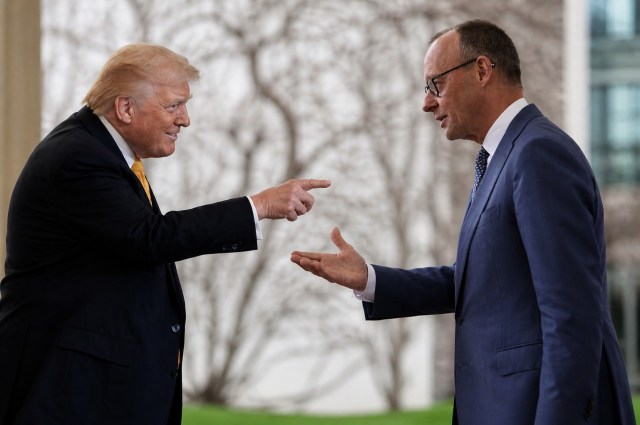
Friedrich Merz: the European Wormtongue. (ChatGPT, via Getty)





A year of toe-curling groveling has gone to waste. They called him daddy. They sat around his desk in the Oval Office and took notes. They followed his instructions to increase their defense spending to 5% of their economic output. They supported him on China even though this is not in their best economic interest. Ursula von der Leyen even traveled all the way to the Trump Turnberry Hotel in Scotland to agree to a trade deal he dictated — the worst trade deal the EU ever agreed to. Europe is over-regulated, over-taxed, and under-defended. What else can they do? Pick a fight with their lord protector? They chose to grovel to Donald Trump.
And yet, despite the EU’s best efforts, Trump still derides them, insults them, and threatens them. Most recently, he threatened to raise the tariff on European cars, from 15% to 25%. Most of them are German cars. He is disappointed with Keir Starmer and Giorgia Meloni. But he really hates the Germans. It seems personal.
I am not quite sure why this is the case. Maybe he hasn’t forgiven Angela Merkel for attempting to stand up to him during his first term. Maybe he’s trying to distance himself from his German ancestry. Or maybe it’s just Friedrich Merz. Merz is the Wormtongue of European politics. I wouldn’t trust him either.
After a year of Merz acting as the Trump appeaser-in-chief, the German chancellor suddenly turned on him last week. He said that Iran had humiliated the US, and that the US had entered the war without a strategy. On the substance, Merz was right, of course. I am always saying the same thing myself — along with virtually every other commentator. But Merz is also the head of government of western Europe’s largest country. He speaks for a large part of the EU and Nato too.
It’s hard to work out why he intervened as he did. My hunch is that Merz simply misjudged the situation, not for the first time. He made his comments during a visit to a class of school children in his idyllic Westphalian constituency, far away from the real world — somewhere he felt safe.
Unfortunately for Merz, though, Trump was listening and hit back immediately. It’s not Trump’s tweets I worry about. I have long ago stopped reading them. But what I do take seriously are Trump’s actions. The US Department of War, as it is now called, announced a reduction of troops in Germany by 5,000 — with Trump threatening still more.
What I also take seriously is his threat to impose a 25% tariff on European cars. The US Supreme Court ruled earlier this year that Trump’s “Liberation Day” tariffs lacked a sound legal basis. But this has been widely and foolishly misinterpreted in the EU: it does not mean he cannot impose the tariffs; he just has to find a different legal basis. And for the cars, he has one. Cars, as well as steel and aluminum, fall under Section 232 of the 1962 Trade Expansion Act — a provision of national security. If the US-EU trade deal breaks down, the 25% on cars will come into force automatically. In fact, for cars, the actual tariff would actually be 27.5% because of an extant and perfectly legal tariff. And given how badly the German car industry is doing right now — with Porsche’s profits already collapsing by 98% — a 27.5% car tariff would be a major disaster.
Merz was the political driving force behind that Turnberry trade deal last August: the one in which Ursula von der Leyen agreed that the EU would drop all its tariffs against the US, even as America promised a 15% on all goods from the EU – including cars. For the EU as a whole, this was a terrible deal. But it was the best deal the German car industry could have hoped for.
Trump has defended his latest tariff increase on the grounds that the EU did not stick to its side of the bargain. This is not quite true, but the European Parliament did score an own goal when it delayed the ratification of the Turnberry deal after the US Supreme Court ruling. That delay has given Trump the excuse he needed to claim that the EU failed to honor its promises. Similarly, when European leaders declared that Iran “is not our war”, Trump could claim “Nato wasn’t there for us”. Merz’s comment about Trump’s humiliation is even more stupid. Trump hit back that Merz should “spend more time ending the war in Russia/Ukraine”, and that he should focus his attention on his “broken country”. Trump is objectively right on all of these points. The Germans are not involved in any Russia/Ukraine peace-making efforts. And most Germans would agree that their country is broken. It is also an objective fact that Nato clearly wasn’t for Trump when he asked. This is after all “not our war”.
Here, then, is the folly of what we are supposed to call European diplomacy in all its absurdity. Europe keeps provoking the President — and yet still depends on his country. Europeans, despite the nonsense they talk about strategic autonomy, have persistently failed to take the steps needed for Europe to be safe without the help of the US. The most important stumbling block being the lack of agreement between France and Germany on the future of the European defense. France sees itself as the senior partner; the Germans don’t. Nor is there any leadership from Italy, Spain or Poland. Domestic policies are all they care about. And when something happens that exposes their lack of preparedness and fragility, they resort to blame-gaming. They blame Vladimir Putin. They blame Viktor Orbán. Now they blame Trump.
If Europe really was serious about decoupling from the US, it would leave the eurosceptics like Orbán on the sidelines, muster a coalition of the willing, and draw up a multi-annual plan as it did for the euro in the Nineties. In stage zero, you would map out the road ahead. In stage one, you would pool your military procurement. In stage two, you adopt majority voting in the foreign affairs council. And in stage three, you begin to merge your militaries and elect or appoint a European commander-in-chief. As things stand, Europe can’t even manage to limp to stage zero. Contrast this inept alliance with what is happening in America. While I agree that Trump went into Iran without a strategy, he does not suffer from a collection action problem. He can rely on a formidable military apparatus. The Europeans don’t have a joint strategy, nor do they have the capabilities.
There is absolutely no reason why Trump should care about European economic interests either. Economically, the European have the capacity to look after themselves. But they chose not to. And the war is going to hit Europe hard — the UK and Germany will suffer the worst effects with several decimal points knocked off economic growth. The car tariffs will be an additional hit on the German economy, costing it an estimated 0.3 points of growth. And neither the UK nor Germany is willing to undertake structural reforms to mitigate their disastrous economic situation.
The Europeans are in dangerous denial: struggling to admit their own powerlessness. And yet not so long ago, Europe was the center of the world’s political universe, the cradle of democracy and western culture. Today, though, the EU is the embarrassing uncle of western alliance, always there, drinking too much, talking too much, telling everybody what to do, and never, ever, buying a round.
Now Trump has called their bluff. No wonder they hate him.
