




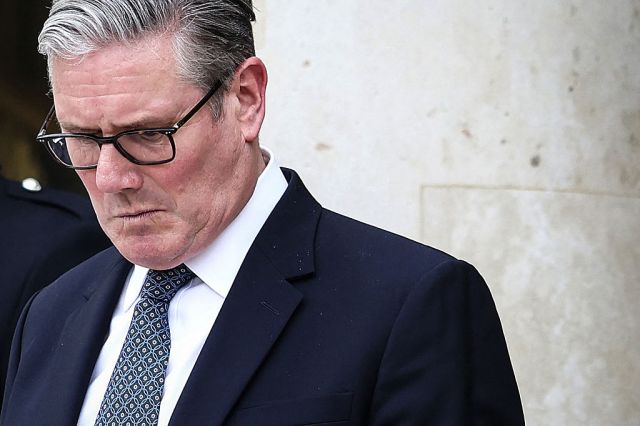
'The real, eventual reset will likely entail the end of everything Starmer sought to preserve.' (Tom Nicholson /Pool/AFP/Getty)





How many resets is that now? On Monday, fighting for his political life, Keir Starmer delivered as close as someone like him is ever likely to get to a heartfelt speech, pleading for his vision and the power of Labour to deliver it. In just over two years since he was elected, by my count this is the fifth. The fourth, itself plagued by mishaps and glitches, was less than six months ago.
But this time, we are to believe, is the real reset. The resetters’ reset. Perhaps, dare we say it, the Great Reset? Nope. For all his huffing and puffing about how the status quo needs to change, to deliver something called “strength through fairness” (er, what?) the effect was a very small reset: a profoundly conservative defense, in fact, of the status quo.
But that status quo ended in 2008. This is partly thanks to the tribalizing effect of the internet, which swiftly displaced “IRL” after the iPhone, and which has since fractured the managerial dream of universal culture into a million warring echo chambers. But more fundamentally still, it’s because Britain’s permacrisis began, as Starmer’s own speech acknowledged, with the 2008 financial crash. And the main takeaway from the Prime Minister’s latest Small Reset is how profoundly in denial he plainly still is, about how obsolete his project is in the ensuing politics of scarcity.
Having been trailed all over the press as offering a bold vision, departing radically from the incremental change Labour have attempted so far, Starmer’s Small Reset in fact began with whatever the opposite is of a big, positive pitch. Please stick with me, he pleaded; at least I’m not Reform or the Greens. He didn’t put it quite like this; rather, he warned about “very dangerous opponents” taking Britain down “a very dark path”.
By contrast, in the Starmerite path of light he set out against this ominous backdrop, we can discern Starmer’s positive vision, such as it is. His ideal Britain, the one he begs us to help him salvage from Reform and the Greens, is a “diverse” country characterized by “decency and respect”. It’s a nation broadly in continuity with the historic one, but with some friendly additional ethnic variety that makes our communities more colorful and our food more tasty, while the country as a whole stays cohesive and integrated.
The vision is familiar. It dominated in the latter half of the 20th century, and I think of it as “Floella Benjamin Britain”, in honour of the Trinidiadian-British actress and singer, and (now) Baroness Benjamin. She served as an early, upbeat role model of multiculturalism, ubiquitous on the children’s TV of my childhood, and as a defining exemplar of this postwar, post-imperial national vision. Starmer’s supposedly bold remedies for our ailing state, and the visceral hatred he now commands on every doorstep, reveal his core conviction that nothing divides the good people of Floella Benjamin Britain which can’t be solved by better administration, more funding, or more economic opportunity.
More “fairness”, more youth schemes, more EU, and more handouts to local governments. It’s all in keeping with a vision of the country that, today, survives principally in leafy suburbs and CBBC casting: one in which there are no truly irreconcilable differences, no wicked problems, no painful tradeoffs. Instead, we blend social democracy with progressive identity politics, to produce maximum fairness and opportunity across the board.
With minor aesthetic adjustments, variants of FBB also appear in Tory and Lib Dem circles too. I would love to live in the Britain to which it would be well-suited. Starmer has put great effort into realizing this country, a project I would appreciate more if I didn’t think it delusional under current conditions.
Before 2008, FBB was just about expansive enough a vision to offer space for multiple, sometimes contradictory, factions within the overall Left. These included the swivel-eyed far-Left, which got behind the identity politics; it also included what was left of the trade unions, now largely repurposed from representing the “old Left” industrial working class to advocating for public sector workers and generous welfare. But the crash ended that coalition.
The industrial working class were already mostly deindustrialized, and the far-Left was already at war with New Labour. Then, New Labour first encouraged the 2000s financial boom, and — when the crash came — bailed out the banks, at the taxpayer’s expense. The decision wrecked the public finances. It also rendered obsolete the social contract for which Tony Blair had only just finished re-engineering the constitution.
The Blairite pact between government and electorates was: let us open Britain up, and in exchange everyone will get richer. With the bankers’ bailout, that died. This single act by Gordon Brown may have, as some claimed, “saved the world”, but the sheer injustice of it, and the lack of accountability, has never fully been forgiven. In the aftermath of this outrage, the electorate has punished every politician who has dared try and govern.
This is partly unspent rage. It’s also partly because keeping even a semblance of that former settlement in place is, increasingly obviously, no longer about a rising tide that lifts all boats. Now, it’s a matter of choosing which groups should suffer in order for others to stay insulated. Who is paying, and who’s still drawing down? That, as they say, is politics: the allocation of resources according to a calculus of friend and enemy.
Starmer might call this framing “division”, just a bad emotion whose remedy is better procedure (or perhaps more censorship). But when people perceive that money is taken from their pay packets and handed to those who don’t work, or who just arrived on a dinghy, scolding them for responding with anger is not going to assuage them. Nor is the promise of a new youth training scheme.
Nor is trying to fix things within the terms of the existing system, as successive governments have sought to. That is, attempting to delay the inevitable via monetary and human quantitative easing, which is to say: simulating growth by printing money and inflating the population through immigration. But these are the only paths open at present. For the current constitution and economy have jammed the country open, in perpetuity, presumably in the belief that doing so would be to our benefit. It’s a bit like not bothering to fit a door on your house, because you think you’ve abolished seasons and no one will ever try and rob you.
Now, after 18 drafty years living in a house with no door, most have palpably experienced QE making them poorer. Meanwhile, the influx of human QE has chipped away at the sense of “imagined community” upon which the welfare contract was predicated in the first place. And far from behaving like inert economic units in a spreadsheet, the people flowing in via human QE programs have turned out, themselves, to be human. Surprise! People have preferences, loves, families, and political interests.
The result hasn’t, at least not uniformly, been everyone blending into a nice CBBC world that’s still the same Britain just with more takeout. The volume of new arrivals is now so great that in some areas there’s no established culture to integrate into at all: just infrastructure, and a transient, polyglot population. As time has gone on, this has begun self-sorting into enclaves, networks, and — increasingly — ethnocentric political groupings. Again, no surprise: when resources grow scarcer, politics gets more tribal. You can’t afford prizes for everyone any more, and want to focus on your nearest and dearest.
That was the driver of Brexit; that was ignored, and now it’s the driver of everything, including an alarming uptick in sectarianism, often internet-enabled. In turn, combining increased resource competition with rising ethnic Balkanization has severely undermined public faith in the imagined national polity that Starmer’s vision of “fairness” presupposes. How can you ask someone to accept their taxes being spent elsewhere in the country if TikTok videos have convinced them that others are getting more than they deserve? Or even that people in that area belong to a fundamentally different tribe, perhaps even one that is hostile to yours?
In response to this fraying solidarity, so far Starmer’s instinct has been to uphold the vision, and just clamp down on the videos. It’s not working. By contrast, Reform and the Greens both lean into the political fracturing Starmer is desperately trying to forestall. No wonder he views them, correctly, as “dangerous”: these parties aren’t just poaching Labour voters, they’re rewriting the rules of the game.
Where Starmer still dreams of a national, perhaps a universalist vision capable of encompassing everyone, and optimized managerially, both Reform and the Greens are far more frankly and unabashedly political: that is, advocating for their political tribes. The Greens’ tribe is that emulsion of students, Islamists, Third Worldists, and the far Left purged from Labour by Starmer himself. For Reform, it’s the long-ignored British working and lower-middle class, functionally abandoned by Labour circa Blair. Both these groups have assessed, correctly, that there’s no longer any point trying to coexist within a big-tent Labour Party: in the new post-crash politics of scarcity, the Omnicause Leftist and ethnic-majority working class tribes have mutually antagonistic political interests.
Is there a resolution? Almost surely, yes, but not within the Labour Party. The purported speech of Starmer’s life included nothing about asylum rules, or the welfare bill, or crime, or crumbling high streets, or tax, or anything really. It couldn’t, because that would mean implicitly picking a side, and thus admitting that what he calls “division” is actually a set of intractable contests whose resolution will produce winners and losers. In other words: politics.
In due course a political actor of some kind will resolve these seemingly intractable issues, and they’ll do so by making changes at the structural level. That is: we’ll eventually reconfigure the country’s political, legal, and economic constraints to align better with Britain as it is, rather than as CBBC wishes it was. But I doubt the person to achieve this will be the lawyerly, procedural, pathologically hands-off Starmer.
His best idea for saving his own skin seems to be restoring the pre-2016 status quo with more Europe. And, madder and more conservative still, appointing as his finance adviser Gordon Brown, the man who stared at the end of the world, in 2008 — then flinched, and gifted Britain the unreal interregnum we’ve inhabited ever since.
Will Farage be the one? Who knows. But eventually it will be somebody. Since the permacrisis began, a whole generation has reached adulthood with the door on Britain’s figurative house jammed open. These young adults have no memory of things ever having been good, and many are willing to take drastic steps in the hope of something better.
These young people also came of age during Covid, and have taken on board what lockdowns taught them about the real scope for authoritarian action. What will they do to Britain’s constitution? Perhaps they’ll fit a door. Perhaps they’ll knock down all the walls. Either way, whether Starmer lasts till next week or till Christmas, the real, eventual reset will likely entail the end of everything he sought to preserve.
