




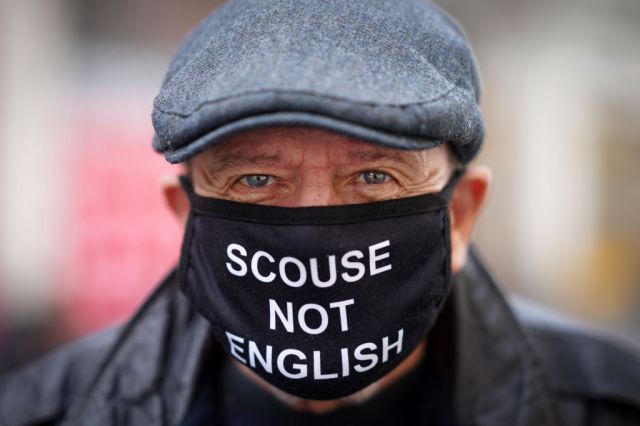
Scouse exceptionalism is a myth. (Christopher Furlong/Getty)





“The magic of Liverpool is that it isn’t England,” the leading Left-wing campaigner Margaret Simey said in the late Nineties. She was expressing a mood that had become pervasive in the city by that time. Liverpool has long seen itself as exceptional, set apart from the country proper: a bolshie, rebel city, so the legend goes, defined by its Labour politics, its working-class culture, its port and Celtic air. An only semi-ironic separatist ethos still shapes Scouse identity today. It’s the reason why crowds at Anfield stadium chant “Scouse not English” and “Fuck the Tories” (the Anglo party par excellence), while at Wembley Liverpudlian hordes boo when they hear “God Save the King”. The militant city, by its own mythology, bravely fought the “managed decline” of Margaret Thatcher while the rest of the industrial North swallowed her iatrogenic medicine whole.
As with any founding myth, a kernel of truth lies within the layers of hyperbole and self-aggrandizement. But it is hard to square Liverpool’s self-referential and pre-supposed Leftism with some of the results from this week’s local elections in neighboring boroughs within Liverpool City Region (the city of Liverpool proper doesn’t go to the polls until next May). In Halton, just a stone’s throw away from Liverpool John Lennon Airport and Halewood car factories that were once the sites of legendary strikes, Reform has just swept the board. To the north, Sefton council has swayed towards Nigel Farage’s barmy army, reducing Labour’s once-mammoth majority, with Reform taking five seats and missing out on many more by a whisker. Three years ago, this Merseyside enclave, the birthplace of Jamie Carragher, was home to 51 Labour councillors. Today, the streets that Carragher – a Labour donor – once played football in as a boy are represented by a Holocaust-denying Reform councillor. Then there’s Knowsley, which in 2023 experienced some of the first violent anti-migrant hotel riots in England. This week, the Labour seats that were up for grabs were decimated, with Independents and Reform benefiting from the Left’s collapse.
Liverpool, then, the quintessential “Red City”, currently stands within a soft, mushy doughnut of turquoise populism. Today’s results could well portend those of Liverpool City Council next May: Labour activists and councillors tell me that their once-solid wards in the north of the city are being dragged rightwards.
Merseyside’s political culture is clearly in a state of flux. And this is in no small part down to the emergence of a new, peculiarly Liverpudlian subculture: the Cosmic Scallies. “Scally” for their roots in Scouse working-class street culture, and “Cosmic” for their predilection for bizarre, New Age-coded, anti-systemic worldviews and lifestyles. These track-suited eccentrics don’t conform to the stereotype of the Leftist Scouser, backing Labour come what may. But they’re certainly not Tories either. Rather, the Cosmic Scallies are Liverpool’s own manifestation of the very online reactionary Right.
This is a broad church without a single, well-defined school of thought — a diffuse medley of influencers and their followers. But, generally speaking, the Cosmic Scally combines a devotion to deranged conspiracy theory, alternative medicine, gym culture, self-help, and men’s mental health discourse, with a side-helping of anti-migrant hostility and “common sense” anti-wokism. Some advocate for the use of psychedelics. Others swear by meditation. Still more are ex-addicts celebrating their sobriety on socials. And their rise, in the streets and online, is part of what’s driving a slow divorce between Liverpool and its Labour traditions.
The Cosmic Scallies were born out of the city’s distinctively proletarian customs. Think not of what tabloid Britain might have called the “chav” — an archetype that was rarely found in Liverpool — but of young(ish) lads in head-to-toe sportswear, Under Armour tracksuits and Nike Air Max trainers. In many cases, the short back-and-sides of yesteryear have been replaced by the “ketwig” — a huge mop of curly, unkempt locks, so-named because of many of its wearers’ enthusiasm for ketamine. Many of these Scouse denizens will be footsoldiers of the Cosmic Scally multiverse.
A typical Cosmic Scally is the lad in North Face with a joint behind his ear who insists on regaling you with muddled tales of Masonic control, chemtrails, corrupt police and the Great Replacement theory at a pub on North Liverpool’s Country Road. Or the taxi driver I met not long ago who turned down the TalkSport phone-in to tell me that the Labour Party was a thinly disguised front for paedophile elites intent on “importing the Third World”, before warning me not to “pump shit” into my body via vaccination.
Their dubious intellectual gurus can mostly be found on social media, where Cosmic Scally influencers push a bewildering range of insidious political messages. Rescuing children from unnamed malcontents is a common theme. After the Southport murders in 2024, it was a “Save Our Kids” protest promoted by the Cosmic Scally cyberspace network that descended into a riot that spread across the country. Other political themes include Stop the Boats, Islam, and migration.
One of the most well known of the bunch is the former Olympic boxer Anthony Fowler, who has built a solid fanbase of more than 200,000 followers selling CBD oil alongside Kerry Katona and Katie Price. He extols the benefits of staring at the sun to avoid sunburn and claims he cured his infant daughter’s cancer with his own CBD oil and an organic diet. Peppering his endless face-to-camera sales pitches are nods to stories of migrants attacking children: “Dont [sic] touch my little sister she’s 12,” he posted, after footage emerged of a Scottish girl brandishing knives, apparently to protect her sister from a migrant attack. “If her parents or legal team can be contacted I am happy to help cover any legal fees,” Fowler said. He implores followers to “Protects [sic] your children”. “If your daughters in the bathroom you see who’s in there [sic],” he once posted, alongside an AI image of a sturdy MAGA man blocking a trans activist from a toilet.
Then there’s the former crystal-meth addict, Muay Thai fighter and stuntman Billy Moore, who makes a tidy living documenting “raise the flag” street protests, talking to the residents of homeless encampments and making fun of the people on Liverpool’s Antifa demos. Last month, he posted footage of a man confronting him and calling him a “little Rightwing piece of filth, taking advantage of homeless left, right and center”. Moore said that his accuser was “a Leftwing bigot” who “voted the Green Party, loves LGBT stuff” and was “probably gay”. His videos regularly garner several hundred thousand views — the stuff of dreams for any beleaguered local Labour politician.
The unofficial King of the Cosmic Scallies is perhaps Sine Missione, an elusive, Banksy-style local graffiti artist. He played a central role in anti-lockdown protests, pushing QAnon, flat-Earth theories and “sacred geometry” psychedelia on his socials. He has since been overtaken by newer, self-styled gurus and accounts, and has deleted his socials. But his message lives on.
When the digital crosses into the real, it can take strange forms. In a Liverpool park, Cosmic Scally-coded “We Stand for Freedom” protests push every slogan and conspiracy under the sun: from “Stop the Boats” to dire warnings of man-made weather, mind-control techniques, and government planes spraying unknowing citizens from gray skies overhead.
The local poet and author PJ Smith (aka Roy) lamented the rise of the Cosmic Scallies in his hip-hop track, “Loss is not infinite”, listing, in doleful resignation, some of the core features of the subculture: “5G conspiracy scalls / Ayahuasca nuts in Mammut kecks… Meditation meatheads / Anti-vaccine stoners.”
Antonio Gramsci might have described these influencers as the “organic intellectuals” of the Cosmic Scally movement. Not intellectuals in the sense of their academic credentials, of course, but in their bottom-up articulation of a “new social type”, giving a “homogeneity”, a kind of collective consciousness and projected voice to the Cosmic Scally strata. Theirs is a diffuse and hybrid identity, combining the solidly plebeian traditions of the modern Scouser with an incredulity towards any-and-all established authority and an unusual blend of back-to-nature hippydom, individual self-empowerment and blood-and-soil nationalism.
The Cosmic Scally influencer is what Alan Finlayson, a Professor of Political & Social Theory at the University of East Anglia and researcher into the digital Right, calls “a new kind of ideological entrepreneur”. No longer constrained by the “old institutions” that once defined the city’s politics — political parties, newspapers, broadcasters, the Church, the trade unions, working men’s clubs — these online influencers act as “independent operators producing new ways of thinking about the world”, creating novel, unconventional political thought.
Social media, the great leveler, has been the driving force behind this. No longer do the gatekeepers of traditional broadcasting keep the Overton window narrow. Where once the realms of political debate were kept focused and respectable, today all sorts of ideas and symbols compete for likes and subscribers in the infinite nexus of “content”. The Cosmic Scallies are a product of the evolution from top-down, one-to-many media communications to a schizophrenic, many-to-many mesh of ideas, poses and products.
This isn’t a self-conscious political tribe: there is no coherent ideology, leader, or formal organization. There’s no Tommy Robinson-type at the top giving orders, nor are there ageing National Front or BNP hard men talking about white supremacy over warm beer in flat-roof pubs. Instead, the Cosmic Scallies constitute what the Marxist cultural critic Raymond Williams referred to as a “structure of feeling”: an ephemeral collective imaginary, a shared vibe or atmosphere.
But while the movement may be amorphous, it is influencing the reconstitution of the politics of Liverpool. While voting for the Conservatives is still anathema to most Scousers, the Reform brand is untainted enough to satisfy the very real anti-establishment culture of the city’s popular classes, particularly in the poorer North End.
“We’re going to get torn apart in the locals next year,” a door-knocking Labour activist tells me over text. “We’re fucked. Bricking it.” Every ward in Liverpool goes to the polls in May 2027. In traditionally solid Labour areas, where “Tory” is used as an insult spat out by contorted faces, many voters are likely to join the Faragist insurgency, just as some of their neighbors have in Knowsley, Sefton and Halton. The demographic here, the miserable Labourite tells me, includes a lot of “very young, semi-drug dealing, or make-up artist-y, Cosmic Scousery renters”. Their fuck-off Scouse animus that once found expression through the labor movement and militant trade unionism could now be set to banish Labour entirely: “The issue will be Reform, or independents,” the campaigner tells me. After several seats in nearby Knowsley fell to Reform, including the home ward of the Corbynite Labour MP Ian Byrne, the activist texts again: “I never thought it would be this bad.”
Part of the problem, they tell me, is that the contemporary Labour Party has alienated so many on Merseyside. Liverpool’s brand of Leftism was once solidly workerist, rooted in industrial struggles and class warfare. Now, the Cosmic Scallies are uniting in opposition to what the US Right have called “gay race communism” — a New Left degradation of the labor movement tradition, dominated by studenty, middle-class cohorts and rooted in politically-correct discourses and the pained language of the perma-activist class. If this is what the modern Left is, says the weary door-knocker, then it’s driving a wedge between itself and many Scousers.
Then there’s the fact that nobody in Liverpool is listening to Labour HQ’s increasingly desperate comms. Labour politicians have no idea how to adapt to a world of short-form vertical video in which the currency is outrage and eyeballs-at-all-costs extremity. They’re still giving speeches and hoping to be featured on the Today program, while the old bastions on the Mersey are being dragged towards an outfit that does understand the new times — perhaps aided by the mad, anti-systemic obsessions of the Cosmic Scally ecosystem. Finlayson’s “ideological entrepreneurs” have filled the void left by the collapse of Christianity, socialism, and syndicalism, channeling the combative spirit of the city towards paranoiac fantasy and Right-wing populists.
Further fueling Liverpool’s collective disenchantment are the usual culprits of economic decline and rapid demographic change. Merseyside has never truly recovered from the containerization of global shipping, which mechanized the loading and unloading of merchant ships, obviating the need for a city full of raucous dock-laborers. That occurred in tandem with the rapid collapse of the commercial trade routes of the British Empire, as well as with the painful move from goods-producing heavy manufacturing to a local hodgepodge of public service behemoths, hospitality, tourism and the culture industry. Add to the mix an inward flux of mainly poor migrants requiring housing, jobs and services, and you have a recipe for political convulsions.
This sense of political despair was accelerated by the pandemic, when locked-down Liverpudlians found themselves traveling deep into online rabbit holes. Rumor, half-truth, and hearsay proliferated as the city’s common culture gave way to the addictions, neuroses, and alienated hyper-individualism of the tailored feed. Liverpool emerged from the crisis with an economy defined by uncertainty and a postmodern epistemological model to mirror it: nothing works, trust no-one, anything is possible. It was the ideal breeding ground for would-be gurus, mini-Caesars and quasi-political entrepreneurs on the make — boom time for the Cosmic Scallies.
During the anti-migrant riots in Liverpool in 2024, a library was burnt down only a few miles from the gleaming city center waterfront. Minority-owned businesses were attacked. The severity of the disturbances here surprised some — though none of it shocked those who had glimpsed the new Cosmic Scally phenomenon percolating through cyberspace.
The result of all this is a city with a very different complexion to the one it had not long ago — a city that imagines itself as a Labour citadel, but in fact looks rather different. No doubt, Liverpool is still a bastion of anti-Toryism. You’ll still find MMA fighters and sportsmen here indulging in popular scorn against established conservatism. That kind of default anti-Tory politics is as much a marker of local identity as the accent — the only English dialect that is strengthening rather than being subject to slow homogenization into “estuary English”. But anti-Toryism won’t stop the populist Right. Reform seems to be emerging as the vehicle of choice for those Liverpolitans who swim in the broad waters of counter-cultural conspiracy and nativism.
This is no aberration. Set aside the myth of Scouse exceptionalism for a minute — that familiar story of class struggle, with Scousers as the plucky subalterns and everyone else the effete bourgeois — and you’ll see that Reform’s insurgency is fully compatible with Liverpool’s history and character. For while its recent civic story is replete with political and industrial militancy, Liverpool was never really a socialist or progressive urban area; that was always a myth. Right up until the Seventies, when religious sectarianism was alive and well, a local “Protestant party” fought against Irish immigration and apparent papal influence, with an effective Tory operation keeping Labour out of power for decades while other Northern cities became Left-wing heartlands. For every famous historical Liverpool strike or uprising, there’s a local race riot or an Orange Lodge firebrand successfully mobilizing working-class Protestants against their Catholic neighbors. We may not like to admit it, but the Left-aligned “Rebel City” origin story is a recent invention.
In fact, John Belchem, a local historian and specialist in so-called “Liverpool exceptionalism”, tells me that many of the wards flirting with Reform today would have had a strong Protestant Party presence in the mid-20th century. There is, then, nothing new about Right-wing populism here. Indeed, the plague-on-all-your-houses symbolism of a populist protest vote sits well with Liverpool’s innate us-against-the-world mentality.
The Cosmic Scally is not, then, an imposter bringing alien politics into a Leftist heartland; on the contrary, he is a product of Scouse culture. He is as much an outgrowth of Liverpool’s supposed exceptionalism as the striking docker, the loud Scouse separatist, or the footballer decrying Thatcherism more than 30 years after her downfall. There’s a spirit of communitarian togetherness in Liverpool that gives the city an unusual sense of cohesion for a large urban area. But that same spirit also creates a punishing environment for those who get “too big for their boots”. Labour may have become too establishment, too arrogant, too complacent, too middle class, too metropolitan to fit in with that all-in-it-together plebeian Scouse pneuma. The Cosmic Scally is merely the strange, Scouse reification of national trends. Perhaps “the magic of Liverpool”, is that it is England, after all.
Jonny Ball is a Contributing Editor at UnHerd. He formerly wrote under the name Despotic Inroad.
 DespoticInroad