




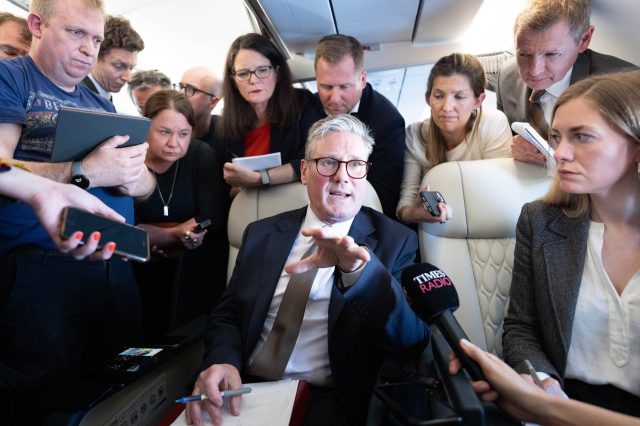
It is Starmer’s turn to be the subject of the modern media environment’s special ability to speculate a crisis into being. (Stefan Rousseau/Getty)





When challenged to name a behavioral trait for which there is no likely Darwinian explanation, the philosopher Daniel Dennett used to reply “masturbation”. Alas, the theory of natural selection has a way of confounding even the most intuitive speculations. In an enormous boost to wankers everywhere, scientists at Oxford have recently argued that man’s favorite pastime may play an important role in regulating the quality of sperm.
Of course, there remain some ubiquitous animal behaviors whose fitness-enhancing value remains a true mystery. Why, for instance, do creatures ever panic? That is, why do they fail to respond in a well-controlled way to environmental threats; why do they muddle important considerations and unimportant ones; why do they sometimes “act-out” or fail to act at all when the stakes are at their very highest?
One has only to look at the two mesmerizing examples of political panic put before us by the Labour Party this week to see how vividly dysfunctional a reaction it is. Politicians rarely face such a clear-cut test of their survival instincts as Keir Starmer did on Tuesday — a reckoning, moreover, largely of his own orchestration. No. 10 strategists apparently toiled long through the weekend to ensure his latest reset speech — his 10th? his 20th? — would see off his challengers.
Surely, faced with the political equivalent of a fight-or-flight threat to his life, Starmer’s reaction would not be the familiar rehearsal, adenoidal in sound and spirit, of a few pre-announced policies and coma-inducing oratorical leitmotifs (“I’ve learned a lot in the first two years in the job. In terms of the policy challenges our country faces…”)? As it happened, like a creature paralyzed by the overwhelming odds against it, Starmer didn’t even attempt to deviate from his tried-and-tested soporific style, whose only appeal at this stage must be its sheer familiarity: a flat, dull, self-derivative piece of oratory. In a truly courageous piece of spin, a listening Labour party apparatchik ventured that he had never heard Starmer speak so “personally” about his background. Ah, yes, Keir Starmer: famously unwilling to use his working-class background as a rhetorical crutch and positively cagey about his father’s mystery profession.
Alongside panic manifesting as overthought underreaction, we have witnessed panic as mindless overreaction. By her own admission, the backbench MP Catherine West hadn’t even looked up her own party’s internal rules before initiating her assault on the Starmer premiership. Still 100 or so of her colleagues signed onto her aimless plan — apparently insensitive to the consideration that whoever replaces Starmer is highly likely to be worse, not least in some of the very same respects that he is already bad. To panic is often to regard action — any action at all, even those that make things worse — as better than failing to act at all.
Philosophers have recently become interested in the idea that groups, as well as individuals, might have mental states — and, therefore, that actions and behaviors might be attributed to them too. In Westminster’s strange ecosystem, one such creature is the lobby: the political media itself. Its unusual, apparently counter-adaptive trait is to thrive on panic. The combination of rolling news coverage, diabolically amplified by the restless Sauron’s eye of X, may as well have been designed to initiate the equivalent of speculative runs on politicians’ political capital. Always on the alert for the first tremors of chaos or collapse, its standing inclination is to direct its disordered attention to every fresh twist of the news cycle. To the chronically online, there is a special sense attached to a “good day” on X: it is one in which, by a kind of dispersed psychological alchemy, the site seems to act as a single collective intelligence — achieving a kind of flow state in which a steady stream of breaking news and claxon emojis melds seamlessly with parody, self-reference, and a commentary providing an instantaneously memeified parallel reality. Has two-tier Keir become two-year Kier? Is No. 10’s sexy lectern man getting a good night’s sleep before his next big outing? Has the prime minister appointed Myra Hindley as children and safe-guarding minister as part of is latest ingenious reset? Wouldn’t it be oh-so-funny if Samantha Niblett, champion of Labour’s ill-conceived “summer of sex” campaign, becomes the “69th” MP to disown her prime minister? The chains of mutual-reference and random association are akin to the thoughts of a disordered mind: the significant and insignificant competing for shared space. When the Johnson government was brought to its brink, ministers were resigning faster than they could be feasibly replaced: the speed and publicity of social-media announcements creating a sense of uncontained, perhaps uncontainable, chaos.
Johnson was correct when, delivering his resignation speech from outside No. 10, he bitterly noted that “at Westminster, the herd instinct is powerful and when the herd moves, it moves”. What he didn’t mention is that such speculative runs would be near impossible to achieve without the coordination mechanism now provided by modern media. Under previous regimes, politicians found room for maneuver amid the comparatively slow speed of information. Just consider the astonishingly quaint recollection Ken Clarke gives of Black Wednesday, when Britain crashed out of the European Exchange Rate Mechanism in 1992. Having “pottered around” at the Home Office a bit, Clarke joined Michael Heseltine and Douglas Hurd who were “cooped up” in Admiralty House, “drinking tea [and] hoping against hope that a second-interest rate rise would work” to avert a sterling crisis. Only some hours into the afternoon did it occur to any of them that, in their splendid isolation from the flow of information, they “were probably less well informed than perhaps anybody else in the United Kingdom about exactly what was going on”. “We began to search for a transistor radio.”
However counterintuitive, in political crises too much information can be as destabilizing as too little. The reasons Britain has recently surpassed Italian levels of prime-ministerial replacement are probably overdetermined. But one important accelerant to the many underlying problems is the dysfunctional epistemic environment, one which offers a surfeit of opportunities to overreact to new information. Recently, Daniel Kodsi and I have argued that there is a distinctive kind of intellectual pathology associated with the temptation towards “presentism”, and more generally the temptation to attach outsize significance to incoming data simply because it is novel or striking. Of course, “presentism” might as well be the in-house motto of rolling news: with its stunted attention span and breathless inability to differentiate between what is significant and what is merely novel.
Of course, the harried reporters of rolling news and locked-in situation-monitors of social media might with some justification claim that their business is a short-term market in novel information. But it is telling that when the hive mind of the modern press is thrown into overdrive, even the criterion of novelty is relaxed: the more basic objective being a manic exercise in pattern recognition for whatever will stoke controversy, and keep the perpetual motion-machine of the news cycle humming at full speed. For that purpose, old news repurposed as revelation will do just as well — aided and abetted by the kind of collective amnesia that comes naturally to a mind that lives in a permanent present. The news that Peter Mandelson had “failed to pass” security vetting in the run up to being posted to Washington as ambassador had been prominently reported in the Independent months before being resurrected as chaos-inducing scoop when its political valence changed. Likewise, clearly not recognizing the moralistic potential of what they had unearthed, the Mail on Sunday reported in gossipy style on early events in the scandal that would become “Partygate” a year before the press adopted the cause with monomaniacal fervor. As was so clear with Partygate, the media’s characteristic priority — to prosecute every fresh detail of a rolling saga under the crudest moral lens to hand — can often actively inhibit the effort to collectively confront harder questions, about, say, the justification and efficacy of lockdowns themselves.
Now it is Starmer’s turn to be the subject of the modern media environment’s special ability to speculate a crisis into being. Pathologically dull and terminally unimaginative, Starmer hasn’t changed a bit since being elected. That the local elections would result in catastrophic Labour losses was not only eminently predictable, but widely predicted, not least by journalists who lusted for months over the political instability that might result. The deeper, underlying difficulty — that Labour’s existing policy program is unequal to alleviating any of the country’s long-term structural or cultural ills — should not come as a surprise to anyone so close to Starmer as to actually be one of his sitting MPs. Why panic now, then, when the evidence of political malaise has been so clear for so long? In an environment dominated by noise, perhaps they can no longer pick out a long-run signal.
More to the point, why think for even a moment that any successor to Starmer would be able to resist the modern media’s predation? The hankering after instability and hunger for panic that moves the news cycle is constitutive to its operation, and not so much — as commentators used to speculate about successive Conservative leaders — something that results from an individual leader’s ability to project “vision” or competence. Britain, as many of the media’s commentators like to observe, seems to have become “ungovernable”: a verdict that should be delivered as much in a spirit of self-congratulation as impartial observation.
