




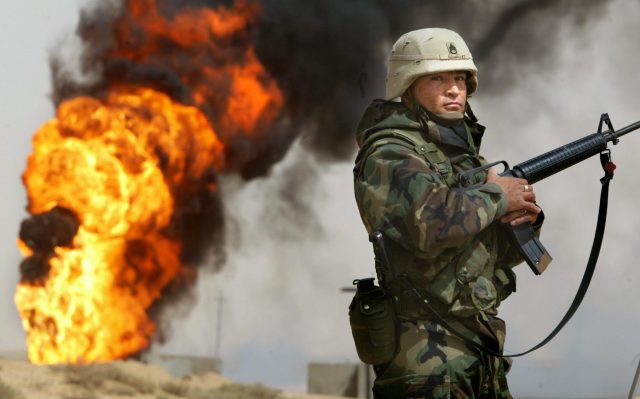
Another TACO? (Mario Tama/Getty)





Bank runs are famously irrational things. Yet as the former Bank of England Governor Mervyn King once quipped, once they start, it’s rational to participate. The same goes for Donald Trump’s war against Iran. It was an irrational conflict to start. The President did not think anything through. He had no clearly-defined war goal, no exit strategy. But now that the war has started, with no success so far, it may well be rational to step up and finish the job.
This is not a prediction of what will happen: that decision depends on the whim of a single person, and I haven’t got the foggiest what’s going on in Trump’s head at any one moment. Yet set against his strategic options, the war could well expand.
What are those options? He could chicken out, declare victory, and hope that no one notices; keep the blockade going and see who blinks first; or resume military action. The latter is often dismissed on the grounds that Trump does not like war. And, certainly, his revealed preference is to secure a face-saving deal. He keeps dangling one in front of our faces, albeit possibly just to keep the markets happy. The problem is that such a deal is not available right now, and indeed may never be. The Americans cannot really walk away with Iran imposing tolls in the Strait of Hormuz, nor can they compromise on the fraught question of nuclear weapons.
The US naval blockade was America’s next big idea. But Iran has 3,662 miles of land borders, approximately the distance from Boston to Anchorage. Indeed, the US here arguably has the same problem as Western countries do issuing sanctions against Russia: the other side has long and porous borders. For all of Trump’s bluster, meanwhile, I’ve read credible reports that Iran has managed to break the US blockade and ship around a million barrels of oil per day to China, even as the Islamic Republic has established the “Persian Gulf Strait Authority” to collect tolls in the Strait of Hormuz.
As for the argument that the blockade will force Iran to the negotiating table, the truth is that, like Russia, Tehran is ready to endure hardship for far longer than we are. After all, the Revolutionary Guards do not have a mid-term election to worry about. This is why we should take the option of a resumption of military action more seriously than we currently do.
Of course, Trump hardly wants to risk Iran blowing up a US aircraft carrier. But, again, we should not be considering what he wants — but what choices he has in front of him. It is a logical fallacy to think that because it was wrong for the war to have started, the right course of action is to reverse it. If you have the capability to win the war, as the US does, the logical conclusion is the exact opposite. The least-bad option is to go all in, resume the war, with the explicit goal to destroy the Revolutionary Guard’s grip on power. I am not a military expert. Yet those who know more about these matters than I do tell me that in the case of Iran, this would require boots on the ground, a serious ground invasion. The scale would necessarily be enormous. Iran has 610,000 active soldiers, including the Revolutionary Guards. On top of this they have 350,000 reserves. Israel has 170,000 troops. A ground invasion would therefore necessarily involve hundreds of thousands of US soldiers, all of whom would first have to be mobilized, something that would take months.
The lack of other options aside, domestic politics might ultimately push Trump to embrace all this. If he TACOs, he’ll be seen as a loser in the eyes of his own supporters. The Trump presidency would be over — not literally, but politically. This would be the point of no return. Trump has survived scandals that would have finished off most other politicians, but lying about the economy is not in the same category as lying about war and peace. Recall that campaigned as the anti-war president. It’s a big deal to break that promise, and he’s already lost some supporters over it. But if he were to chicken out now, he would lose the remainder too. You cannot fool all of your supporters all of the time.
For its part, the MAGA base wouldn’t struggle to understand that the Iran nuclear deal — which Barack Obama agreed to and which Trump canceled during his first term — was superior to anything Trump would now have to sell as a diplomatic victory. Getting Iran to agree to international monitoring of its nuclear stockpile is exactly what the Iran nuclear deal did, in a framework more credible that what is likely to emerge now. As for allowing free passage through the Strait of Hormuz? That’s hardly a victory: the waterway was never closed before the war began. Even the best possible deal, from a US perspective, is inferior to anything they could have had — had they not gone to war.
Now consider the advice Trump will get. His political advisors and pollsters may tell him to cut his losses before the mid-term elections. The conventional wisdom is that Americans don’t like to pay $4.50 a gallon for gas. Yet even if the price of oil falls back to $3 by October — a big if — it’s unlikely that disappointed Republican supporters would forgive and forget. Voters care about the economy, but it’s not as mechanistic as that. If people believe that the removal of the Iranian regime were to bring about a permanently lower oil price, they might accept a short period of higher gas prices.
The old slogan — it’s about the economy stupid — is true, but not in a literal sense. It’s not so much about the economy as measured by official data. It’s about economic confidence, and Trump’s unique skill is to instill confidence in his supporters. I struggle, then, to see how a retreat from a war with Iran would boost this confidence. As long as the US is sure of winning the war eventually, both political and economic arguments should weigh against a premature exit.
We should also not underestimate the advice Trump will get from advisors in the security apparatus, and indeed from Israel. We know from the New York Times that Benjamin Netanyahu played an instrumental role in getting Trump into the war. Marco Rubio, the secretary of state, and Vice President JD Vance, were both skeptical. The decisive argument that persuaded Trump was the idea that the costs of not acting would outweigh the costs of fighting. What has changed since is that the cost of the war is higher than Trump anticipated. But as I’ve explained, the cost of chickening out are higher still. Since the US is unlikely to achieve a military victory over Iran before November anyway, the President has only a few imperfect options left. A longer-term triumph over the Islamic Republic would destroy one of the most horrendous regimes on earth, a regime which imposes tolls on global shipping in defiance of international law, and which may one day develop nuclear weapons. A skillful communicator, which at his best Trump is, should not struggle to explain this.
The Europeans, of course, are advising Trump to end the war immediately. They were also the main diplomatic force behind the defunct Iran nuclear deal, which must now surely be seen as one of the great diplomatic achievements of modern times. But the Europeans have since lost their influence in the world, especially with the White House. As has become painfully clear over the last few years, Trump simply doesn’t care what they think.
Of course, a counter to my argument is that most wars don’t end with a decisive victory or defeat, but rather an armistice or a peace deal. Just look at the Ukraine war, the archetypal war of attrition. Russia is struggling hard to acquire new territory, but Ukraine is struggling too. And when it comes down to it, Russia has nuclear weapons and a vast theoretical reserve of men. We hear a lot of fairy tale stories about Ukraine regaining the initiative. When this war finally ends, however, it will be through a peace deal, not when a Ukrainian flag flies over the Kremlin.
Yet I am less sure that the Iran war will end this way. Unlike Russia, Iran is not a nuclear power, and on conventional forces alone the US surely has the military capability to theoretically defeat the regime. Whatever we might think about what is good or bad, right or wrong, it would therefore make sense for Trump to resume the war, and even to put boots on the ground if that is what’s required. It is what the logic of war dictates.
