




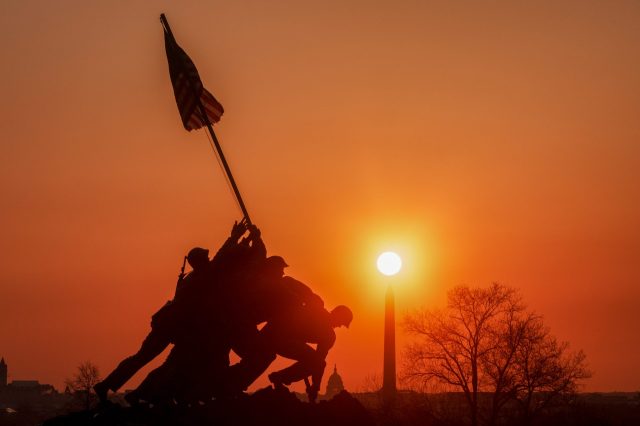
The US Marine Corps War Memorial. (J. David Ake/Getty Images)





At the outset of the war, Iran’s grand missile offensive had long been planned to wreck Israel and US installations across the region, from Erbil in northern Iraq down to Qatar. Iran could call on some 2,500 ballistic missiles weighing between 15 and 26 metric tons as well as many drones. But these plans were successfully pre-empted by US and Israeli aircraft. After that, the US war against Iran had a second act ready to go. It was difficult to imagine that Tehran would escape, as it now might, with a favorable peace deal.
The US could assure victory even if the regime survived the decapitation it had suffered on the war’s first night. Supreme Leader Khamenei was killed, along with his defense minister, his chief of staff, and the Revolutionary Guards chief, among others. Subsequently, the US launched an unimpeded bombardment of missile factories, stored missiles, missile launchers, and the Revolutionary Guard headquarters in Tehran, Mashhad and lesser cities.
Act I, therefore, ended swiftly. As for Act II, the US deployed thousands of Marines and 82nd Division Airborne troops to Qatar and nearby bases. But nothing happened. Tehran came to resemble Berlin after Hitler’s death, with the SS guards left in sole control, still able to hang anyone who wanted to stop the fighting, but with no plans at all to avert imminent defeat. In 1945, it was the arrival of Russian troops that finished off the last SS holdouts, just as the arrival of American troops mopped up the last Nazi holdouts in Bavaria.
Nobody expected an American army to advance to Tehran from the nearest port of Bandar Abbas on a single highway, across 800 miles of mountains and deserts, to venture into a city of more than ten million, to drive the Pasdaran Revolutionary Guards out of town, and scare the Basij militia into changing back into civilian clothes. It would have made for a very arid quagmire, with plenty of incidental US casualties even if there were no concerted and determined resistance.
But the arrival of thousands of Marines and Airborne troops offered an altogether more realistic, far quicker and definitely very much safer path to victory. And when, as a defense contractor, I heard of the deployment, which occurred along with the far more publicized air campaign, I assumed that it had that rather obvious purpose, which arises from the geography of the Persian Gulf — hardly terra incognita in the Pentagon, which has been dealing with the Gulf and its recurrently threatened oil tankers for decades.
By now everyone at all interested knows that the Persian Gulf varies in width from roughly 180 miles opposite Bahrain to the 35-mile width of the Strait of Hormuz, but the navigable channels of the mostly very shallow Gulf are much narrower.
Most relevant for the US Marines and 82nd Airborne troops are the islands in the Persian Gulf, from which it is possible to secure safe passage for friendly tankers by denying them to Iranian anti-ship missile teams, by precluding minelaying attempts, and by detecting all manner of other threats with low-altitude helicopter patrols. Unlike the current American plan to give tankers military escorts, taking the islands deals with the problem closer to the root.
Some islands are closer to Iran’s mainland than others, but all can be denied to Iran’s ground forces from nearby shores. There is abundant close air support available from Al Udeid base in Qatar and elsewhere. Only one Island, Qeshm, is at all large, at 580 square miles, almost twice Manhattan’s 305 square miles. The rest are much smaller, and none could be overrun from the mainland as any coastal outpost might be.
To avert further damage to the global economy, everyone’s oil and gas exports — from Iraq and Kuwait up north down to Saudi Arabia’s Ras Tanura and Qatar’s liquefied gas — must be secured. (The Emirates have their Fujairah terminal on the Indian Ocean, out of danger.) If the islands are used as bases for highly mobile US units, it is eminently feasible for them to keep the exports secure.
As for the denial of Iran’s oil exports, it is already accomplished; its Kharg island principal oil export terminal has been disarmed, and in any case the US Navy is stopping any attempts to ship out Iran’s oil by tanker.
Stopping Iran’s oil export revenues is enough to reduce the country’s power day by day. Iran entered the war with minuscule foreign exchange reserves for a country of ninety million, and the government receives very little hard currency from traditional exports. The merchants who sell carpets, pistachio nuts, saffron and pomegranate juice do not repatriate the foreign exchange but use it for luxury imports. Iran’s economy is now wrecked. The Rial has collapsed to 1.3 million for $1. That inflation means that many can only have plain bread with their water
The Chinese have supported Iran politically, but they are not sentimental, and will not ship missile fuel precursor chemicals, or anything else, without payment. Hezbollah’s surviving leaders might be sentimental, but their men depend on their salaries and must search for other employment if unpaid. The Houthi leaders, too, might be sentimental, but in the misery of Yemen they really need their pay to buy flour.
Russia is a very important supplier for Iran, with fast Caspian shipping routes from Astrakhan in the Volga delta to Amirabad only 750 miles away, or even less from Russia’s closest port in Makhachkala. But again, Russia is itself at war and cannot be generous. In other words, the power of the regime must diminish day by day without oil exports — which can be denied indefinitely, if all others can export their oil.
Given all this, why the inaction? Why do the fine troops remain idle? I fear that the answer is the arrival to the United States of what I have called the “post-heroic” syndrome. It is the historically unprecedented but now widespread refusal to accept the risk of casualties, even if very few, even if warranted by the most important interests. It is not a matter of ideology, for it originates in the drastic decline of female fertility. When mothers habitually had three or more children, one might be lost in combat but the family lived on. Now, few women have two children, let alone three. Average fertility in the US is only 1.6, well below the 2.1 replacement rate — and most combat losses result in the extinction of a family.
Hence the political tolerance of the casualties of war has drastically declined. On 9 November, 2022, President Macron abandoned Opération Barkhane. With just over 5,000 French troops, the operation had long protected the immense territories of five Sahel ex-colonies, but Macron feared that a small number might die. Putin fights in Ukraine with mercenaries without a single Russian conscript. The mere suggestion that Nato troops might guarantee a Ukraine ceasefire, if one were ever negotiated, was enough to trigger sheer panic in Italy, where on 1 April, 2025, Foreign Minister Antonio Tajani and Defence Minister Guido Crosetto stood side by side in front of TV cameras to rule out “any possibility whatever” that Italian soldiers might be deployed in Ukraine, even after a cease-fire.
For the United States, the post-heroic syndrome means that if, say, a thousand US troops were killed while finally defeating Iran’s very dangerous rulers, President Trump’s reward could be a swift removal from the White House by impeachment, with the help of Republican votes. If that is why US Marines and Airborne troops remain idle, the time has arrived to turn to contractors who need not fear elections or impeachments.
Professor Edward Luttwak is a strategist and historian known for his works on grand strategy, geoeconomics, military history, and international relations.
 ELuttwak