




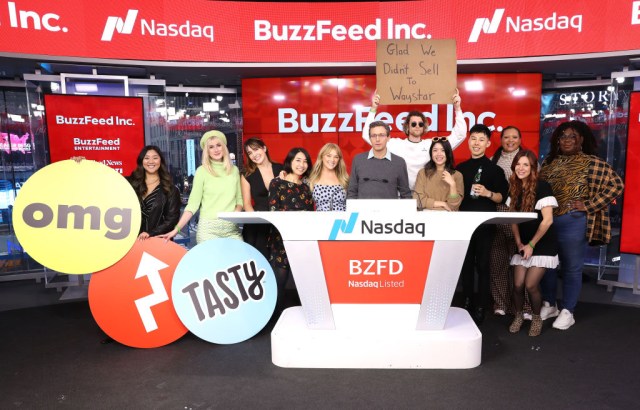
Better days: Buzzfeed co-founder Jonah Peretti (center) at Nasdaq. Credit: Getty





Byron Allen, the former standup comedian and small-scale media mogul who took over Stephen Colbert’s late-night slot on CBS this month, will pay $120 million for a controlling stake in BuzzFeed, in a deal announced last week. He has installed himself as chairman and chief executive and plans to turn the dominant media outlet of the 2010s into a free streaming service. Buzzfeed co-founder Jonah Peretti has been rebranded as “president of BuzzFeed AI” — the corporate equivalent of being put out to pasture in a particularly elaborate paddock.
The number was once unthinkable. BuzzFeed went public in late 2021 at a valuation of more than $1.5 billion. As a private company, it had been worth $1.7 billion, and was the unicorn that set the benchmark for the decade’s digital-media venture funding. Allen acquired the entire operation for roughly 7% of that peak figure. Most of the purchase price is a five-year promissory note; the cash portion was only $20 million.
Meanwhile, Vox Media has spent the past three years quietly accepting that its 2015 NBCUniversal valuation of a little more than $1 billion is not coming back. Penske Media took a controlling stake in 2023, at a $500 million valuation, half what NBC had paid eight years earlier. Vice Media, valued in 2017 at $5.7 billion (yes, billion), filed for bankruptcy in May 2023, sold to its creditors for $350 million, and by February 2024, stopped publishing on Vice.com altogether. The brand survives. The company does not.
This is not really a story about three failed startups. This is a story about a genre of media that disrupted nothing, lasted briefly, and is now being sold for parts. Each of these companies was an experiment in betting that new distribution platforms could underwrite editorial ambition. The bet was wrong, but for a few years it looked right.
Vice began in 1994 as a Montreal free magazine, founded by Suroosh Alvi, Shane Smith, and Gavin McInnes; that last went on to found the Proud Boys, an awkward provenance that Vice Media still prefers to leave underdiscussed. By the mid-aughts, the magazine had relocated to New York and developed an aesthetic of irony-laced gonzo reportage: well-educated young men visiting war zones and methamphetamine encampments with their smirks intact. An HBO deal in 2013 conferred prestige. The editorial product retained its faux-outlaw posture. At its peak, the company ran 35 offices, an HBO show, an in-house creative agency called Virtue, and a record label. James Murdoch invested through Lupa Systems. So did Disney, TPG, and Technology Crossover Ventures. The 2017 valuation implied that Vice had cracked the code of monetizing youth-culture authenticity.
It had not. What Vice had cracked was the willingness of corporate advertisers to pay premium rates to associate themselves with disreputability. When that willingness faded — and it began fading the moment the brand became too familiar to be transgressive — Vice had nothing left.
BuzzFeed’s story is more interesting, because the journalism, for a stretch, was real. Jonah Peretti, a co-founder of The Huffington Post, built BuzzFeed in 2006 as a viral-content laboratory. The famous early product was the listicle: “21 Pictures That Will Restore Your Faith in Humanity.” But in 2012, Peretti hired Ben Smith from Politico to build a news division on top of the listicle engine. Smith’s bet was that the same social-platform mechanics that propelled animal-rescue videos could also propel investigative journalism. He hired aggressively, opened bureaus across the world, and soon presided over a newsroom whose international reporting on the Chinese government’s mass internment of Uyghurs won the 2021 Pulitzer Prize. BuzzFeed News published the (dubious) Steele dossier in 2017. It covered Silicon Valley with greater sophistication than most of the legacy press. For five or six years, it was the most consequential newsroom in American digital journalism.
The catch was that the apparatus rested on Facebook’s referral algorithms. When Facebook decided, around 2018, that it had grown tired of subsidizing publishers, BuzzFeed’s traffic collapsed. The news division burned cash. In an April 2023 staff memo, Peretti admitted that he had “overinvested” in the news division because he loved the work, and confirmed what had been obvious for months: BuzzFeed News was shutting down. About 180 staffers were laid off.
Finally, there was Vox Media. Founded by media executive Jim Bankoff with seed funding from Comcast, the firm traveled a different route to the same destination. The Vox website launched in 2014 with two policy bloggers, Ezra Klein from The Washington Post and Matt Yglesias from Slate, joined by Melissa Bell, an editor with a digital pedigree from the Post. Vox’s premise was technocratic. Smart people were busy and confused; journalism’s job was to package the underlying expertise behind the news. The site’s design templates — an index-card-styled “explainer” footer, providing background context on stories, embedded charts, and house-style explainer videos — were copied by other publications. At its peak, Vox had a Netflix series called Explained, a billion-dollar valuation, and ambitions to be the equivalent of CNN.
Each of these companies succeeded by being native to the larger social-media platforms it depended on. Each was undone the moment the platforms changed terms. The collapses were not symmetrical. Vice went bankrupt. BuzzFeed shrank into peddling snark and lists, and shed half its workforce. Vox negotiated a soft landing inside Penske’s stable of legacy titles, which includes Variety and Rolling Stone. But the trajectory was the same.
Klein left Vox for The New York Times opinion section in late 2020. Matt Yglesias departed a week earlier for a Substack newsletter called Slow Boring, where he now earns considerably more than he did at Vox. Smith, the founding editor of BuzzFeed News, decamped in 2020 for a Times media column, then in 2022 co-founded Semafor, a newsletter platform, with the former Bloomberg Media chief Justin Smith. Semafor today employs some 80 people, has 750,000 newsletter subscribers, and generates more than half its revenue from live events. Lauren Williams, the BuzzFeed News deputy editor, left to start Capital B, a black-civic-journalism nonprofit. Other BuzzFeed alumni founded subscription products on Substack and Beehiiv. At Vice, the diaspora was wider and quieter: writers scattered to legacy outlets, independent production, freelance.
Each departure made the same point. The value the platforms had accumulated was always portable. The audience attached itself to writers, not to the brand. When the writer left, the audience left, too. BuzzFeed could not retain Ben Smith’s authority because Ben Smith was the asset. Vox could not retain Klein’s subscribers because they were reading Klein, not Vox. These companies turned out to be temporary scaffolding around durable individual reputations.
This is, of course, what newspaper proprietors used to understand. H.L. Mencken’s name sold The Baltimore Sun. Walter Lippmann’s column ran in 250 newspapers because it was Lippmann’s column. Westbrook Pegler, Stewart Alsop, Jimmy Breslin, Mike Royko: their bylines moved subscriptions. The new-media companies briefly persuaded themselves that the brand was the asset. They were corrected. The talent walked. The shells remain.
The transactions of the past three years tell a story not of media renewal, but of media dismantlement. Vice’s $350 million 2023 sale to a consortium led by Fortress Investment Group, Soros Fund Management, and Monroe Capital was a creditor takeover dressed as a sale. CNBC reported at the time that the new owners planned to hold the company for two or three years and “further shave off the business.” They did. By February 2024, the new CEO had announced “several hundred” additional layoffs and confirmed that Vice.com would cease publishing original content. The website would now syndicate or partner with others. The brand was kept alive because brands have residual value. The journalism was finished.
Vox’s 2023 deal with Penske Media was less brutal but more revealing. Jay Penske, who built his fortune in motorsports media and entertainment trade publications, took the largest outside stake at a valuation that halved Vox’s 2015 mark. Vox now sits in a bigger portfolio alongside media commentary and taste-curation outfits. These brands continue to elevate cultural trends, but they are more about vibes than news. Their editorial ambitions have been quietly downsized. This is what survival looks like.
The Byron Allen acquisition of BuzzFeed is the most candid of the three transactions — and the most instructive. Allen is not a journalist. He is a Detroit-born comedian who built a syndication and distribution empire from a foundation in 1990s television production. He owns 13 broadcast affiliates across ABC, CBS, and NBC; 10 cable networks, most prominently the Weather Channel, which he bought in 2018; four streaming platforms; and a two-hour late-night comedy block on CBS that just expanded into Stephen Colbert’s old slot. He understands the economics of distribution.
When Allen looked at BuzzFeed, he did not see a journalism asset. We can imagine that he saw three things. He saw a recognizable brand, nostalgia for which could be monetized. He saw a content library of two decades of audience-tested digital material that could be licensed to an AI company. And he saw an integration opportunity: his BuzzFeed could feed his streaming infrastructure, with the hope of growing ad revenue. He said as much in his announcement: “Our vision is to build on the iconic foundation of BuzzFeed and HuffPost by expanding into free-streaming video, audio, and user-generated content. As of this moment, with the power of AI, BuzzFeed is officially chasing YouTube to become another premier free video streaming service.”
Note what is absent from that sentence: any reference to journalism, reporting, or news. Note also the AI mention. Peretti’s new title, head of BuzzFeed AI, is the giveaway. The asset Allen is buying is not the company. It is two decades of human-written content that can be used to train AI systems, plus a brand name under which machine-generated content can plausibly run. The Reuters licensing deal at $200 million annually, the OpenAI partnership announcements, and the recent Disney-OpenAI billion-dollar deal: these are not isolated transactions. They are the new revenue model. Publishers’ archives have become a training data inventory. Their brand names have become trust-laundering vessels.
For buyers of declining new-media brands, there are three distinct logics that overlap.
The first is distribution integration. A company like Allen Media Group, which owns broadcast and streaming pipes, can use a content brand to fill those pipes more cheaply than it can produce original content. The economics are roughly the ones William Randoph Hearst used in the 1920s, when his magazines fed his newspapers, and his newspapers fed his radio stations. The form is updated; the structure is identical.
The second is intellectual-property licensing. The archives have value as content libraries that can be repackaged for streaming, podcasts, or, increasingly, AI training. Vice’s old documentaries get licensed. BuzzFeed’s listicles get repurposed into vertical video. The journalism, where it ever existed, becomes incidental to the intellectual-property play.
The third is what we might call brand-laundering. A trusted-sounding brand name carries value beyond the journalism that originally built that trust. Algorithmic content running under “BuzzFeed” or “Vice” carries credibility freight that the same content would not carry under its own name. This is why the brands survive even when the newsrooms don’t. The empty shell is the asset.
The dominant theme is that none of these logics requires the people who originally made the brand worth anything. Once the talent left, the shell still had financial value. Not as a journalism business, but as a content asset, a brand asset, and an audience asset, monetized in ways the original founders never imagined and would not have wanted.
What this tells us about the state of the media industry in 2026 is not subtle. The mid-tier digital publisher is dead. The economics that briefly sustained newsrooms of 200 or 300 journalists at outlets like BuzzFeed and Vice no longer exist. Programmatic advertising has collapsed. Google’s AI overviews have throttled search referral traffic. Facebook deprioritized news years ago. Apple’s privacy changes wrecked targeted-ad economics. The only viable models left are very small (Substack, individual subscriptions) or very large (The New York Times, with its 11 million digital subscribers, has functionally replaced the regional newspaper system as the country’s national paper of record). Everything in between is being either absorbed into the very large or stripped for parts by the financiers.
The consolidation logic has reshaped every other consumer industry over the past two decades. Private equity buys the brand, fires the staff, and runs out the residual value of the customer relationship until it runs dry. Gannett, MediaNews, Tribune Publishing, McClatchy: the American local-newspaper system was hollowed out this way over 15 years by hedge funds like Alden Global Capital. Digital media are now experiencing their own such moment, abbreviated and accelerated. What took the local papers a decade and a half is taking the new-media companies about six years.
The familiar pieties about democratization will not survive contact with this story. The new media was supposed to break the gatekeeping monopolies of legacy publishers. It did so, briefly, replacing them with venture-funded shells whose economics were never sustainable. But once those shells collapsed, the gatekeeping has reconstituted in a more thorough form than before — we used to have gatekeepers at a constellation of local papers; now there’s only The New York Times.
This is the lesson of the last decade, and it is older than the internet. Disruption is rarely what the disruptors claim it is. It is more often a redistribution of who collects the rent.