




Choose your side. (JG Fox)





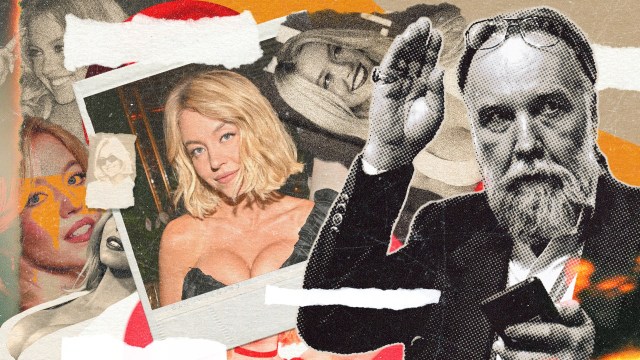
Sydney Sweeney has upset a lot of people in her short career. Since rising to fame playing “crazy Cassie” in the edgy Gen Z drama, Euphoria, the 28-year-old American actor has been variously accused of degrading the morals of a generation (passim), spreading Nazi propaganda (she appeared in a jeans commercial), supporting genocide (she wore a dress by an Israeli designer) and worst of all, disrespecting Taylor Swift (she was briefly involved with pop uber-villain, Scooter Braun).
Now, should the worst come to pass — should Western civilization be erased from the face of the earth — then those of us who make it to the fallout shelter will be able to add another crime to the list. Annihilation will also be Sydney Sweeney’s fault. A culture that can produce a scene like the one in Euphoria season three — in which Sweeney’s character performs sex-cam work while dressed as a baby — apparently deserves all the hydrogen bombs coming to it.
The HBO drama appears to have been the final straw for the influential ultra-nationalist Russian “philosopher” Alexander Dugin, who earlier this month launched into an extraordinary rant on X, apparently inspired by his late-night TV viewing. “Look: is there at least one argument why the US shouldn’t be erased from the face of the earth?” he asked.
To those who might respond: “Sydney Sweeney in American Eagle jeans”, Dugin offered short shrift. Sweeney may be a MAGA darling — she is, after all, blonde haired and blue-eyed and comes from a Republican-coded family — but to a committed Russian nationalist, this is irrelevant. “You are not the people,” he wrote. “You are stupid slaves on the Epstein’s menu of cruel cannibal elites. You are eaten, your brains are. It is why you watch Euphoria. Because all of you are perverts. Disgusting civilization. No reason to exist. Please, die.” Thanks — we’ll take that on board.
It’s not too hard to see why Euphoria — with its interracial, intersex, into-absolutely-anything cast — would be a particular trigger for the Kremlin’s on-off court philosopher. Born in the Khrushchev era, Dugin spent his youth vaguely agitating against communism before the break-up of the Soviet Union deeply wounded his national pride. Like every fascist before and since, he became obsessed with the idea of humiliation. He co-founded the National Bolshevik Party — the “Natbols” — with Eduard Limonov in the Nineties. The party’s flag was a Nazi-style white circle on a red background — only instead of a swastika, it had a black hammer and sickle. Russians aren’t generally fans of the Nazis; Dugin admired both the Nazis and the Bolsheviks for their Nietzschean will to power. It was the liberal West, with its dangerous ideas like human rights and free speech, that he regarded as the true evil. A hairy ogre of a man, Dugin conveyed his ideas with charisma and force. He was a hard drinker and a rich storyteller with a deep resonant voice in which he delivered mesmerizing monologues about the destiny of Russia to the eager young jackbooted Natbols.
For all his mad array of influences — Hitler, Stalin, Guy Debord, Terminator, Lao Tzu, Mishima, Rosa Luxemburg, René Guénon — and his fondness for terms like “rhizomatic” and “hermeneutic circle”, Dugin’s philosophy is actually pretty simple. In Foundations of Geopolitics (1997), he argues that Russia must reverse the humiliation of the Soviet collapse by rebuilding itself as the core of a new Eurasian empire that is destined to challenge and ultimately dismantle Western (i.e. American) hegemony. America and the EU in this vision are not merely political rivals like China, India or Iran, say — but decadent forces, intent on dissolving Russia’s identity and historical purpose. Beneath the book’s strategic language lies a messianic strain: a wounded civilization is redeemed through expansion, action, spiritual renewal and permanent struggle. Only Russia, with its spiritual depth, its powers of endurance, its capacity for hard action, is capable of saving the world from the liberal antichrist. The book has become a set text for Russian military leaders and seems to have guided Vladimir Putin’s strategy in Ukraine. Asked what policy Russia should take towards its Western neighbor as early as 2014, Dugin’s response was: “Kill! Kill! Kill! There can be no other discussion.”
Dugin’s pronouncements became more deranged following the assassination of his daughter Darya in a car bomb in 2022, and his targets have become a little more scattergun. He has a particular hatred of the popular Russian cartoon character, Cheburashka, for example — “the concentrated expression of that very feeblemindedness against which I have battled my whole life” — and frequently rails against Marvel movies, McDonalds, and various other symbols of American cultural power.
But Euphoria — in which literally every character is performing sex work to support their crystal meth addiction and/or gender reassignment surgery — would strike Dugin as a representation of everything evil and degrading in Western culture. And the fact that America permits this depiction of itself — indeed, that Euphoria has launched the careers of some of its most lauded stars, including Sweeney, Jacob Elordi and Zendaya — is further evidence of the moral degeneracy of a culture. In his fawning interview with that useful American idiot, Tucker Carlson, Dugin declared that the dystopian futures depicted in Hollywood movies like The Matrix and Terminator were not warnings, but actual visions of where the West was heading. Why do American filmmakers never depict happy families or thriving communities in their future visions, he asked. It’s because Americans are willing on this apocalypse. Thus Euphoria’s self-loathing, atomized, narcotic, nihilistic, multi-racial hell is basically a warning — this is what America would impose on the rest of the world, a staging post on the way to Skynet.
What’s interesting about all this — and what Russocurious American conservatives like Carlson often seem to miss — is the strain of messianism in Russian thought. Americans are so accustomed to thinking of their culture as the envy of the world and their eccentric conception of “freedom” as the universal absolute that the idea Russia might have its own global vision seems not to have occurred to them. They are more comfortable patronizing Russia as a backward, violent, pitiful place — much of which goes back to those images of Russians in the Eighties queuing for Big Macs in Red Square and going crazy for Levis (which clearly made Dugin furious). Thus Carlson could tour a Moscow supermarket in 2024, simply amazed that they have affordable groceries. But this cultural complacency frequently leads non-Russians to miss Russian critiques of the West (say, of American racism) and to underestimate the very real strain of messianism in Russian thought — that is, Russia’s own mission to save the world.
So as ludicrous as Dugin often appears, there is a coherent set of ideas behind his philosophy — and in any case, recent history tells us that it is the ludicrous people we need to take most seriously. To understand where Dugin is coming from you need to understand the Eurasianist tradition of which he is a mutant 21st-century outgrowth, as well as Russia’s dual conception as both an Asiatic and Christian civilization. There are many ways this dichotomy manifests. You can see it in the rivalry between the two capitals: St Petersburg, constructed by Peter the Great as a “window onto Europe”, and Moscow, the older Slavic center of Orthodoxy and imperial memory. But there are two key moments in Russian history that the Eurasianists have drawn upon to lend grandeur to their vision.
The first is the Battle of Kulikovo in 1380, when the forces of the Russian principalities defeated the Tatar army of the Golden Horde and began to free their lands from their Mongol oppressors. In the Russian cultural memory, this event has mythic significance: the point at which Russia begins to define itself through resistance to, and absorption of, the steppe world. “Our path runs through the steppe – and boundless anguish / Your anguish, O Russia!” wrote the symbolist poet Aleksandr Blok in his cycle On the Field of Kulikovo (1908), which conjures a “holy banner” and the “Khan’s sabre” rising against a blood-red horizon. The idea this animates is Russia as a land formed of Mongol violence and Christian redemption — with a destiny of, hurrah, “boundless anguish”.
The influential Central Asian scholar (and virulent antisemite) Lev Gumilev — son of the appallingly persecuted poets Anna Akhmatova and Nikolai Gumilev, both acquaintances of Blok — built an entire civilizational theory from this image. He argued that the Mongol period had not merely been an occupation but a formative synthesis. Rather than seeing Tatar horseman rampaging through Russian villages, raping Russian women, burning Russian crops as a catastrophe, he reframed it as a creative ethnogenesis. The Russian “ethnos”, in Gumilev’s formulation, emerges from a fusion of Slavic and Turkic elements, formed through long cycles of what he calls “passionarity” — a kind of heroic fusing of land, soul and idea. Gumilev developed an entire theory around this “ethnos”, arguing that this was no mere abstract theory but a “biophysical reality”.
From here comes the notion that it is actually the liberalizing, secularizing, Enlightenment Europeans who are actually the dangerous ones — since they want to flatten out all ethnoi into one rainbow coalition of consumerism. Or as Dugin had it in his rant on X: “Whites? They are destroyed the world and themselves. To be white means to be nihilist. It is self hatred race. It caused so meany troubles to others and to itself. It lost the right to be something. No arguments to support their existence.” (He is said to speak 15 languages, and you have to wonder if his grammar is as bad in the others.)
The second foundational moment was the fall of Byzantium in 1453, when Constantinople was conquered by the Ottoman Turks. From this rupture emerges one of the most consequential ideas in Russian political theology — of Moscow as the “Third Rome”. As Philotheus of Pskov argued in the 16th century: “Two Romes have fallen, but the third stands, and there will be no fourth.” Rome itself had fallen into heresy (i.e. Catholicism), Constantinople to conquest, which meant that Moscow remained as the final guardian of true Orthodoxy. This notion would guide Russia’s self-conception not only as a state, but as a providential civilization — the nation destined to preserve and ultimately redeem Christendom itself and, certainly, its near neighbors like Ukraine and Georgia. So, Russia is no mere country but a vessel of sacred history, a restraining force against chaos — a katechon holding back dissolution; the dissolution of Sydney Sweeney, Zendaya, Jacob Elordi and friends.
This is the deeper ideological field upon which later debates about Russia’s destiny take place. Whenever “Westernizers” have argued that Russia should reform itself along liberal, democratic, secular lines (Dugin would say “white” lines), there are always “Slavophiles” to argue that this is not the Russian way. In the 19th century, Slavophile philosophers like Aleksey Khomyakov and Ivan Kireevsky argued passionately against European modernity, insisting instead that Russia’s strength lay precisely in what Europe had lost: Orthodoxy, communal life, and a form of spiritual wholeness they called sobornost — a notion of organic unity in which truth emerges not from isolated individuals but from a living moral community.
There are traces of this in many of the great 19th-century Russian novels. Fyodor Dostoevsky, indeed, had his own Euphoria moment when he visited London in 1862 and was appalled by what he saw. “Everyone is drunk, but drunk joylessly,” he wrote. “Everyone is in a hurry to drink himself into insensibility…” But what unsettled him most was not vice but order — or rather, the promise of a new kind of world order. He was one of millions of international visitors to the Great Exhibition in Hyde Park, which featured 28,000 exhibitors from dozens of nations showcasing steam engines, telegraphs, leech barometers, machine tools, Japanese prints, American cocktails — the whole world assembled in one glass pyramid. Forever after, the “Crystal Palace” recurred in Dostoevsky’s work as a horrifying hallucination of mankind forced into rational order through science, commerce and industrial progress. Where Western visitors might have seen a vision of global harmony, Dostoevsky saw spiritual erasure: atomization, loneliness, the reduction of human beings to interchangeable units in a vast rational machine. If you have ever toured the shopping malls of Los Angeles or Dubai, you may have experienced a similar shudder.
“All Europeans try to attain one and the same goal,” Dostoevsky later wrote — that is, “the universally human ideal”. But in striving toward this abstraction they dissolve the very cultures that give human life meaning. Only Russia, he concluded, had the spiritual vigor to withstand such a fate. Russia possessed “a distinct peculiarity of its own” — a “talent for universal reconciliation, universal humanity”. This is the essence of sobornost: a paradoxical unity that preserves difference within a shared spiritual whole. This idea is the great theme of Dostoevsky’s Pushkin speech of 1880, where he presents the Russian national character as uniquely capable of absorbing and reconciling all cultures while remaining spiritually intact. It is also a theme Dugin resumes in his X commentary: “To be on the side of Russia, of Iran, of China, of multipolarity is to be on the side of the being against the non-being. The (post)modern West is the citadel of the non-being, of nihilism.” Liberalism, in his reading, is a project to liberate the individual from any form of collective identity — be it Church, family, nation, empire, even gender (trans-related scare stories are a particular source of horror).
So Russia’s mission is to save the world from all this — and especially its near neighbors in the so-called Russkiy Mir, a telling phrase. Mir in Russian means “world” and also “peace” — but it also has a connotation of a peasant village community (as opposed to svet, which means “light” but also high society). So when Putin appeals to the Russkiy Mir he is not merely referring to the Russian-adjacent peoples of Belarus, Georgia, Kazakhstan, etc — but harking to an idea of organic peasant communal life. Come back to the village-empire! (Mir is, of course, also what Russians call the International Space Station. The progenitors of the Soviet space program often referred to the idea that the USSR, owing to its enormous spiritual depth, was the most suitable nation to represent Earth in the cosmos.)
All of this would be wonderful if Russian peasant life were not famously brutish, miserable and subject to ultraviolence from on high. In Dostoevsky’s The Brothers Karamazov, Alyosha recounts the story of an eight-year-old peasant boy who accidentally injures his master’s favorite hunting dog while throwing stones. The landowner orders the child to be stripped naked and spend the night in a miserable hovel. In the morning, he is torn apart by hunting dogs in front of his mother and the whole village. For Alyosha the story represents the failure of any kind of system — Christian, political, philosophical — to account for human suffering: “If the sufferings of children go to swell the sum of sufferings which was necessary to pay for truth, then I protest that the truth is not worth such a price. I don’t want the mother to embrace the oppressor who threw her son to the dogs! She dare not forgive him!” In other words, any system or theory that tries to justify or excuse the suffering of the innocent is obscene. The realism of Dostoevsky’s depiction of this horrific event — and the social hierarchy that permits it — serves as a convincing repudiation of any argument that could be used to justify it.
Indeed, it is never entirely clear what the Russian Utopia actually looks like — beyond “eternal anguish”, that is. Nor have I ever seen any of these thinkers truly spell out what those in the Russkiy Mir are supposed to get from their spiritual communion; the millions of Kazakhs who starved during collectivization, for example, or the Siberian tribes slaughtered as the Russian Empire marched eastward; or for that matter the more than 350,000 young men (predominantly from the Muslim-dominated monotowns of the South) who have died fighting to impose brotherhood on the disobedient Ukrainians. A vision of nationhood that promises redemption through suffering is quite useful when you want to explain away millions of dead. The hardest pill to swallow for many following the Soviet collapse was the idea that all of that suffering meant nothing — hence the ever-escalating need to put all the famines, all the wars, all the purges and sieges and atrocities into the service of some higher ideal.
Still, rather like the oligarchs of America who romanticize honest blue-collar work but have no idea what it actually consists of, the great romantics of ordinary Russian life tended to be from the svet as opposed to the mir. Most of the Slavophiles were serf-owning aristocrats. Putin’s legitimacy, such as it is, is largely predicated on his ability to provide shopping malls and farmers’ markets for a Moscow elite who are quite happy to shuttle back and forth to their villas in Dubai, Zurich, London, Nice and Cyprus when it suits them. Dugin himself seems to spend an awful lot of his time watching HBO and scanning social media — and, I would suggest, not enough time reading Dostoevsky.
It seems outside of Dugin’s philosophy that Euphoria might itself be a critique of precisely the kind of societal atomization that capitalism produces — and that this capacity of Western democracies to critique themselves might indeed be a source of strength. Putin has been careful to provide modern capitalist comforts to Russian elites, but he has meanwhile cranked up the state censorship machinery to pre-Glasnost levels, so any Russian who attempts anything like an honest depiction of Russian life will soon be censored, banned, banished, imprisoned, or voluntarily exiled, like the recent Cannes Grand Prix winner, Andrei Zvyagintsev. It’s not as if Russian youths are all happily singing patriotic songs as they march towards the drones of the Donbas.
Meanwhile, the third season of Euphoria does gesture towards redemption. After she winds up in the home of a family of Texan true believers, the character of Rue (played by Zendaya) experiences a growing religious obsession — culminating in an epiphanic vision of God and a hint that there is, in fact, a higher meaning, beyond lonely pleasure-seeking. As Dostoevsky wrote: “Love is such a priceless treasure that you can redeem the whole world by it, and expiate not only your own sins but the sins of others.”