




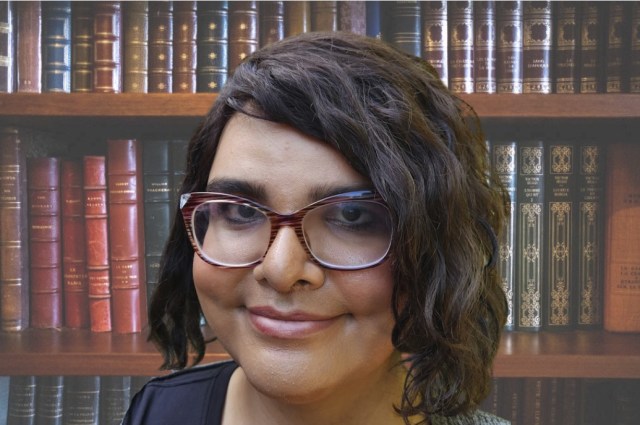
A critic defends the Great Books. Credit: Getty





We don’t get to choose our fans.
Naomi Kanakia, for example, probably doesn’t want me — a religious-minded, gender-critical writer — to review her book, What’s So Great About the Great Books?: Why You Should Read Classic Literature (Even Though it Might Destroy You), published on Tuesday. The book is a defense of the classics, written for the Left, and it has agonizingly cringe chapter headings such as “Aren’t the Great Books kinda problematic?” In it, Kanakia trots out all the usual progressive objections to the canon, including that Western novels can psychologically damage marginalized people, and that to say you like Great Books can be read as an endorsement of white men (the horror). The biggest problem with the great books, though, is the people who read them: Right-wingers, religious people, racists, and transphobes.
Kanakia is a literary critic and author of several young-adult novels, and she writes the excellent literary Substack Woman of Letters. This book sprung out of a lifetime self-improvement (and enjoyment) project in which she read her way through most of a legendary “Great Books” list, The New Lifetime Reading Plan, by Clifton Fadiman and John S. Major. The process changed her life and her tastes, set her on a rigorous program of reading a wider range of classics, and had unexpected results (the promise to “destroy you” in the title is joking, but the books will change you, she cautions). In her case, several years spent reading the 18-book-long Sanskrit epic Mahābhārata, one of the longest epic poems in world literature, caused her, a secular American of Indian origin, to begin finding something “deeply true” in Hinduism; her Substack has mentioned that she now goes to temple.
However, “the main reason I have trouble endorsing the Great Books is that so many transphobes also love them,” Kanakia writes. She is trans, and “transphobes” in her estimation include people who imagine trans rights are complicated, and those who feel that trans rights might be “up for debate.” (A note on pronouns: it has always been my belief that the usage of transgender pronouns is the provenance of the speaker, and should be decided as a relational matter between individuals. Despite Kanakia’s probable feelings about gender critics like me, a few years ago I had a friendly exchange with her on X, formerly Twitter, and I will refer to her as “her.”)
All this would appear to be a political gulf too vast to navigate, and What’s So Great About the Great Books? would appear to be a niche product for a niche audience. But it is actually much more. In the same way Kanakia does not want people on the Left to miss out on the Great Books because of their politics, I do not want people on the Right to miss out on her great book because of their politics.
The topic of what books we should be reading and teaching is obviously a cultural flashpoint, with the “diversity” versus “tradition” camps well established, and horror stories abounding. Most recently, a professor at Stanford went public with the complaint that the university’s three-course general-education requirement includes, “with the partial exception of Frankenstein,” no literary classics in the Western liberal tradition. In addition, the Stanford scholar complained, “the syllabus assigns roughly 45 pages of canonical Western philosophical writing across the entire quarter, against more than 500 pages of contemporary work organized around identity, oppression, and indigenous ways of knowing.” These latter books, he says, are eminently skippable: “if these courses were electives, I would not recommend them; I would tell students to seek out the best courses Stanford offers in the humanities instead.”
This trend in education, and the backlash against the trend, make Kanakia’s topic of vital significance to anyone interested in culture and education in America. If we want a return to the classics, what do we even mean? What are the Great Books? (They are a concept invented by a president of Harvard in the early 20th century, she tells us, which was only popularized in the 1930s; there’s no definitive list.) Is reading the Great Books really a return to ancient or classical tradition? (No, the classical tradition was almost exclusively to study Greek and Latin; popular-novel-reading represents a withering of tradition.) And can we really say any book is “great” in some kind of objective, existential way, or does that depend on the reader? (We actually can say so, though personal choice is always relevant, too.)
Kanakia’s treatment of these subjects is wonderfully illuminating. And the extreme skepticism with which she approaches the concept gives her conclusion — that she loves these books; and that they are worth reading — a beautiful force. What she’s really doing is taking on the haters of the Western canon, giving their arguments the strongest and most sympathetic possible interpretation, and then defeating them. The treatment should be highly satisfying for any lover of literature.
For instance, in the chapter “Why not read other books that are equally beautiful but have better politics?,” Kanakia demolishes the idea that it’s possible for a book to be great and also politically correct. “If you’re asking for a book that can only be read as supporting one politically correct viewpoint, then you’re asking for a book that is lacking precisely the quality that makes the Great Books so great,” she writes. In any truly great book, she argues, the author has engaged courageously with thorny “moral, ethical, political and spiritual questions on the deepest and most rigorous level,” which means they have engaged with situations that are legitimately complicated, and they have portrayed the complexity. In her lovely phrase, she promises you’ll often see “the ghosts of other answers” within whatever answer a book produces. Authorial willingness to take on such fearless exploration is “integrity,” in her word, and it is the quality that more than any other defines a Great Book.
This is a reasonably good description of Kanakia’s own method. She is one of the best critics and literary Substackers around, and both are professions that require a person to be able see (or read) something and form an original opinion — not the consensus opinion, not an opinion you learned in school, but an opinion of your own. She has a rare talent for this, and also a rare talent for erudition without pretension. Her piece on New Yorker fiction is required reading for anyone who wants to understand the literary landscape today. Her willingness to take on establishment hits is estimable. And What’s So Great About the Great Books?, itself, is brave given her milieu and the cultural circumstances.
Kanakia’s list starts with the Epic of Gilgamesh, and ends in 1958 with Things Fall Apart. It was originally published in 1960, but the new, revised version she is working from, published in 1997, offers an edited selection that includes more works of world literature. She took a casual, pragmatic approach, reading out-of-order, starting with works she considered easiest (in the same order I’d choose myself; maybe we all know “easy” when we see it): American realists and modernists, then British realists and modernists, then 19th century, then Russian …. The hard stuff — epics, philosophy, Old and Middle English and poetry — came last.
She doesn’t discuss particular works, except in the few cases she uses a text to make one of her larger points about reading and greatness. Her reading of Proust, for example, serves as the anecdotal material for a discussion of taste: what pleasure is she getting from this difficult-to-read book, she asks, and how does that pleasure differ from the pleasures of an unquestionably simpler one? Or, for another example, a snippet of Old English poetry is used to illustrate a point about diversity: when dealing with vast differences in time, to insist on racial diversity is essentialist and reductive. “It seems rather arbitrary to say that one people, the Anglo-Saxons, were white and therefore more similar to us, whereas another, the Chinese, were a different race and hence very different from us and more worthy of our study.”
Throughout, she pulls in other writers and thinkers — Husserl on the “lifeworld” or Kant on the limits of human reason, for example — with a truly unusual and admirable simplicity and clarity. Kanakia may be a critic and a professional, but she is first and foremost a reader, and the book’s ultimate thesis is that the Great Books are for everyone — or can be.
It’s a shame, then, that her view of trans rights issues, and of the conservative and religious enemy is one of the few places she does seem unwilling to see complexity. She writes critically about Hillsdale College, a Christian institution that requires the classics of the Western canon as part of its core curriculum, because it “has a history of opposing LGBTQ rights and discriminating against LGBTQ students.” That she’s writing about Hillsdale at all is, in one sense, an example of her integrity and clarity of vision. She’s determined to speak the truth, including that the books she loves are championed by the Right. (“Is it really so surprising that they’d love Anna Karenina?” she asks. “Of course not … it’s an explicitly Christian book!”)
But in another sense, the greater integrity would be admitting that, obviously, there is a debate over trans rights, and that people, including religious people, might have reasons for this that are more complex than “transphobia” — a fake word, used to simplify and demonize your opponent and win an argument, and thus not a word worthy of a great book.
