




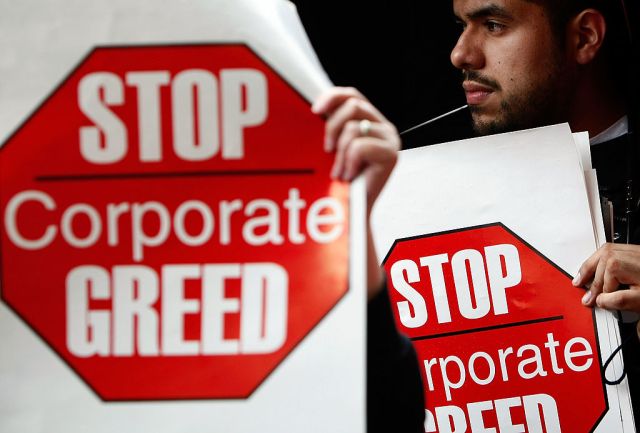
Protests against large corporations are misguided. Credit: Getty





President Trump’s war in Iran is petering out inconclusively. But the smart money — judging by US equity prices — is that American economic resilience will win the day. Many analysts are betting that Iran’s closure of the Strait of Hormuz and other turbulence generated by the recent Persian Gulf war are much more likely to squeeze Europe than either the United States or its Chinese rival.
Which raises a larger question: why is Europe falling behind? The average European is much better off than the average Chinese, and the EU population of 450 million is larger than that of America, with its 324 million. And yet in one industry after another, Chinese or US firms dominate world markets and global rankings. Between them, Chinese and American firms are responsible for 40% of global output.
Even worse, Europe is lagging behind the United States and the People’s Republic in fast-growing, innovative industries, not least artificial intelligence — in part because European R&D spending is half that of its Chinese and American rivals.
The upshot, then, is that the lack of pan-European champion firms that can invent and invest in new technology, dominate the European market, and make inroads abroad, is the fundamental cause of Europe’s lack of competitiveness with the United States and China — not the costs of the European welfare state, or higher labor union density, or export surpluses, or high energy costs, or other factors that are often cited.
Some degree of relative decline by Europe is unavoidable. The economic development of China and other parts of the world naturally is causing both the American and European shares of global GDP to shrink. While shares of world GDP are important for military power, in the long run, progress in an advanced society depends not on overall output, which can be boosted merely by population growth, but on productivity growth — making goods and providing services with less labor and other material inputs over time, thanks to technological innovation.
That’s why Europeans should be concerned by the fact that, between the outset of the pandemic in late 2019 and 2024, labor productivity per hour grew by only 0.9% in the eurozone (in the United States, by contrast, it grew nearly 7%).
Since the Industrial Revolution, labor productivity has mostly been driven by technological innovation. Today’s libertarians, trust-busters, and populists don’t want to hear it, but modern technological progress isn’t incremental and driven by constant competition for customers among many similar firms. Rather, it is transformational and driven by radical technological breakthroughs whose development and deployment must be paid for by the deep pockets of giant firms, along with governments and huge pools of venture capital.
Laptops didn’t evolve incrementally as a result of free-market competition among manual typewriters; they drew on new technologies, originally developed by the US government and big firms like IBM, rendering typewriters obsolete.
The economist Joseph Schumpeter coined the term “creative destruction” to mean the replacement of entire products and entire industries by technological innovation, which he described as a “process of industrial mutation that incessantly revolutionizes the economic structure from within, incessantly destroying the old one, incessantly creating a new one.” In the words of Schumpeter: “The capitalist achievement does not typically consist in providing more silk stockings for queens, but in bringing them within reach of factory girls.”
Nylon stockings for women were made possible by corporate chemistry labs and mass-production factories — Big Chemistry and Big Factory, to use the pejorative language of today’s antitrusters — not by competition among small businesses. Contra Hollywood and business-school mythology, the next big breakthrough technology isn’t going to come from a college dropout in his parents’ garage or an eccentric solitary inventor with Einstein hair.
When laptops wiped out typewriters, and nylon stockings replaced cotton and wool stockings, they wiped out a lot of jobs. That’s OK. A dynamic technological economy doesn’t have to be anti-worker. On the contrary, high wages give employers an incentive to substitute technology for labor. But it must be easy to close down failing businesses and shrink obsolescent industries, while transferring workers as painlessly as possible to dynamic firms and growing sectors.
Economists call this “labor-market churn.” According to the US Federal Reserve, during the recession that came in the wake of Covid, three times as many American as European workers changed jobs, even though the workforces of the United States and the European Union are comparable in size.
While the European social model has much to teach America in terms of social insurance and sectoral collective bargaining, all too often, the attempt to preserve specific jobs means preserving specific companies and specific industries, as well, and this reactionary preservationism comes at a price in an era of transition from one techno-economic paradigm to another.
The reason is simple. There are two ways that technological innovation can spread throughout the economy. One is the brutal Darwinian method — the early adopters of innovation wipe out their less-innovative rivals and replace them. A gentler alternative to mass extinction is for government to diffuse technological innovations to small businesses, which, unlike big firms with deep pockets or promising startups with rich backers, lack the ability to invest in R&D and new machinery or software.
As a guest of the French government some years ago, I met with local officials seeking to create their version of Silicon Valley. Using a 1960s-vintage overhead projector, they showed me a diagram of links and partnership among a dozen local firms and educational institutions and asked what I thought of their plan. I explained: “In the United States, we are much more Darwinian. A few successful firms drive the others out of business and absorb their workers and assets.” An official smiled ruefully and said, “In France, no institution can ever be allowed to die.”
It is true that there have been successful examples of this kinder and gentler, non-Darwinian approach to the diffusion of new technologies. In America, land-grant universities helped modernize American agriculture by diffusing scientific and engineering breakthroughs to existing family farmers with the help of county extension agents. In Germany, the Frauenhofer Institute offers R&D and technological instruction to small and medium enterprises that otherwise might not be able to afford them.
As a practical matter, however, the Darwinian, winner-take-all method is the quickest and most efficient way to bring about a technological upgrade of an economy. The permissive attitude toward firm destruction in the United States has allowed firms with new internet-based models — Amazon (retail), Office Depot (hardware), Lowe’s (home supplies) — to annihilate many of their struggling and technologically primitive Mom-and-Pop store rivals. And America’s permissive approach to mergers and acquisitions allows startups to grow by incorporating other companies and likewise permits entrepreneurs to sell innovations to existing big firms that can provide scale.
The Darwinian method of technological development and diffusion by individual firms only works if the baby tyrannosaur, after hatching, can grow to great size. The most technologically advanced sectors of the economy, like manufacturing and software and telecommunications, are characterized by increasing returns to scale or network effects that reward sheer size. In these sectors, free-market competition will quickly result in the elimination of many firms and the domination of an industry by one or a few winners — not because the winners are cheating monopolists, but because they benefited as lucky first movers from the ability to scale up rapidly.
The ability of dynamic firms to scale depends not only on permissive competition laws that allow some firms to die and others to grow or merge, but also on the size of the market, both at home and abroad. Populous countries, including China and the United States, tend to dominate the Olympic games and other international sports competitions. Darwinism again! The best soccer players from Brazil (213 million people) tend to be better than the best soccer players from Suriname (population 645,000).
As with athletes, so with corporations. Companies from Japan and Germany do well in global trade in part because Japan and Germany are the two most populous democratic capitalist industrial nations, after the United States. And as a rule in Europe, the wealthier nations have the largest shares of their workforces employed by large and medium firms, like Sweden, France, and Germany, while the countries with the highest employment by small businesses tend to be poorer (Greece, Italy).
China’s national champions are supported by the state in various ways intended to minimize the Middle Kingdom’s reliance on foreign technology and foreign firms. They include Huawei in telecom, Xiaomi in consumer electronics, and the Aviation Industry Corporation of China. Both Europe and the United States have imposed tariffs to protect their own automobile companies from China’s state-sponsored electric-vehicle champion, BYD.
Having lost global market dominance to China in many manufacturing industries, the United States holds its own in IT thanks to American champions like Microsoft, Apple, Alphabet, Meta, and IBM. In the AI race with China, the American team is led by giant firms including Nvidia, Anthropic, and OpenAI.
What about Europe? Apart from Airbus, there is no pan-European techno-industrial giant comparable with these Chinese and American titans. To be sure, there are national champions based in individual European nations: France’s Dassault Rafale in defense, Germany’s BMW and Volkswagen in auto. As one observer notes, “Europe is a graveyard of failed [pan-European] national champions. They span from the glamorous Concorde to obscure ventures like pan-European computer consortium Unidata or notorious Franco-German search engine Quaero” (googling became a verb; no one remembers Quaero).
Attempts to create purely national, rather than pan-European, champions have often failed, as well. After World War II, the British government sought, by means of mergers and industrial policy, to consolidate inefficient industries and create colossal British national champions that could compete with the big American firms: British Steel (steel), British Leyland (auto), International Computers Limited (IT). The execution was a failure, but the strategy was sound, as we can see from the success of immense Chinese and American firms.
Unfortunately, European “competition policy” — what in the United States is called antitrust — is a major obstacle to the scaling up of European firms that can boost productivity and compete with those of China and the United States at the global level. In 2019, the European commission refused to allow a merger between the two biggest train-signaling and railcar systems companies, Germany’s Siemens and France’s Alstom, even though the new corporation might have dominated markets outside of Europe as well as within.
Unable or unwilling to understand the industrial economics of imperfect markets and economies of scale, European competition-policy advocates (along with American progressive and populist antitrusters) cling to pre-industrial free-market dogma. According to Margrethe Vestager, a former EU competition policy officer, “competitiveness within a single market translates into external competitiveness.” On the contrary, as China’s and America’s national champions demonstrate, dominance of a single market translates into competitiveness in global markets, and that kind of dominance can never be obtained if a national or bloc government insists on mechanically breaking up successful companies or preventing mergers in order to keep companies small.
Within Europe, there is growing recognition that scale matters in productivity growth and global commerce. French President Emmanuel Macron has proposed that companies be allowed to increase their scale by consolidation, and the lowering of barriers to a single truly integrated European market in strategic sectors. In Germany in 2019, at the time of the EC anti-merger ruling, Economy Minister Peter Altmaier proposed an industrial policy involving the creation of European national champions.
From a technocratic point of view, creating a genuine European single market in which pan-European national champions can be born and grow to compete with Chinese and American titans in global markets makes sense. Is it politically realistic? It will be difficult.
Viktor Orbán may have lost his bid for re-election, and Trump may have alienated his European allies on the Right, but “national sovereigntism” will remain a major force in European countries. The attempt to create a single European market in labor, in which Albanians and Poles willing to work for lower wages could move to Britain, backfired and motivated Brexit. And while pseudo-populists may campaign as nationalists and then govern as pro-business transnational neoliberals, nationalism is likely to ensure that the project of creating genuine “single markets” in European labor, services, banking, and energy is doomed.
But a compromise between a single European superstate and a nationalist Tower of Babel might be found in the idea of a “multi-speed Europe” in which some member nations can agree to greater integration in certain sectors without requiring others to join them. Already membership in the Eurozone currency bloc and the Schengen Agreement governing border checkpoints are examples of differential integration. If a few of the larger European countries like Germany and France agree to support European champions in particular strategic industrial sectors, it should not be necessary to give Malta, Luxembourg, and Cyprus a veto. The inspirational success of Airbus should negate the paralyzing memory of failures like the Concorde.
To call a company or an industry a “dinosaur” is usually to dismiss it as doomed to extinction. But in today’s global Jurassic Park, to avoid extinction, Europe needs some young, vigorous dinosaurs of its own.
Correction: An earlier version of this essay misstated the population of Suriname.