




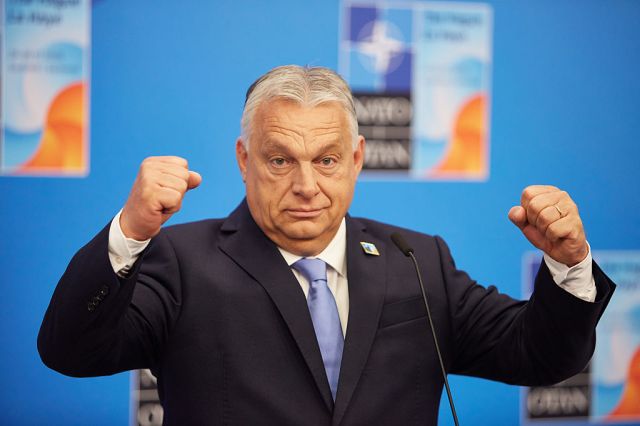
Will Orbán pull off a last-minute victory? (Pierre Crom/Getty)





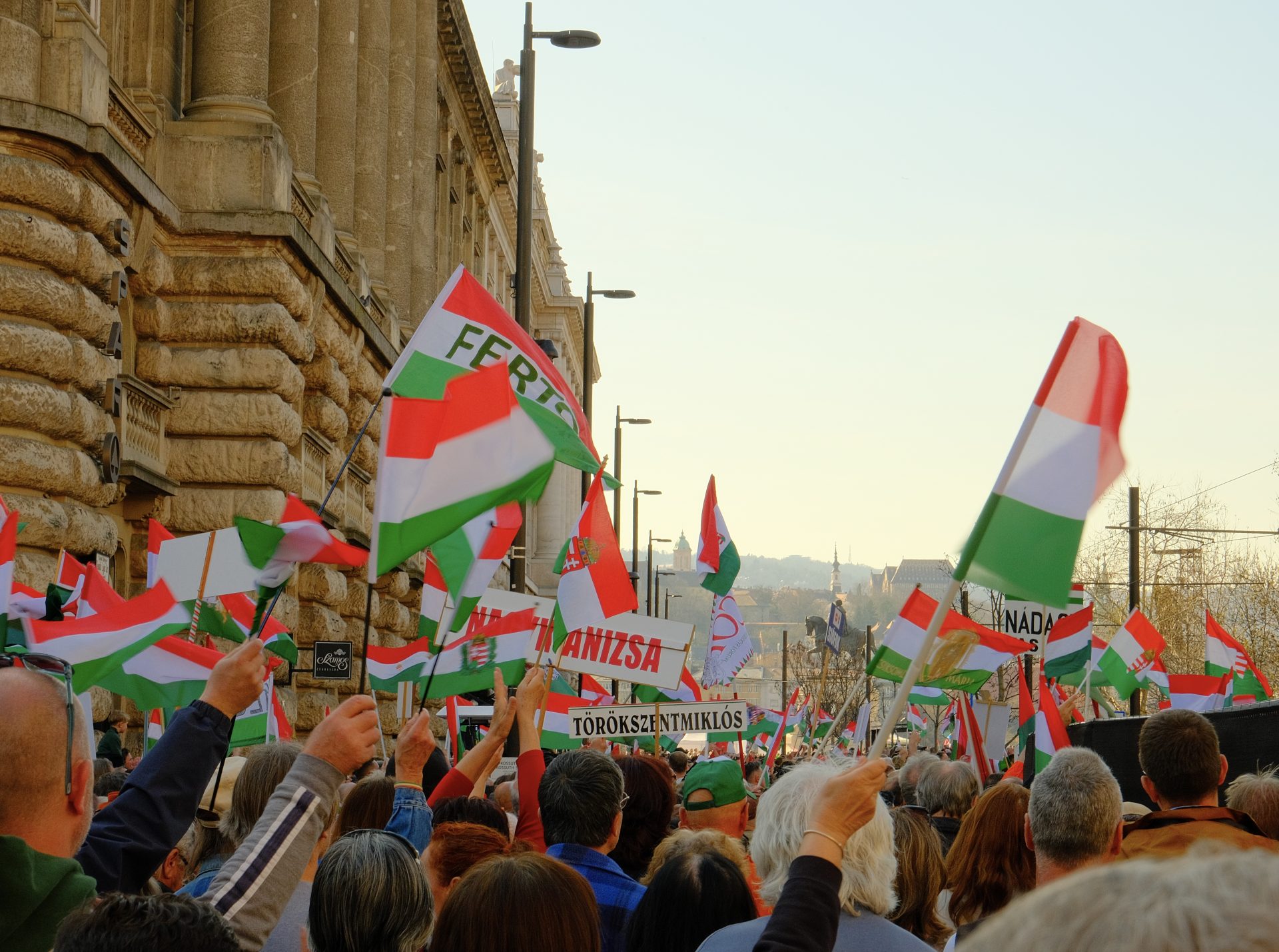
On 15 March, perhaps 100,000 supporters of Hungary’s Fidesz government packed central Budapest for the country’s national day. They filled the boulevards and bridges in the spring sunshine, for what had been billed as a peace march, against deepened involvement in the Ukraine war. With Viktor Orbán facing, in Péter Magyar’s Tisza Party, the greatest challenge yet to his 16-year-long rule, this mass demonstration was to be a show of both support for the current government, and a means to portray its opposition as pro-Ukraine warmongers.
In the election’s final days, the tone of campaigning has become unusually dark, with both sides accusing each other of being the playthings of foreign intelligence services, conjuring apocalyptic visions of the other’s victory. The news cycle is now dominated less by campaign pledges than by competing leaks of wiretaps, intelligence service interrogations, arrests and accusations of treachery and espionage. The claims and counter-claims, simultaneously dramatic and unprovable, are as dizzying as they are plausible. Even independent commentators, like the former leader of the Green Party András Schiffer, now allege the British, French, German, Polish and Baltic security services have involved themselves in influencing the election’s outcome, while journalists and activists supportive of the opposition assert Russian interference and looming false flags to keep the incumbent in power.
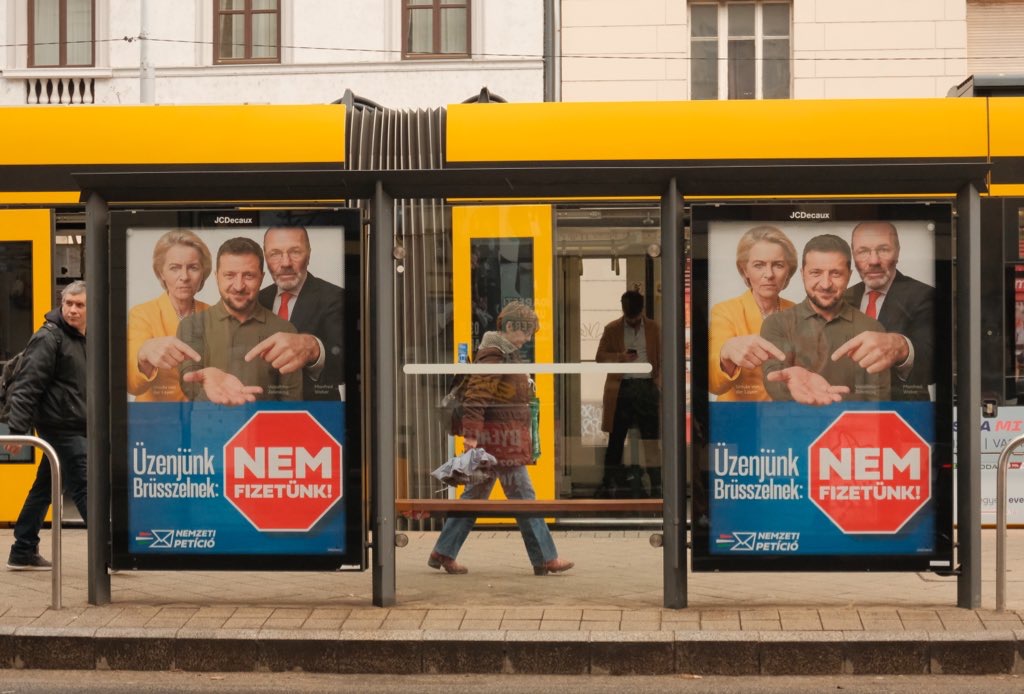
In the meantime, Volodymyr Zelensky’s face looms everywhere here in Budapest: in posters depicting him smugly reaching out his hand for Hungarian taxpayers’ money, or cackling evilly at passersby. As Hungary’s relationship with Ukraine, frosty at the beginning of the war, has dramatically worsened, it feels as if Ukraine itself, personified by its leader, has become Orbán’s primary antagonist in the election.
According to Gábor Győri, a political analyst from the progressive Policy Solutions think tank, this focusing on Ukraine is a tried-and-tested Fidesz tactic. Aware that the opposition’s strength lies in Hungary’s faltering economy, Ukraine is a useful external enemy for Orbán — one previously played by transnational migrants and their NGO lobbies; Brussels; and the international LGBT movement. “Since the war seems like a stalemate from a Hungarian perspective,” Győri told me, “and it hasn’t moved that much in Hungary’s direction, the recent effort has been to portray Ukraine as an active threat.” At the beginning of the war, Hungary condemned the Russian invasion, sent humanitarian aid to Ukraine, and opened its borders to Ukrainian refugees, despite Orbán’s amicable relationship with Vladimir Putin. Yet since then, Győri observes, “it has shifted to saying that, well, Russia was provoked, to now saying that, essentially, Ukraine is the culprit, the really aggressive power, so much so that they are a threat to Hungary. And I’m not sure if they can sell this, to be honest, but that’s the effort now.”
At least in liberal Budapest, not everyone is on message: it is common to see posters linking Magyar to Zelensky torn off advertising columns, or defaced with stickers saying “Vile, Deceitful Propaganda”, “Dirty Fidesz”, or simply, “Shit”. But at the Peace March, the message seemed to play well enough among the crowd, which had thronged to Budapest’s vast neo-Gothic parliament behind a banner declaring: “We will not become a Ukrainian colony!” “Viktor Orbán is one of the few in politics who is proud to be Hungarian,” attendee Marco, 42, told me, “But Tisza and Péter Magyar, I think he will make steps outside of Hungary, maybe in Brussels against his own country, against the government, and this I think is not correct.” The crowd cheerily waved placards demanding “Stop War!”, and when Péter Szijjártó, the foreign minister, gave his speech railing against the “Ukromafia” the crowd booed Zelensky’s name like a pantomime villain.
The Kyiv government, which has at times exasperated its European allies with a demanding and sometimes alienating approach to diplomacy, is partly to blame for the worsening of its relationship with Hungary. The European Union has sided with Hungary and Slovakia in the dispute over Ukraine’s closing of the Druzhba pipeline, which carries the cheap Russian oil on which both countries depend, and whose smooth operation, despite the war, is a central plank of the Fidesz electoral offer to voters. By apparently directly threatening Orbán, Zelensky recently earned another direct EU reprimand. As relations worsen, Hungary has used its veto to block the EU funding package on which the Ukrainian state survives, while Hungarian intelligence officers recently arrested their Ukrainian counterparts transporting a shipment of money across Hungary for what was heavily implied to be nefarious purposes.
In response, Zelensky’s security services arrested a Hungarian alleged to be running Budapest’s spy network in Ukraine’s Zakarpattia oblast, home to the country’s Hungarian minority, and long an area of contention between the two countries. Despite multiple requests, neither Tisza nor the Ukrainian foreign ministry agreed to an interview for this piece. The Hungarian government was more accommodating, offering unusual access to some of its senior leadership. Framing a Tisza electoral victory as a risk to Hungary’s energy security and neutrality, Péter Sztáray, State Secretary for Security Policy and Energy Security, told me “We [would] have to let through weapon deliveries through the Hungarian-Ukrainian border… while, at the same time, Ukraine is closing our energy supply, Ukraine is shrinking the rights of the national minority communities, including the Hungarian community. So why should we do that? And their political messaging is very insulting at the same time.”
Now, the war next door has moved from a source of background anxiety for Hungarian voters to the very foreground of Fidesz’s campaign. As polling day nears, it is more openly being alleged by government figures that Tisza is directly funded by Kyiv, and that it is infiltrated by the Ukrainian intelligence services. In a rather dubious riposte to claims of electoral inference, the Ukrainian government last week launched a 24-hour Hungarian-language radio broadcast, aimed directly at Hungarian voters. Should Orbán pull off a last-minute victory, despite the strong polling lead claimed by the opposition, it is difficult to see how the relationship with Kyiv could be salvaged. For Fidesz, it may not matter. Hungarian government policy is driven by the assumption that, however long it takes, Ukraine will eventually lose the war, and the rest of the EU will slowly come around to this reality, just as it eventually did on Hungary’s isolated stance on the 2015 migrant crisis. As a consequence — and fueled by equally hostile rhetoric from Kyiv — a working relationship with Hungary’s larger neighbor is seen as an acceptable sacrifice for a domestic election victory.
A few days after the march, I asked one of the most powerful men in Hungarian politics, Balász Orbán — Viktor Orbán’s strategic advisor, and campaign manager — whether the temporary demands of the election were setting up a longer term enmity with its larger neighbor.
“The conflict between Hungary and the Ukrainian leadership is based on three issues where we have complete disagreement, and there is no in-between,” he replied. The first, Orbán said, was active financial and logistical support for the war against Russia. “We don’t want to finance the war, we don’t want to give our weapons to them, and we don’t want to send soldiers for Ukraine.” The second issue is European Union membership for Ukraine: “it goes also against the interest of Hungary, because if anything happens in Ukraine, it would mean that we are in the war. And the second thing is, we don’t want to be a net contributor.” The third issue “is the Russian energy. In this situation, when the Middle East is blowing up and energy prices are again skyrocketing, we cannot say no to Russian energy, simply it goes against the interest of Hungary, and I think it goes against the interest of all other European nations. These are the three critical issues, and these are just black and white issues. So either we give it up and we surrender, or we keep our positions.”
Yet while the Tisza party is portrayed by the Hungarian government as zealous pro-Kyiv radicals, and is indeed heavily promoted by Ukraine’s excitable online fanbase on this basis, Magyar himself has avoided talking about the war on the campaign trail. Indeed, in his rare interventions so far, Magyar, a former Fidesz functionary and conservative nationalist, has seemed to echo Orbán’s policy platform, opposing sending weapons to Ukraine; insisting that Kyiv’s EU bid should be subject to a Hungarian referendum it would almost certainly lose; and stressing that weaning Hungary off Russian energy would take at least a decade. Hopes in Brussels or Kyiv of a post-election about-turn in Hungarian attitudes to Kyiv seem unlikely to survive the apparent inclinations of Magyar himself, let alone the broader suspicions of the Hungarian electorate.
Four years ago, the risks and uncertainties brought about by Russia’s invasion of Ukraine helped turn the tide in an election campaign where Hungarian voters seemed, until the results came in, to be leaning toward the opposition. The Fidesz messaging at the time, that Orbán’s long track record of steady governance was the safest option in a volatile international situation, is now being replayed, in an election where the opposition would rather focus on Hungary’s domestic problems. But the rhetoric has, since 2022, dramatically escalated, with the added novelty of Ukraine itself now being presented as a direct threat to Hungary’s sovereignty and security. Now both sides are trading accusations that their rivals are deeply enmeshed with foreign security services, working against the national interest.
If it is confusing and exhausting for foreign journalists, it must be doubly so for Hungary’s voters, 79% of whom believe foreign intelligence agencies will attempt to meddle in the election. On Easter Sunday, the Hungarian government, alongside its regional ally Serbia, revealed what it has claimed to be a plot to sabotage the vital Turkstream gas pipeline with explosives, a development that Magyar has immediately claimed to be a false flag to sway or delay the election. As Hungary’s hard-fought and ill-tempered campaigning season approaches its climax, the European Union’s most important election of the year has now fully adopted the murky and paranoid tone of a spy novel.
