








Once upon a time, no conversation about Playboy magazine was complete without a jab at the oft-repeated claim by certain men to read it for the articles — which was broadly understood to be nonsense, the pretend literacy of the shameless horny liar.
But today, on the eve of what would have been the centennial birthday of Playboy progenitor Hugh Hefner — and two decades into the era of ubiquitous, hardcore, high-definition internet porn that makes Playboy’s softly lit, artfully posed centerfold look positively quaint, even pre-Raphaelite, by comparison — I must grudgingly admit that the defense of the nudie magazine as literary artifact seems a lot less ridiculous than it once did. Did anyone read Playboy just for the articles? Probably not, and yet there was a time, not so long ago, when they plausibly could have. It was a golden era of great tits and great journalism, where lust and literacy still existed in conversation, rather than in conflict.
Playboy launched in 1953 with a singular purpose, filling what its creator saw as a gap in the world of leisure reading for men. For the outdoorsman, there was no shortage of content; but for his urban counterpart? A sad state of affairs: there were but two magazines for what Hefner called “the city-bred male”, and these were woefully overstuffed with service journalism. An editorial note in the opening pages of Playboy’s first volume lamented the excessive focus on “fashion, travel, and ‘how-to-do-it’ features on everything from avoiding a hernia to building your own steam bath”, all of which came at the expense of fun.
“PLAYBOY will emphasize entertainment,” Hefner promised. “Affairs of state will be out of our province. We don’t expect to solve any world problems or prove any great moral truths. If we are able to give the American male a few extra laughs and a little diversion from the anxieties of the Atomic Age, we’ll feel we’ve justified our existence.”
That first issue, in its time, was most notorious for featuring a pictorial of Marilyn Monroe in the nude — photos taken in 1949 before she was famous, or even a blonde. But today, the most remarkable thing about that first volume is its capacity to transport us back to a world where attention spans had not yet been decimated by the advent of the endless scroll, where a magazine might make for an afternoon’s leisure.
The centerfold makes for a spectacular gimmick, but most of Playboy was text, and longform text at that; the inaugural issue contained three works of short fiction, journalistic dispatches from the worlds of college football and jazz music, a combination investigative report and opinion piece about alimony with the self-explanatory title, “Miss Gold-Digger”, and a recipe for Cuban chicken. There are also a number of single panel cartoons and a page of quaint, short-form japes that my grandfather would have called “dirty jokes” and a contemporary HR department would call “creating a hostile work environment”:
An elderly gentleman visited his doctor with the complaint that he believed he was becoming impotent.
“When did you first become aware of this problem?” the doctor asked.
The old gentleman replied, “Yesterday afternoon, twice last night and again this morning.”
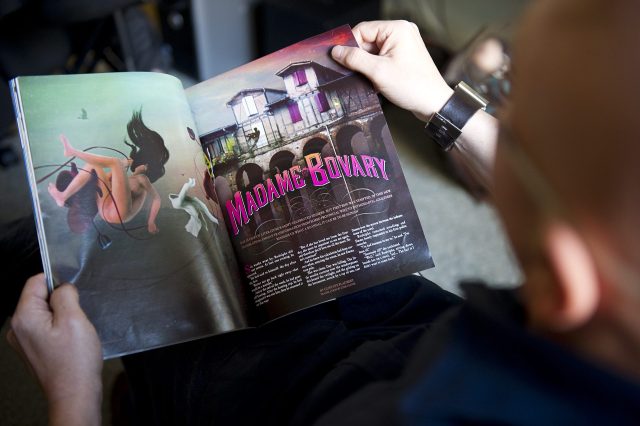
If this all feels somewhat dated now, it was a durable journalistic model: a combination of bawdy humor, cheeky cartoons, and the ever-present centerfold sandwiched between voicey reportage and short fiction from the best storytellers of their generation. Vladimir Nabokov, Joyce Carol Oates, Ray Bradbury, John Cheever: all of these and more graced the pages of Playboy, without embarrassment. Peruse any issue at random, and it’s hard not to be impressed by the magazine’s stylistic consistency over the decades, even as its substance kept pace with the times. In June 1988, 35 years after Playboy’s debut, the world had changed but what constituted “Entertainment for Men” remained the same: jokes, cartoons, journalism, women. Here is Miss June Emily Arth, all creamy skin and sunlit hair like a John Waterhouse painting, tastefully framed by a David Foster Wallace short story on one side and satire of the upcoming presidential election on the other.
This frank sensuality, the uncritical and unselfconscious acknowledgment of sex as simply part of the pantheon of typical male interests along with sports, culture, and cool office furniture, makes vintage Playboy feel not just outdated, but like a dispatch from another planet — one where men’s desires had not yet become problematized, let alone subject to interrogation and scorn. Its editorial vision, which placed it at the cutting edge of the media landscape in mid-century America, hit differently in a post-Y2K world.
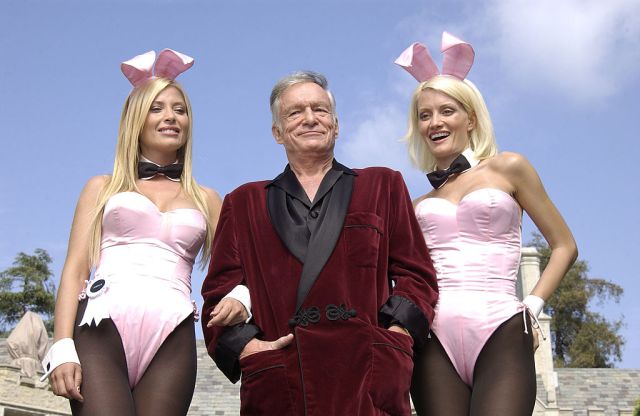
The perspective shift was perhaps best embodied by the transformation of Playboy’s founder over the decades — from a young visionary thumbing his nose at the censorious prudishness of a post-war US, to a creepy old man whose penchant for women six decades his junior was as unseemly as his habit of sporting silk pajamas as daywear. By the time he suffered a fatal heart attack in 2017 at the age of 91, both Hefner and the brand he’d created had grown from a modest print magazine into a massive, multi-million dollar, bunny-headed hydra encompassing everything from nightclubs to fragrances to broadcast media and beyond. They were also, however, synonymous with a sort of dirty-old-man sensibility which the incoming generation of progressive millennial tastemakers found intolerable, not to mention repulsive.
Perhaps unsurprisingly, Playboy magazine has struggled to stay afloat, let alone relevant, in a landscape reshaped by digital technology and rapidly shifting social mores. Its most recent gambit: a quiet launch on Substack, where a mix of archived, classic Playboy material lives alongside newer commissions from contemporary journalists.
“Welcome to The Playboy Reader, the latest development in Playboy’s 73-year history as a literary institution. Yes, Playboy has always featured photos of minimally-clothed women—that’s not changing!—but we’ve been known for our writing, too,” reads the inaugural post.
There was of course a moment when this did change, albeit briefly, a dark night of the soul for Playboy in a world beswarmed by digital porn. In October 2015, the magazine announced that it would no longer publish nude photos; “You’re now one click away from every sex act imaginable for free. And so it’s just passé at this juncture,” explained Scott Flanders, the chief executive, at the time. That decision was reversed two years later, but the identity crisis it represented is ongoing — as is the abandonment of the magazine’s original tagline, “Entertainment for Men”. In 2019, a new editorial staff comprising half a dozen socially conscious millennials — zero of whom were heterosexual men — sat for a New York Times interview about the new “brand vibe” of Playboy: “intimate” but not “explicit”, and “cheeky” but not “cheesy”. The article noted that the company was “working to expand into cannabis, skin care, sex toys and sexual wellness”; the magazine, meanwhile, abandoned its straight-male-skewed content in favor of interviews with politician Pete Buttigieg and MeToo founder Tarana Burke. In 2019, the cover famously featured male actor Ezra Miller wearing lingerie and bunny ears.
You’d be forgiven for wondering exactly who this new Playboy was for, a question evidently overlooked by its creators amid their fervent quest to distance the magazine from its original readers. In addition to now being on Substack, Playboy has a new editor in chief, a new president of media and branding, and a new home in Miami. It also, as far as I can tell, remains more or less completely confused as to its place in the contemporary media landscape, or whether it even has one. Playboy has consciously uncoupled itself from its original vision; it is, explicitly, no longer “entertainment for men”. But negative polarization only goes so far in the attention economy, and for now, Playboy has succeeded largely in intentionally alienating its longtime readership in favor of making content that is attractive to basically nobody.
Some of this, to be sure, is about the new prudishness of the digital native. Gen Z, so awash in ubiquitous online porn and yet so peculiarly sexless in real life, is understandably bewildered by the notion of a magazine that is made more for titillation than masturbation, that invites the specter of sexuality to cavort playfully through its pages but also expects its reader to actually read.
But if this represents a fundamental misunderstanding of Playboy‘s literary appeal, it is even more a misapprehension of men and what they want. Pictures of naked women? Yes, of course, but not only this. Even before the advent of Pornhub and the internet it rode in on, the man who preferred his smut unadulterated would naturally decamp from Playboy to baser pastures; there was Hustler, Penthouse, X-rated video cassettes, an entire rack on the newsstand of B-list publications that contained significantly fewer words and a lot more exposed labia than Hefner’s magazine cared to feature. Playboy valued and published quality writing because its readers were, in fact, readers. They were also men who liked women, and liked looking at them, and saw no conflict between these things because, in fact, there was none.
Today, the consensus seems to be that only a vulgarian could be so comfortable with so little separation between sex and the rest of it, that we are better off for having replaced the casual, ambient eros of the mid century with a world in which sex is both optimized and compartmentalized, guarded by formality and confined to a designated time and place. Behind closed doors; behind the paywall; within the safe and transactional confines of a parasocial and paid relationship on OnlyFans. But if this has been an effective means of banishing sex from places it perhaps doesn’t belong — like the office utility closet — it has also squeezed from the discourse a certain joie de vivre, a certain cheeky symbiosis between high culture and animal instinct, a certain winking acknowledgment of love and lust as powerful forces which (as the song says) birds, bees, and even educated fleas are helpless to resist.
Maybe it’s too late for Playboy, specifically, outdated as it is in the post-MeToo era, and tainted as it is by the distasteful image of Hef tottering around in a silk smoking jacket and captain’s hat like the cadaverous Ghost of Stag Parties Past. But the readers it existed for — the men who contained multitudes enough to enjoy a spectacular piece of writing on one page, and an equally spectacular pair of breasts on the next? I’d like to believe they’re still out there, still waiting to be entertained. They would read it for the articles, whatever it is; perhaps the real question is whether anyone is bold enough to write them.
Kat Rosenfield is an UnHerd columnist and co-host of the Feminine Chaos podcast. Her latest novel is You Must Remember This.
 katrosenfield
Join the discussion
Join like minded readers that support our journalism by becoming a paid subscriber
To join the discussion in the comments, become a paid subscriber.
Join like minded readers that support our journalism, read unlimited articles and enjoy other subscriber-only benefits.
Subscribe