




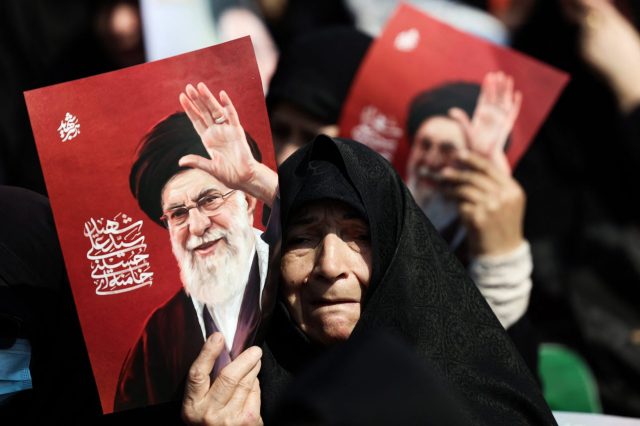
'Predictions of imminent collapse in Tehran have often proved misplaced.' (Credit: AFP/Getty)





From bombings back to the Stone Age, to the very death of Iranian civilization, Donald Trump’s language towards the Islamic Republic has long been an object lesson in hyperbolic brutality. Yet his threats — whether as political strategy, or as what a senior diplomat calls “cultivated unpredictability” — fail to grasp a basic point: force can’t break a society. What the President long failed to understand, and is only partially grasping even now that negotiations are underway, is that countries are held together not merely by institutions or coercion, but more profoundly by narratives of suffering. Iran is one such country. In a different register, my native Ireland is too, even as it offers hints at how the Iranian regime may finally collapse.
The Easter Rising of 1916 and the martyrdom of Husayn at Karbala more than 12 centuries earlier may belong to radically different historical worlds. One was an abortive insurrection in the capital of “West Britain”; the other a 7th-century massacre on the plains of Iraq, when Husayn, the Prophet Muhammad’s grandson, was slaughtered with his family by the forces of the Umayyad caliph Yazid. Both, however, acquired their enduring force from the afterlife of sacrifice. In each case, bloodshed was transfigured into drama, defeat became moral victory, and death became a claim upon the living. Patrick Pearse, architect of the Rising, understood this instinctively. His language of “blood sacrifice” was not just a metaphorical flourish — but a statement of political theology.
In their stupidity, the British supplied the necessary martyrs. What might have remained a failed rebellion became the founding narrative of the Irish state — a drama replayed in commemorations, monuments, and even the naming of railway stations after the dead heroes. The molding of martyrdom into nationhood also opens avenues for satire, when the language of redemption, once detached from lived suffering, becomes performance. Seán O’Casey saw this with pitiless clarity in Juno and the Paycock. His Captain Boyle, a man sustained by bluster and fantasy, converts St Paul’s grave defiance — “O death, where is thy sting?” — into music-hall bathos: “Death, where is thy sting-a-ling?” The line gets a laugh, but it should also give pause.
In Shia Islam, the paradigm is older, deeper, and more systematically ritualized. The martyrdom of Husayn is not simply remembered; it is re-enacted. Through the commemorations of Ashura — with processions, lamentations, ritual self-flagellations and passion plays — Karbala is made permanently present. It furnishes what might be called a “grammar of endurance”: oppression confirms rather than negates the moral order; suffering anticipates vindication. The parallel with Ireland is not exact, yet in both cases geography is secondary to narrative. What matters is the structuring idea: that unjust death generates authority, that sacrifice binds community, and that loss can be converted into a durable political resource.
This grammar acquired a specifically national form in Iran with the Safavid revolution of the 16th century. Here the new ruler Shah Ismail shifted from being the awaited imam or messianic figure of his Turkoman followers and adopted Twelver Shiism as the state religion. In Twelver Shiism, the true imam in the line of Ali and Husayn remains in “occultation”. This means that his awaited return, at which point he will bring about universal peace and prosperity, is deferred indefinitely. In adopting this theology, Shah Ismail did more than enforce a doctrinal shift. He also marked out a civilizational boundary. Iran came to define itself not only against its immediate rivals but against the Sunni ecumene dominated by the Ottoman Empire, whose legal and institutional life was shaped by Hanafi legal orthodoxy. The adoption of Shiism thus functioned as a form of geopolitical differentiation: a way of inscribing religious distinctiveness into the fabric of statehood, not dissimilar to the way Ireland resisted the imposition of Anglican Protestantism by embracing Roman Catholicism, a doctrine imposed on the ancient Irish church by enthusiastic Vatican appointees.
Over time, Persian historical consciousness became fused in part with a sacred history whose emotional center, like that of Ireland, lay outside the nation’s borders, at Karbala, while its eschatological horizon pointed toward the return of the Hidden Imam — one whose return will signal the end of the world — in the line of Ali and Husayn. The result was a national identity underpinned by a narrative in which injustice, suffering and deferred redemption were not contingencies — but structuring principles.
Seen in this light, the resilience of the Islamic Republic — which has both confounded and annoyed Trump — is hardly surprising. What sustains it is not simply repression, nor even ideology in the narrow sense, but a historically sedimented fusion of religion, memory and nationhood. External pressure, instead of weakening resolve, risks activating precisely those symbolic frameworks that transform adversity into confirmation of purpose. This is not confined to Iran. Across the Gulf, in Bahrain and in Saudi Arabia’s Eastern Province, Shia communities remain politically marginalized. In Lebanon, their more activist community faces obliteration by Israel. The 2016 execution of the cleric Nimr al-Nimr in Saudi Arabia was intended as deterrence. Instead, it functioned as martyrdom — a contemporary re-enactment of the Karbala paradigm, especially with its transnational resonance. Pressure on Iran cannot be neatly contained within its borders. It touches a wider theater in which sacrifice remains a potent political force.
The Irish comparison is illuminating precisely because it is asymmetrical. Irish Catholicism formed part of a universal Church extending far beyond the island, while Twelver Shiism was historically a minority tradition that became nationalized. Yet both sustained identity under pressure through narratives of suffering and perseverance. In Ireland, after all, Catholicism functioned as a carrier of national identity under Protestant domination; in Iran, Twelve Shiism performed a comparable role vis-à-vis a wider Sunni world. In both cases, martyrdom provides a language through which political weakness can become the catalyst for moral agency.
The complementarities are not total. Irish national identity, articulated largely in the English language after the erosion of Gaelic, and the Vatican’s historic preference for Latin over the vernacular, lacked the linguistic distinctiveness that often anchors nationalism. It therefore required symbolic intensification. The cult of 1916 compensates for that absence. Martyrdom, in this sense, becomes a substitute for language: a means of binding community through shared acts of remembrance rather than through linguistic difference.
Yet there are instructive parallels when it comes to education. In mid-20th-century Ireland, the Catholic Church exercised a form of soft theocracy, controlling schools, shaping curricula, and supplying a moral intelligentsia through institutions such as the famous Maynooth seminary. If the language of sacrifice helped sustain Irish Catholic identity under external domination, it was the later exposure of clerical abuse that corroded its moral authority from within. From the Nineties onwards, a succession of official inquiries — most notably the Ryan Report and the Murphy Report — laid bare a pattern that was not merely episodic but systemic: the abuse of unmarried mothers and their children by clergy and religious orders, compounded by institutional habits of concealment, transfer, and denial. What shocked Irish society was not only the scale of the wrongdoing, but the disjunction between the Church’s historic role as guardian of national virtue and its failure to protect the most vulnerable within its care.
The consequences were profound. A Church that had once exercised near-hegemonic influence over education, welfare, and the moral imagination of the state found its authority abruptly relativized. Attendance at Mass declined, vocations dwindled, and the deference that had long insulated clerical authority gave way to scrutiny, anger, and, in many cases, indifference. The symbolic economy of sacrifice — so central to both Catholic devotion and nationalist memory — was inverted. No longer did suffering signify redemption; it testified instead to betrayal.
For now, the Irish case may diverge from the Iranian one. After all, while the Islamic Republic has certainly faced its own crises of legitimacy, its clerical establishment has not been discredited by a comparably documented pattern of abuse against children within religious institutions. The persecution of gay behaviors, however obnoxious, may not yet be seen as conflicting with mainstream Islamic values. The erosion of authority in Iran proceeds along different lines — political repression, economic mismanagement, generational estrangement — rather than the moral implosion triggered in Ireland by revelations of clerical wrongdoing. But the crash may yet come: if and when the horrors of the brutal repressions earlier this year come to light.
Perhaps Ireland will point the way. Maybe O’Casey’s instinct about the fragility of sacred language is instructive. Here the idiom of martyrdom that once underpinned national cohesion now carries a more ambivalent charge: still potent as memory, but no longer sustained by an unquestioned ecclesiastical authority. Once the credibility of the institution that utters it is compromised, the rhetoric of sacrifice risks tipping into parody. The distance between “thy sting” and “sting-a-ling” is not merely comic. It marks the point at which a culture ceases to believe its own consolations.
There’s an irony here. The educational system overseen by the Church proved unexpectedly effective. The rigor of the Leaving Certificate, often contrasted favorably with the British A-level system, helped produce a highly literate and analytically capable population. The same structures that enforced conformity also cultivated habits of critical judgment. When the Church’s moral authority collapsed in the wake of abuse scandals, those habits enabled a remarkably swift cultural shift. Within a generation, Ireland moved from one of the most observant societies in Europe to one of the most secularized.
A comparable paradox may become visible in Iran. The Islamic Republic has invested heavily in education, expanding literacy and higher education to levels that place Iranian students in competitive global standing, particularly in science and engineering. Despite rules forcing them to adopt the headscarf, women have achieved striking levels of educational attainment. As the researcher Rasmus Nielsen has noted in his global survey of secondary science education, the teaching of science, including evolution, in Iran is on a par with that of most Western countries.
The comparison with the Sunni world is instructive here. Even in relatively secular countries such as Turkey the teaching of evolution — a prerequisite for basic science education — has been marred by culture wars similar to those raging in parts of America. In Saudi Arabia, Iran’s principal Sunni rival, evolution is barely mentioned in secondary education texts except in advanced biology courses, where it is introduced as “a fallacious and blasphemous theory derived by the Englishman Charles Darwin, who denied Allah’s creation of humanity”.
As in Ireland, Iran’s educational attainment carries an inherent tension. A system designed to reproduce ideological conformity has helped create a population capable of questioning the very structures that govern it. The protests that erupted with the 2009 Green Movement, and after the death of Mahsa Amini 13 years later, were not only about patriarchal rules and clerical authority. Instead, they revealed a deeper contradiction between clerical governance and an educational agenda oriented toward modernization.
The contradiction has intellectual and theological roots. Ernest Gellner’s distinction between Islam as a “cult of the Book” and Christianity as a “cult of the Person” requires modification in this context. It applies most neatly to Sunni Islam and Protestantism. But Shiism, with its focus on the Hidden Imam and its eschatological expectation of return, introduces a principle of personal mediation closer to Catholicism. Its theology, like Catholic Thomism, contains rationalistic elements that can assist the advancement of science. Authority is not confined to text; it is embodied, transmitted, and anticipated. This eschatological horizon intensifies the dramaturgy of sacrifice. Karbala is not merely remembered; it is unfinished. Its resolution lies in the future.
The Iranian intellectual tradition reinforces this dynamic. Shia thinkers from the Ismaili tradition that holds to a Living Imam — that is, a living, present spiritual leader rather than a hidden one — articulated a vision in which reason and revelation were intertwined, and in which truth possessed dimensions that could not be reduced to text alone. One might call this “pre-verbal” revelation. Such frameworks facilitated Islam’s expansion into non-Arab intellectual milieus — from Gujarat to the High Pamirs — where conversion required philosophical depth as well as legal adherence. They also helped embed belief in a structure where adversity itself is meaningful, where suffering confirms rather than undermines the moral order.
What emerges from this comparison is not a simple analogy, but a warning. When sacrifice becomes foundational, politics is tempted to follow suit. The dead acquire authority over the living; compromise begins to resemble betrayal. Pearse’s rhetoric of blood sacrifice has long made Irish liberals uneasy for that reason. The revolutionary deployment of Karbala in modern Iran has similarly enabled the mobilization of grief as a political resource.
Predictions of imminent collapse in Tehran, whether issued from Washington or Jerusalem, have often proved misplaced. You can bomb bridges and clinics, assassinate leaders, tighten sanctions — or even blockade ports and take over ships. But what you cannot easily dissolve is a solidarity rooted in a narrative that interprets suffering as moral, even ontological, vindication. The retreat of the Church in Ireland shows that such structures can eventually unravel, but only from within, and often through the unintended consequences of the very institutions that sustained them. Iran may yet follow a similar path, but not by bombs.