








April 16 2026 - 1:00pm
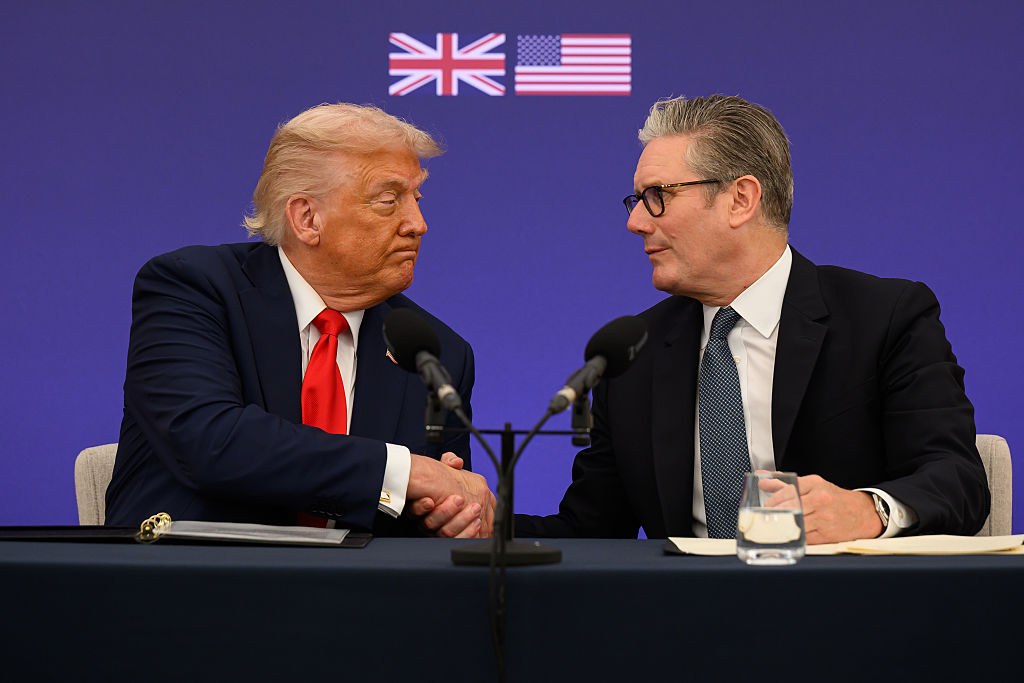
Donald Trump has impeccable timing. Just as the International Monetary Fund publishes its forecast predicting Britain will see the biggest hit to growth prospects of any major economy due to the Iran war, the President threatened to reopen the US-UK trade deal and downgrade the terms. These renewed terms would threaten to turn a bad year into a terrible one for Britain.
Trump is not stupid. He knows that Britain needs easy access to American markets to sustain its fragile economy. Keir Starmer also knows this, and has said that he wants to get closer to Europe to reduce dependence on the United States. This is to misdiagnose the problem. The British economy needs America precisely because of its imbalanced trading relationship with the European Union.
There are three great trade powers in the world at present: the United States, the European Union and China. Britain is currently running trade deficits with two of them: China and the European Union. The British economy is importing £42 billion more from China than it generates in exports. The deficit with the European Union, however, is more than twice as large and stands at just under £90 billion a year. The only major success in terms of trade is with the US, where Britain’s surplus currently stands at roughly £73 billion.
In essence, the problem is that Britain can sell services very easily to the United States because of cultural, linguistic and historic ties, but it is much more difficult to sell them to the EU. On the flip side, demand for European goods has never been greater. This has nothing to do with Brexit but with the country’s dependence on Europe’s energy and goods while solely selling services. In 1999, Britain’s trade deficit with the EU was £11 billion, but by 2015 it had reached £69 billion.
If Britain’s trade deficit worsened while it was an EU member, it is hard to see how things will improve by simply getting closer to Brussels. The real £90 billion question is why the EU would allow this relationship to substantially change when the bloc is doing so well out of it. The only reason to get closer to Brussels is if there is a promise to address this trade imbalance.
Trump’s team knows that to pay for Britain’s weak trade position with the EU and growing dependence on Chinese goods, the economy cannot afford to lose any American trade. This gives the UK no leverage in negotiations, just as Trump likes it. The only thing holding the US back is the huge stock of American investment in the UK, worth over £640 billion. However, this is hardly something to cheer about. Using this in a negotiation would be equivalent to pointing a gun at our own head and threatening to pull the trigger.
All this matters because net trade is currently acting as a drag on growth. The British economy is running a £56 billion deficit because we are spending more on imports than we earn from exports. It is now fashionable in Westminster for former Atlanticists to restyle themselves as “Anglo-Gaullists” and call for greater independence from the US. However, these so-called Gaullists are simply seeking to swap economic vassalage to the United States with economic vassalage to the European Union.
The only way to strengthen Britain’s hand with America is to make the economy more resilient. This means maximizing productive resources (particularly critical minerals and energy), reducing dependence on goods imports through manufacturing, using savings and capital to grow British business, and pursuing a harder-nosed trade strategy with Brussels and Beijing. That would be an Anglo-Gaullism worthy of the name.
Andrew O’Brien is the former Director of Policy at the think tank Demos and currently Head of Secretariat of the Independent Commission on Neighbourhoods. He writes in a personal capacity.
 ADOBrien88
Join the discussion
Join like minded readers that support our journalism by becoming a paid subscriber
To join the discussion in the comments, become a paid subscriber.
Join like minded readers that support our journalism, read unlimited articles and enjoy other subscriber-only benefits.
Subscribe