




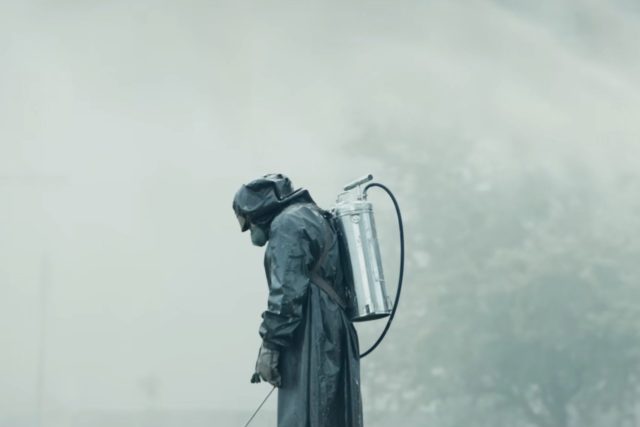
Still from the TV series Chernobyl 2019. (YouTube)





For a substance that could end most life on the planet, highly enriched uranium looks disappointingly bland. The finished metal pellets might be mistaken for a collection of old bottle caps or a bunch of grayish pipe components, such as might be found in a drawer at the corner hardware store. It does not glow. It has only a faint radioactive signature and can be handled with ordinary gloves.
Banal as it may appear when viewed up close, this concentrated form of a uranium isotope is perhaps the most sought-after ornament among nations. It makes intoxicating promises: energy independence, military supremacy, carbon-free electricity, foolproof insurance against regime change.
Just as gold and diamonds have the intrinsic power to trigger acquisitive lust within certain greedy individuals, highly enriched uranium has the same beckoning effect on thirsty nation-states. At least three countries — Iran, North Korea and Pakistan — have dangerously leveraged themselves in its pursuit, spending vast sums of capital on moonshot nuclear programs and nearly starving their own citizens as a result. Producing it inside a massive industrial facility costs at least $150,000 per kilogram once tens of billions of dollars of startup costs have already been sunk. And it is worth exponentially more on a potential black market should it ever be peeled away from close supervision.
The irony of this desire, though, is that uranium has rarely lived up to its utopian promises. In fact, it usually brings a new level of trouble and a welter of unforeseen consequences. The combined hope and disappointment of uranium now serves as a thread connecting various furores and difficulties, national and international. In Britain, the Government’s ambitious Net Zero target has driven up energy costs and prompted renewed calls for a greater reliance on nuclear power. Britain’s peers, too, are rediscovering their interest in this form of energy supply. At the same time, the world is at the mercy of the crisis in the Middle East, at whose heart is the longstanding problem of Iran’s nuclear program and the unknown fate of its stockpile of highly enriched uranium (HEU).
US and Israeli bombing missions have demolished the above-ground campus of the enrichment facilities at Isfahan and done an unknown amount of damage to the subterranean chambers where scientists reportedly built an assembly line of centrifuges to do the delicate work of separating the wobbly isotope U-235 from the “natural uranium” of U-238. Since the former occurs in a ratio of about 0.7%, this is like picking a few red sprinkles out of a bowl of cupcake batter. The U-238 must be reduced to uranium hexafluoride gas and run through the spinning centrifuges hundreds of times before the substance can become fissile enough to sustain a chain reaction — a state known as weapons-grade.
Notoriously, President Trump claimed that Iran’s nuclear bomb factories at Natanz, Isfahan and Fordo had been “completely and totally obliterated” in a joint Israel-US air attack last June, an assertion he contradicted in a Florida speech on March 27 in which he admonished listeners: “Remember, they were two weeks away… If we didn’t knock the hell out of them, they would have had a nuclear weapon within two to four weeks.”
The more sober assessment by most intelligence agencies — that Iran’s enrichment capabilities have been significantly degraded — still leaves open the question of what happened to the estimated 400 kilograms of HEU that may still by lying in the wreckage, and whether the US military should commission a commando raid to seize or destroy the canisters of gaseous material — if they are even still located at the facilities. This week’s ceasefire may only give the Iranians more time to squirrel away a portion of their stockpile. Though it is almost impossible to hide the underground city required to process ore into weapons-grade uranium, the finished material itself can be easily concealed, transported and stored elsewhere for an indefinite period.
Such an operation would amount to the most complex recovery missions of the last 80 years. US Special Forces would have to secure one or more tight perimeters in the middle of a hostile foreign nation for as long as several weeks, while combat engineers burrowed through a tomb of rubble in search of small targets. The Iranian military would certainly hurl missiles and other deadly objects into the excavation site while the hunt was underway. The operation might even require an airstrip to get all the equipment in and out via cargo plane. While extravagant and dangerous, the costs of this scenario would still be a fraction of the estimated $3 trillion spent on the eight-year occupation of Iraq — another war of regime change sold to the public as a crusade to seize and destroy uranium.
The pursuit of a nuclear weapon may well end as the last misstep of the Islamic Revolutionary government of Iran. But it also illustrates the unique psychological hold of uranium on the consciousness of the United States, the inventor of the atomic bomb and thus far the only nation to use it in wartime. Guilt and fear descended immediately after Hiroshima. The Manhattan Project transformed itself into the civilian Atomic Energy Commission in 1947 and changed its mission to spreading “peaceful” uses of uranium and its sister product plutonium. This involved touting nuclear power plants as miracle domes capable of generating electricity “too cheap to meter” and helping nations from Jamaica to the Belgian Congo acquire experimental reactors. Perhaps not coincidentally, some of these global energy programs — notably in Israel and Pakistan — turned into undercover programs to divert enough fuel to make a weapon. In both cases, the rationale was that this was the only way to preserve sovereignty in a hostile neighborhood.
Now some in the UK are looking to uranium in similar messianic terms, though for a different goal: as the only sustainable path for meeting Net Zero emission goals within the next quarter century. The Government has made a call for a nuclear power “renaissance” to quadruple its generating capacity, thus getting free of the Russian natural gas chokehold, rising AI dominance of the grid, and nasty greenhouse emissions, all in one deft stroke. This is despite some unpleasant realities. Previous “renaissances” have run aground on the hard realities of just how much it costs to build a new nuclear plant (£35 billion for one that generates 3.2 gigawatts, less than 10% of the national baseload), combined with the enduring problem of waste disposal and the unquantifiable risk of a catastrophic accident.
Talk of a nuclear-powered future got hot and heavy in the first decade of the 21st century, for example, backed by Panglossian discourse (including a book with the unfortunate title Power to Save the World) until a 2011 earthquake and tsunami ravaged the Fukushima Daiichi Nuclear Power Plant in Japan in a way that its designers had not anticipated. The fallout from that incident went beyond leaking contaminants: the biggest damage was to the long-term future of an energy source that creates a waste product hazardous for half a million years merely to boil water into steam. Germany phased out its nuclear grid as a result, as did Belgium. Even in France — where up to 74% of the baseload is provided by a fleet of 57 aging reactors — the government announced plans to reduce its dependence to 50%, though this goal keeps getting postponed. France used to view nuclear power as a pillar of its nationalism; not so much anymore.
The promise of uranium isn’t completely chimerical. Parity in nuclear weapons between Nato and the Soviet bloc may well have been the deciding factor in preventing a third European war in the 20th century. Whether justified or not, the leaders of North Korea certainly point to their arsenal of weapons — estimated at 50 — as the amulets that keeps the American and South Korean troops on the borders from invading. Air pollution from coal-burning plants has doubtlessly killed more people than nuclear accidents which, in the past 61 years, have proven relatively rare, though the United States still has not devised a permanent way to dispose of spent fuel rods, which emit deadly levels of radiation. The haphazard temporary fix of keeping them in concrete shells called dry casks means that up to 80 nuclear power plants across the country are guardians of a gruesome buried treasure.
Just as the instability of the U-235 isotope gives the substance its tremendous power, the inherent dangers of a “nuclear solution” to a foreign policy dilemma, or to an effort to limit emissions, means that the call of the unstable element ought to be treated with extreme caution. Whenever he gets frustrated with Western interference in his Ukrainian project, Vladimir Putin likes to remind his listeners that he could convene the world’s greatest barbecue on command, a threat that grows more tired with each telling, even as the American president seems to emulate him with loose talk of genocide and civilizational erasure that points inescapably toward the sabre of the US nuclear armory. He has asked his advisors why they shouldn’t be used in ordinary warfare, made a priapic threat to North Korea about the bigger size of the “nuclear button” on his desk, and has mused about detonating them inside hurricanes to limit damage to coastal areas. He has the sole authority to launch them, with no legal mechanism to overrule him.
When I was writing a book about its origin and uses some 15 years ago, an official at an Australian mine told me she thought of the substance in anthropomorphic terms: a seductive character not unlike Mozart’s Don Giovanni who tries to appear respectable but cannot help reverting to his sinful state. Nations that succumb to the charms of uranium and embark on a secret weapons program put themselves at risk of preemptive invasion. Those that embark on a nuclear “renaissance”, building new power stations in an era of solar proficiency and improvements in battery technology, expose taxpayers to the risk of funding a whole circus of expensive white elephants dotting the countryside.
The lure persists, just as it did in the beginning. In 1945, when the world’s first batch of U-235 pellets were brought to the Los Alamos lab in New Mexico, the scientist Otto Frisch watched in fascination as the dull metal cubes started to oxidize and harmlessly turn blue. They looked weirdly beautiful, even though they would soon amount to embodied death for the residents of Hiroshima. “I had the urge to take one,” he confessed. “As a paperweight, I told myself.”