








April 21 2026 - 4:00pm
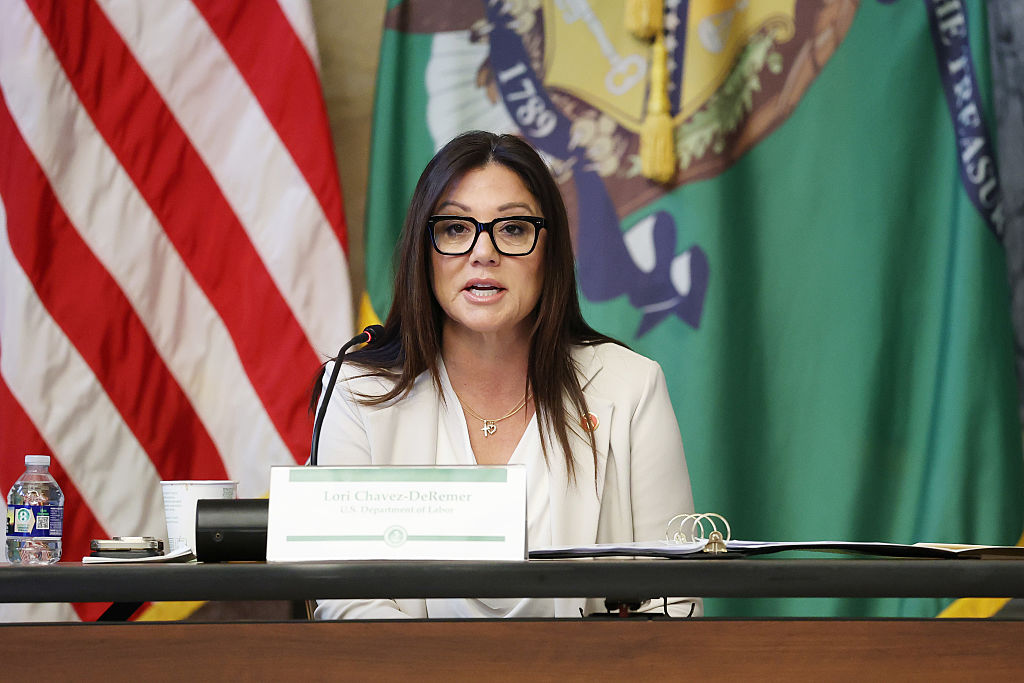
Donald Trump’s labor secretary, Lori Chavez-DeRemer, is leaving the administration under a cloud of misconduct allegations. These include drinking on the job, having an affair with one of her bodyguards, and fake expense reports used to justify taxpayer-funded trips to visit her loved ones. Chavez-DeRemer denies any wrongdoing.
Yet the real scandal is how little she achieved relative to the promise she embodied as a rare pro-labor advocate in a supposedly pro-labor administration.
When Trump first nominated Chavez-DeRemer, an Oregon lawmaker, she faced intense opposition not from the Left, but from congressional Republicans committed to the GOP’s perennial anti-union agenda. Bucking that tendency, she was one of only three Republicans to sponsor the PRO Act.
The labor movement’s number-one legislative priority, the PRO Act aims to reverse the hollowing-out of Franklin Roosevelt’s landmark 1935 National Labor Relations Act, also known as the Wagner Act. Wagner was originally aimed at encouraging collective bargaining in the American economy. Over the near-century since then, however, big business and mostly Republican judges and labor-board members steadily abridged its protections for organized labor.
As a result, union density in the private sector, the share of workers covered by collective bargaining, now stands intractably at about 6%, down from a postwar peak of nearly a third. While deindustrialization and automation played a part, their role is far smaller than commonly assumed. As the economist Lawrence Mishel has shown through statistical analysis, even controlling for the decline in manufacturing would do little to change the trajectory of falling union density since the Seventies.
The bigger factors were the changes in American law that made it easier for employers to thwart unionization drives. These include subjecting employees to captive-audience meetings at which they could be barraged with anti-union messaging, barring union representatives from workplaces, and dragging out union elections through legal challenges and delays. The law can still punish employers when they cross certain lines, but this only amounts to a light rap over the knuckles. Meanwhile, the anti-union strategies in question will have had their intended chilling effect.
So it was no small matter when Trump tapped Chavez-DeRemer as his second-term labor secretary: someone who had been on the record as seeking to combat these trends by passing the PRO Act. Labor leaders had spoken up in her favor, most notably Teamsters President Sean O’Brien, who wrote an op-ed hailing her as the best pick. Other mainstream labor leaders likewise told me they were thrilled with the choice.
But then nearly a year and a half passed, and… what exactly did Chavez-DeRemer do for labor? That is, other than giving her social-media staffers free rein to post “based and red-pilled” memes on X featuring blond-haired, squared-jawed men in Fifties-style outfits, accompanied by calls to “BUILD YOUR HOMELAND’S FUTURE”? (How, one is tempted to ask, when factory construction went down 7.3% during the first year of Trump II, after surging under Joe Biden?)
As for boosting union density, early in his second term Trump removed a board member from the National Labor Relations Board, the outfit that enforces the Wagner Act, thus depriving it of the quorum needed to hear cases and thus creating a “lost year” at the agency. As it happens, Trump-friendly moguls such as Jeff Bezos and Elon Musk have been trying to argue in court — preposterously — that the NLRB itself is unconstitutional. Thus, Trump’s labor policy has been more libertarian and pro-business than George W. Bush’s.
Against that policy backdrop, can one really blame Chavez-DeRemer for allegedly spending her days boozing on the job and shagging her security detail?
Sohrab Ahmari is the US editor of UnHerd and the author, most recently, of Tyranny, Inc: How Private Power Crushed American Liberty — and What To Do About It
 SohrabAhmari
Join the discussion
Join like minded readers that support our journalism by becoming a paid subscriber
To join the discussion in the comments, become a paid subscriber.
Join like minded readers that support our journalism, read unlimited articles and enjoy other subscriber-only benefits.
Subscribe