




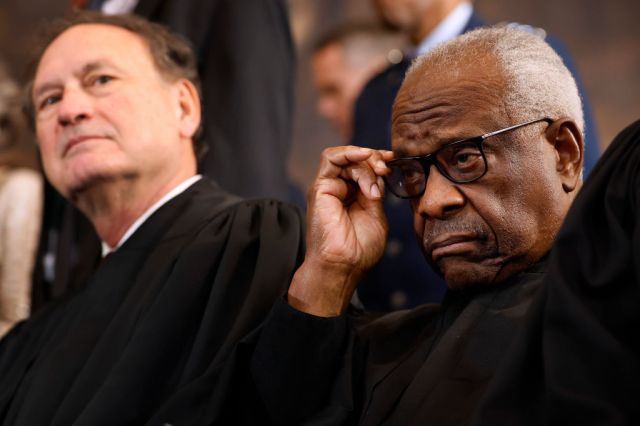
The conservative justices led by Samuel Alito (left) broke the Democratic civil-rights industrial complex. Credit: Getty





The Supreme Court on Wednesday dealt a serious blow to a legal strategy long used by Democrats and allied civil-rights groups to accumulate power. That strategy deployed the 1965 Voting Rights Act to compel states to create majority-minority electoral districts favoring the Left. In Louisiana v. Callais, a 6-3 high-court majority ruled that section 2 of the VRA doesn’t obligate states to draw majority-minority congressional districts.
In the context of the case itself, the fact that black voters comprise roughly a third of Louisiana’s population, the court held, doesn’t automatically require the state to redraw its congressional map to give that group proportional representation in a third of its six congressional seats. Writing for the majority, Justice Samuel Alito reasoned that Section 2 remedies require a clear showing of racial animus — “a strong inference that the state intentionally drew its districts to afford minority voters less opportunity because of their race.”
Mainstream liberal headlines greeted the ruling as another cruel blow to democracy, another attack on racial minorities, another dark day in civil-rights history. NAACP President Derrick Johnson declared it “a major setback for our nation that threatens to erode the hard-won victories we’ve fought, bled, and died for.” Former President Barack Obama warned that the decision frees “state legislatures to gerrymander legislative districts to systematically dilute and weaken the voting power of racial minorities — so long as they do it under the guise of ‘partisanship’ rather than explicit ‘racial bias.’” Liberal Justice Elena Kagan stood to read her dissent aloud from the bench, a rare gesture used to underscore her strong disagreement with her colleagues.
These liberal stalwarts aren’t entirely wrong that something significant has ended. But what has ended isn’t the protection of minority voting rights. What has ended is a decades-long political strategy that used the moral language of civil rights to accomplish something the civil-rights movement never actually intended: the expansion of deliberate racial sorting of American voters into engineered electoral districts designed to favor the Democratic Party.
The concept of “using race to fix race” is a pillar of the legal architecture that arose from the 1960s civil-rights era: affirmative action in college admissions and employment being its most explicit and controversial examples. But “using race to fix race” was never understood to be a feature of the Voting Rights Act. Congress designed the VRA to stop state governments from excluding minorities from the ballot box — not to mandate racially engineered outcomes.
But decades after the civil-rights movement, something shifted in how Democratic-aligned rights groups understood the VRA. The law stopped being primarily a shield against racial discrimination and became a sword to expand minority political power by compelling states to draw new districts. Strangely shaped maps that snaked across counties and clustered racial minorities into artificial majorities were no longer per se bad. They could be a useful tool, so long they benefited Democrats. (To justify their gerrymandering, liberal civil-rights litigation recasts residential racial integration — one of the genuine achievements of the post-civil-rights era — as intentional “vote dilution,” requiring the judicial remedy of clustering racial groups into artificially drawn maps.)
That strategy accelerated after the Supreme Court’s 2013 ruling in Shelby County v. Holder, which gutted the Section 5 provision of the VRA that had required states with a history of discrimination to get federal preapproval before changing their election rules. Stripped of that powerful administrative lever, liberal groups turned to Section 2, the VRA’s general anti-discrimination provision, to litigate similar outcomes through the courts.
Over the following decade, a web of organizations — the NAACP Legal Defense Fund, the ACLU Voting Rights Project, the Lawyers’ Committee for Civil Rights, LatinoJustice, and a constellation of Democratic-aligned law firms led by the Elias Law Group — went into action. They turned to a 1986 Supreme Court precedent to advance the theory that Section 2 requires the creation of majority-minority districts wherever the demographic math could be made to support one.
With this logic, these groups won federal court orders in dozens of redistricting cases compelling governments to redraw maps at every level, from school boards in Alabama to statehouses in North Dakota and Mississippi. The targets expanded with each cycle: first majority-black districts, then majority-Latino, then Native American, and, most ambitiously, “coalition districts” combining black, Latino, and Asian voters into a single legally protected class.
The deeper problem with this strategy is one mainstream coverage consistently refuses to examine. Racial clustering isn’t an expression of civil rights. Deliberately drawing maps that concentrate people by race is a form of segregation, regardless of the political justification. It was wrong when white Southern legislators used it to dilute Black voting power in the 1960s. It is wrong when liberal lawyers use it to manufacture safe Democratic seats today.
The principle doesn’t change based on who draws the map.
What the Democratic civil-rights industrial complex built was, at its core, a system that treated black, Latino, and Asian voters not as individual citizens with rights to be protected, but as demographic raw material to be sorted and clustered to the party’s benefit. In 2024, not a single Republican won a majority-minority district anywhere in the country. Instead, these were guaranteed seats for Democrats with no competition, no accountability, and no reason for an elected Democratic representative to do anything other than perform the expected cultural politics of their carefully created constituency.
The question worth asking, which the Democratic Party has thus far avoided: what did those guaranteed seats deliver for the racial minority communities they were designed to represent? The most Democratic-run cities in America, anchored by these safe majority-minority districts, are also among the most expensive, most unequal, and most poorly managed. Guaranteed seats for Democrats didn’t produce good government. Instead, they set a permanent stage for racial grievance politics that reliably generated fundraising and turnout while delivering remarkably little in the way of material improvement for these captive constituents.
The new Callais ruling curtails the ambitions of the liberal coastal elites who control the Democratic Party and its various legal and advocacy apparatuses from expanding this captive electoral model through Section 2 of the VRA. There will be short-term costs, to be sure. Republican state legislatures will redraw maps. Some black and Latino Democratic incumbents will face genuinely competitive races for the first time.
But discomfort for a political party and injustice for a minority racial group aren’t the same thing. Minority voters dispersed into competitive districts produce something the majority-minority district system never could: real pressure on candidates of both parties to earn those votes. In the long-term, the GOP will have to compete for black voters in Georgia, Latino voters in Texas, and working-class minority voters across the South. This is a better arrangement than one that would simply corral those voters into packed Democratic districts. It also allows Republicans the time and opportunity to build persuadable platforms to absorb the coming demographic wave of post-1960s naturalized Americans voters and their offspring, who will play an increasingly important role in future elections.
As for the Democrats, the high court has effectively curtailed the efforts of party operatives to use the VRA to lock in more racial minorities in state redistricting following every US Census. This is a decidedly good thing, because majority-minority districts for decades have left black and Latino voters captured by one party with nowhere else to go. The result was a party that allowed itself to believe that symbolic representation could replace actual representation; and that racial-justice rhetoric could be substituted for material economic results.
For many observers, it has been obvious for some time that the long-term Democratic strategy was to use Section 2 to create more majority-minority maps, eventually allowing the “coalition district” concept to be held constitutional to cluster two or more racial minority groups to create new districts as the demographics of the United States reflect not just greater number of Hispanic and black voters, but increasing numbers of Asian immigrants.
Long term, Callais is about something larger than redistricting. For more than 60 years, since the passage of the major civil-rights legislation, race became the organizing logic of Democratic electoral strategy because racial sorting was electorally useful. It filled campaign coffers, it guaranteed political seats, and it gave consultants and lawyers and civil-rights organizations a lucrative and powerful position near the center of the party’s operation. The latest court ruling sets the upper limits of the legal architecture the party sought to expand to capture an increasingly diverse electorate. Now if the Democrats want new voters, they will have to earn them.