




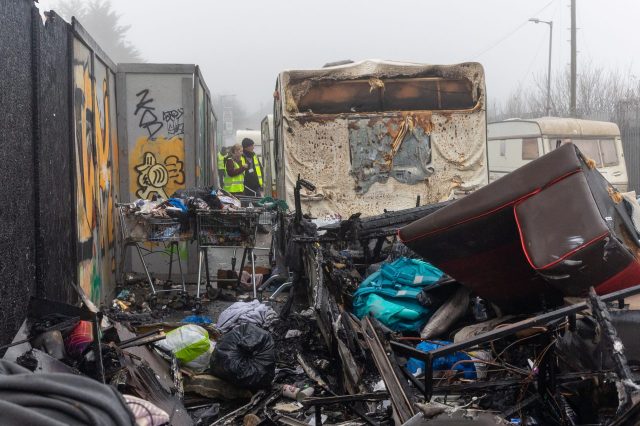
Fly tipped rubbish is left besides the remains of a burned out caravan in a Bristol slum, 2026. (Anna Barclay/Getty)





History, declared the liberal commentator David Brooks recently, is running backwards. He’s not the only one to remark on this: others point to similarities between our era and the Gilded Age, while others worry about the emergence of “Weimar America”.
The most concrete evidence in Britain is the return of slums. Local press in Essex reports that a campsite near Thurrock, originally licensed for 50 showman’s caravans, has expanded by degrees and is now thought to have more than 1500 occupants. Traveller media says it’s not a Traveller site but rather “houses residents from many different backgrounds” — comprising, according to local press, “evicted tenants, people who can’t afford anywhere else, illegal immigrants, organized criminals and even fugitives”.
Slum housing was endemic, and squalid, in 19th-century English cities. George Gissing’s grim 1889 novel The Nether World described life in these bleak and crime-filled environments, where impoverished families in cramped accommodation struggle to survive. Public outcry at the resulting violence and disease drove social reform movements, and in time the demolition of slums and construction of social housing: a wave of building that surged after the two World Wars.
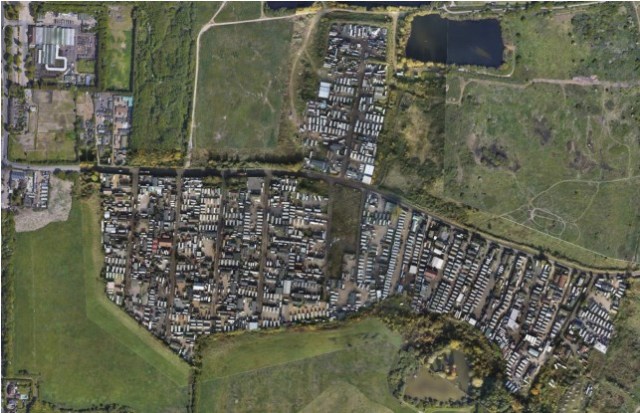
The Buckles Lane campsite, South Ockendon. (East Thurrock Council)
How did we end up here again? The political knot is difficult to untangle, for the politics of housing and property ownership have been a driving force for England’s economic engine for centuries, powering prosperity and imperial expansion, and have since been exported to the entire world. But in the process, it has left this country with so much tied up in home-ownership that the incentives this creates are devouring our social contract from the inside out.
The story of shantytowns in 21st-century England starts around 500 years ago, in 1536. Two years after breaking with Rome, Henry VIII set in motion a revolution in English landholding: the dissolution of the monasteries. In a move so Trumpian it makes Trump himself look like Keir Starmer, he announced that all the land occupied by England’s then 800 or so abbeys, monasteries, priories, and nunneries henceforth belonged to the Crown. Then he kicked out the occupants, parceled up the land, and sold it to his political allies to fund wars.
Back in Henry’s time, the notion that land could be “alienated” from its monastic or aristocratic owner and sold for money was so novel that Henry’s bureaucrats had to invent whole new types of legal process to facilitate it. In the process a new precedent was set, in which land was now something it was possible to “own”.
For those not in a position to buy land, these events were more disruptive. Perhaps not as brutally as for those monks and nuns, Henry’s land revolution also accelerated the displacement of England’s medieval peasantry. By degrees, more common land was “enclosed” and treated as private, in the process evicting peasants who had hitherto enjoyed customary access rights for subsistence food production. This, in turn, prompted the creation of the first welfare state: with the working poor having been stripped of their pastures and vegetable gardens, new relief measures were needed for those in desperate need. This resulted in the first national-level Poor Law, which was introduced by Henry’s daughter, Elizabeth I, in 1601.
You can tell this story in a Marxist key as an instance of primitive accumulation — a literal land-grab — or as a kind of internal colonialism. Or you can tell it in the mournful “post-liberal” one, as the moment we began to demolish Merrie England in the name of progress, technology, and amoral individualism. Or, again, you can make a more ambivalent case that, while brutal, Henry’s land reforms were the original kick applied to England’s backside.
That kick produced the restless, entrepreneurial, expansionary, imperial spirit that has energized Anglo-modernism ever since. Certainly, it created the first impetus, and demand, that the “labor mobility” economists now view as indispensable to economic growth. As agricultural revolutions made farming more efficient, and industrial and mercantile money began to displace the landed interest, the English countryside began to empty either into the cities, or overseas to seek opportunity in the colonies.
But in time even Elizabeth I’s parish-based Poor Law proved inadequate to the new industrial-age demand for mobility. For in order to keep some control on the volume of people claiming poor relief in any one parish, “vagrancy” laws sharply restricted travel for anyone without means. In turn, this made for a highly inflexible labor pool; hence, as the economy industrialized, factory-owners demanded more mobility. So in 1832 parish-based welfare was replaced with a nationalized system: the notorious “workhouses”, made deliberately harsh to discourage people from seeking its aid.
“Labor mobility” has remained one of England’s engines of prosperity and expansion. From Henry VIII on, we have baked this dream of escaping the peasant predicament through land ownership into the economic DNA of this country. You buy a patch of land; then you own an asset; then maybe you can graduate to letting that asset, and thus reach escape velocity from wage slavery.
But its costs and benefits have always been unevenly distributed. Unless softened by welfare measures, it can leave a working class for whom subsistence peasantry has been foreclosed in desperately grim conditions. Accordingly, every time mobility has increased, this has produced another round of welfare reform to mitigate the impact on the working poor. As a class these individuals would form, in time, the electoral backbone of the Labour Party, where they set about advocating for further such mitigations: founding the modern welfare state, and replacing slums with local authority housing after the two World Wars.
But everyone wants to be the owner, not the renter. Accordingly, after 1979 Margaret Thatcher executed her version of Henrician privatization, securing the votes of England’s aspirational lower middle class by enabling these to buy their local authority homes. More recently, this dream became the Cool Britannia-era “buy to let” aspiration. But this era also saw the concept of “labor mobility” become global, leading to the demolition of industrial England. And with this, the model faltered and went into reverse. We should understand the re-appearance of shanty towns in Britain in this context: the economic model set in motion by Henry VIII was exported to the whole world — and, in the process, exhausted itself at home.
For de-industrialization eliminated many of the jobs previously filled by the un-propertied, which in turn swelled mitigatory state welfare provision: a divide now so stark that in 2025 more households were net welfare recipients than taxpayers. For the rest, too, and most starkly for what’s left of the middle class, perhaps especially those who joined the homeowning classes thanks to Thatcher’s reforms, prosperity is mostly tied up in “property”.
In turn, this means no politician who wants to be re-elected can afford for house prices to fall. The easiest way to ensure this is by restricting supply and increasing demand. And this is able to continue, despite the fact that the white British population has been shrinking in absolute terms since 2001, through a means as obvious as it is contentious: migration, and the steady liquidation of cheaper housing stock into increasingly squalid slum housing.
This is the bituminous fuel now driving Britain’s shaky housing prosperity, as well as our increasingly vituperative migration politics: slum landlordism. Yield Investing reported last year that houses of multiple occupation (HMOs) currently deliver some of the best returns in the market, outpacing traditional buy-to-lets and returning a juicy 9% in some areas. The report advises investing in areas with average prices below £200,000 and targeting properties converted to HMOs at university students, low-paid workers in sectors such as care, and social housing (which in practice often means asylum seeker HMOs).
And in order to keep delivering growth, this industry demands ever more people. So just as the industrial era demanded labor mobility, now its deindustrialized successor demands the same mobility — just not of workers, but tenants. Where these originated is irrelevant: from an HMO landlord’s perspective it doesn’t matter who a tenant is, as long as they go on delivering 9%. Meanwhile the HMOs are themselves often damp, dangerous, mold-ridden and overcrowded: scarcely more habitable than the “Nether World” described by Gissing more than a century ago.
This Potemkin economy has been running for a quarter of a century now. Long before the Brexit vote, Blair was juicing Britpoppers’ buy-to-let portfolios by bumping up population numbers, while those EU migrants who couldn’t even find low-wage gig economy work would end up in shanty towns in the East of England. And thanks to Baumol’s cost disease, those gig-economy jobs that still exist mostly don’t pay enough to meet developed-world salary expectations. So the class that manned the factories and founded the Labour Party has their salary expectations either supplemented or replaced by welfare, while a new employment category is created under them, for workers with lower expectations (or less bargaining power). Many of the people who fall out of the bottom of the post-industrial rentier economy end up in this gray zone: the Guardian reported in 2024 on Bristol’s delivery-driver shantytown.
The end of Merrie England and displacement of her peasantry energized our national expansion, powered the Industrial Revolution, and created one of the most restless, inventive cultures in modern history, in its collective quest for property. But then the industrial jobs were drained away to places with lower labor costs, by the relentless demand for “mobility”. In their absence, there’s little left of the economy save wringing whatever profit can be had out of property. For some that looks like a 9% margin on turning family homes into slums. The Home Office is a very reliable customer.
And so we’re stuck in this doom loop, where house prices must keep rising so we can afford the taxes to subsidize jamming people into HMOs so house prices will keep rising. The native working class is alternately mutinously angry, or checked out on welfare. And with fewer rights and entitlements, their multinational “labor mobility” substitutes have embraced gray-economy work, and a berth in a shantytown.
The least gloomy version of how this ends is some new reform of the market-society model that patches it up a while longer. That is surely the intent of Labour’s new Renters’ Rights Act, though it’s hard to see how its provisions will help anyone living in a shantytown, or even incentivize anyone but corporates to be landlords. The bleaker version is also the least acceptable in polite company: mobility accelerates still further, turning all England into an extension what the French anti-migration critic Renaud Camus called “global shantytown”, dissolving all places and polities worldwide into a single chaotic, undifferentiated, jerry-rigged slum.
Or it might mean the final exhaustion of the property-owning economy that defined modern England. And if history really is running backwards, my guess is this would not look like Karl Marx’s preferred solution, communism. Nor is there any reason to assume reversal would end at the Gilded Age. Between the rise of institutional landlords, and the consolidation of wealth, ending the dream of castles for all Englishmen is more likely to look like some kind of neo-medieval feudal order.
Would this be worse than globalized Ponzi landlordism or Essex Soweto? Who knows. Perhaps there’ll even be monasteries.
