




’The generation-long political experiment of Orbánism is over.’ (Credit: Aris Roussinos)





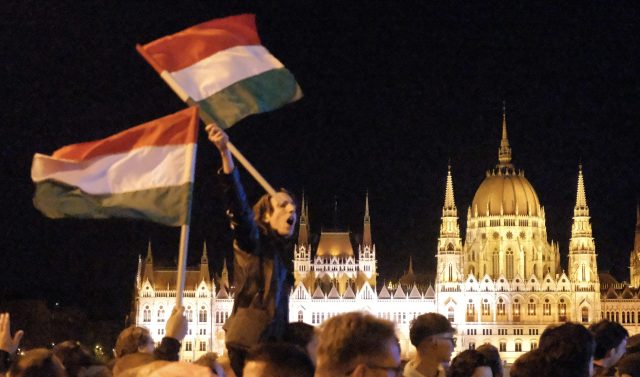
“Why are we here? We are hopeful to see Orbán fall,” said Laura, a 58-year-old lawyer, as she insisted I take a paper cup of the generously home-mixed vodka and orange she had brought with her to either toast victory or sweeten defeat. Like thousands of other Tisza voters, Laura had come with her sisters, friends and niece to Buda’s Batthyány Square, directly across the Danube from Hungary’s floodlit Gothic parliament, to witness history, one way or another.
I asked her what it was about the Fidesz system she disliked. “It’s about the corruption,” she said, “and selling our country and our nation to the Russians, and stealing our money, and EU taxpayers’ money, and this sort of feudalism that he built.” Beatrix, her niece, nodded along emotionally. “I want to get married and have children,” she said. “We all have good jobs but we don’t earn EU wages. My boyfriend lives in London, and if we lose now I’ll move there and leave Hungary forever. I see this as an election for the EU and against Russia — I’m a European and I don’t want to belong to the East.”
But as polls closed, and the crowds gathered in front of the giant screens showing the televised results coming in, the outcome still seemed to hang in the balance. Government-aligned commentators had made much of what they claimed were strong showings across the country; earlier in the day, turnout had looked strongest in rural areas long seen as Fidesz strongholds, with liberal Budapest only rousing itself to vote in significant numbers in the afternoon. It had been assumed that the initial results would show a strong showing for Fidesz and Orbán, with the true dynamics only revealing themselves late into the night — or even, in case of a close-fought battle, later in the week, once the results from the sizable Hungarian diaspora had been counted. But whatever inner trepidation the crowd felt was not to last long. As each new tranche of results came in, the crowd roared in joy at the victory suddenly unfolding before them, chanting “Dirty Fidesz” and “The Tisza is Flowing”, the motto of their party, named after Hungary’s second-largest river. Fidesz’s vote share in the provinces had collapsed, a source at the government’s rival election night party told me, and the mood there was grim. A Trumpian election night party, Patriots of Europe, was abruptly canceled.
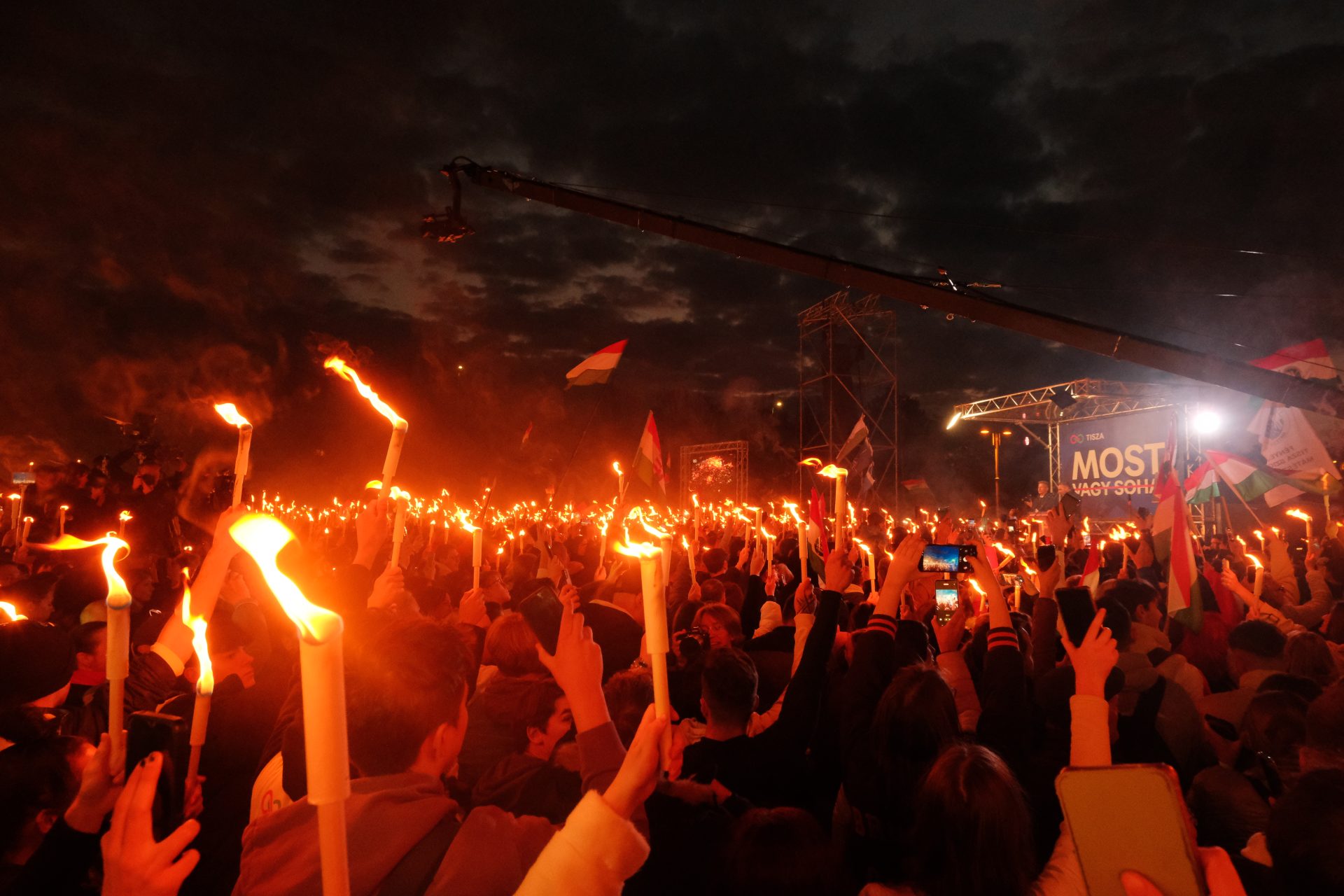
Perhaps this wasn’t the shock it seemed. The evening before, I had attended Péter Magyar’s final campaign event in Debrecen, Hungary’s second city, close to the eastern borders with Romania and Ukraine. Long a Fidesz stronghold, Debrecen was now contested territory. Orbán had pulled large crowds into the city center a few days earlier, but the crowd for Magyar, gathered in the University Square, was larger still. The sight of tens of thousands of Tisza voters, young and old, bearing flaming torches in the lowering night sky and chanting for Magyar’s victory was impressive enough from the middle of the crowd. Seen on television, the sea of fire filmed from above by a drone, it was overwhelming. The speech from Magyar, a fluent and charismatic speaker, was good enough, but the sheer size of the crowd was the real message being sent to the wavering voters watching at home. Provincial Hungary was now in play, Gabor, a 22-year-old trainee teacher from a nearby village told me. “The majority are still Fidesz voters, unfortunately,” he said, “but we are trying to convince our parents and grandparents, and things are definitely changing.” Daniel, a 19-year-old student, agreed. “Hungary’s history has always been pretty bad, to be honest. And now we feel that things are finally beginning to change.”
Back in Batthyány Square, the whole crowd pulsed with a mass intake of breath and then let out a vast roar of victory as the ticker ran across the screen announcing that Orbán had congratulated Magyar on his win, long before anyone expected — such was the scale of Tisza’s victory. Magyar had won a countrywide landslide, and the generation-long political experiment of Orbánism was over, at least for now. Breathless and alarmist commentary, from Hungarian opposition activist-journalists and their aligned thinktankers and commentators in the West, had warned that Orbán would, in the face of defeat, try to hold onto power through some malign dodge or other, whether dragging the election through the courts or staging some kind of provocation to annul the results. But in truth, this was never Orbán’s style: illiberal he may have been, but he was never a dictator, however his opponents framed him. In the end, the genuine popularity that kept him in power for a generation meant too much to him, and when he lost, in a free and fair election, he relinquished power gracefully.
Even so, it was a historic moment for those gathered in the square, debating what should be done with the man who had shaped Hungary in his image for so long: I hope he goes to Russia, one said; no, I hope he goes to prison, her friend said; no, said an older woman, shaking her head slowly as if asserting the wisdom of age, I hope he stays in Parliament, and is made to answer for everything he did. “We feel the breath of ‘89,” Hanna, an 18-year-old goth, told me. “All our lives, we lived through the Fidesz system, it’s kind of a new breath to see this change. Fidesz never cared about us, until we make children.” Her companion, Milos, agreed. “Thank God, Thank God,” he said, casting his eyes upward. “I really hope we get closer to the European Union, and we can distance ourselves from Russia.”
This election, cast externally as a battle between liberal Europeanism and something approaching Asiatic despotism, was perhaps swung by hard-nosed domestic rather than broader philosophical concerns, centering on the struggling economy, on corruption that was “simply indefensible”, as one Fidesz insider had previously put it to me, and on the parlous state of public healthcare and social infrastructure. Yet it must be said that the liberal, middle-class inhabitants of urbane Budapest, gathered in the square, some of them waving EU flags as well as the far more numerous Hungarian ones, certainly fit the image of Tisza positively projected by its supporters outside Hungary, and negatively by Fidesz loyalists domestically and abroad. Budapest, which still looks and feels like the polyglot imperial capital it once was, is a liberal city in a conservative country: but the final electoral map made the country as a whole look far more like Budapest than anyone had expected.
Yet Tisza’s leader, a Right-wing nationalist with a far more restrictive stance on legal immigration than Orbán, is hardly the radical liberal Fidesz and its army of MAGA influencers made him out to be. The crowd’s most animated and vehement chant was “Russians Go Home”, a relic of the 1956 revolution latterly applied to Fidesz, but Magyar has already signaled he won’t be unplugging the country from Russia’s cheap and plentiful energy bounty any time soon. Hungary has moved from one version of personalist conservative rule to another, this time round led by a former Fidesz insider with a European focus, ready to unlock Brussels’ long-withheld and sorely missed financial bounty. Magyar’s victory seems less a defeat for the European Right than a generational evolution of it, which — at least in Hungary’s unique circumstances — has brought liberals and Leftists, both political nullities in this country, under its conquering wing. Perhaps that’s why Phil, a 26-year-old voter for the far-Right Mi Hazank party, was calmly philosophical about the new regime, as he watched the crowds of ecstatic zoomers beeping horns and waving flags as if Hungary had just won the World Cup, pulsing Eurodance blaring from car windows. “Orbán was just too close to America, and Hungary is a European country,” he shrugged. “At least Tisza is Right Wing.”
