




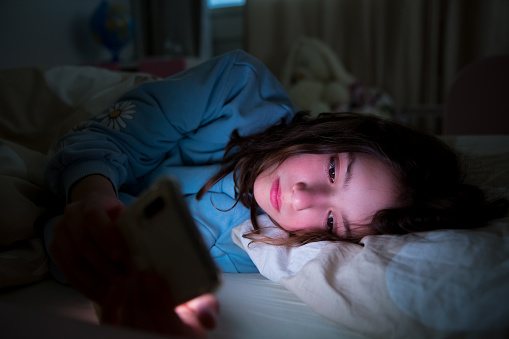
There are good reasons to think that the harms associated with smartphones operate less through social media itself than through the activities it displaces — like sleep. (Suzi Media Production/Getty)




The debate about whether social media is bad for mental health has reached new levels of intensity. Meta and Google have been found liable in a US legal claim that their social media platforms were designed to be addictive. Snapchat is facing investigation by the European Union over child safety. ChatGPT has driven people to kill themselves. And yet, instead of confronting the complexity of the problem, we are converging on a remarkably simple solution: banning teenagers from social media. Australia has already banned under-16s from social media, while, in Europe, France, Spain, Denmark, Norway, and Austria are implementing similar restrictions. Indonesia has moved forward with legislation, and the UK will test a social media ban on a six-week pilot trial.
The case for a ban rests heavily on the argument, advanced most prominently by Jonathan Haidt in The Anxious Generation, that social media is a primary driver of a worldwide deterioration in adolescent mental health. Haidt has met with leaders from the UK, France, Indonesia and the EU to discuss bans. The case rests on two core claims. First, that anxiety, depression and self-harm have risen among teenagers — particularly girls — across multiple countries and coinciding closely with the widespread adoption of smartphones and social media. Second, that even if much of the evidence tying social media to mental health is correlational, it is consistent enough to justify action now, rather than waiting for scientific consensus. It is a compelling story. But that doesn’t make it true.
The evidence that social media is a primary driver of declining adolescent mental health is weaker and more ambiguous than is often suggested, and in many cases difficult to interpret causally. At the same time, there are good reasons to think that the harms associated with smartphones operate less through social media itself than through the activities it displaces — sleep, in-person interaction, and sustained attention. To Haidt’s credit these are also central to his broader claim that adolescence and childhood have been “rewired”, with less time spent in independent real-world activity and more time mediated through screens. This distinction matters because it suggests that blanket bans risk targeting the wrong problem.
There is still no robust evidence that social media, in itself, is a major driver of poor mental health among adolescents. Various researchers in the field have written damning reviews of Haidt, alarmed by the gap between the force of his argument and what the research actually shows, as well as his irresponsibility in whipping the public up into a frenzy that may prove difficult to correct.
One study of over 300,000 12- to 18-year-olds in the US and UK, for example, found that technology use had such a negligible association with wellbeing as to be “too small to warrant policy change”. To put this in perspective, the effect was roughly equivalent to wearing glasses. Other known risk factors, such as being bullied, had more than four times the association. Even umbrella reviews that summarize all the other reviews tend to conclude that the relationship between social media and mental health is “weak and inconsistent”.
Part of the reason for this ambiguity is that much of the evidence is vulnerable to basic problems of confounding. Teenagers who are already anxious or depressed may be more likely to spend large amounts of time on social media in the first place. Untangling cause from effect in this context is extremely difficult. The result is a literature that can just as easily be read as showing that unhappy teenagers use social media more, rather than that social media makes them unhappy.
Even longitudinal studies that follow the same individuals over time, examining whether changes in their usage makes their mental health worse, find mixed results. In one summary of 24 longitudinal studies, 38% found no overall relationship, 33% found that greater usage led to worse mental health, and 25% found effects only for specific subgroups such as girls or heavy users. One of the 24 studies even found the opposite relationship. Meta-analyses that pull together many longitudinal studies tend to find small negative associations, i.e. a higher social media use at one time point makes an individual’s mental health at a second time point very slightly worse — but nothing resembling a large or consistent effect. To be clear, none of this proves that social media has no impact. But it is far from the evidence base of a clear-cut case.
Even the headline claim of a global decline in mental health isn’t so clear. The latest World Happiness Report shows that under-25s in English-speaking countries have seen marked declines in wellbeing over the past decade. Elsewhere, including Asia and Europe however, trends are flat or even improving. It is not obvious why social media should be uniquely harmful in the Anglophone world. One suggestion is that smartphones interact with characteristics that are distinctly “Anglo”. In this reading, English-speaking people have a particular propensity for talking about mental health online which may explain why English-speaking people are particularly affected by smartphones. Another reading, of course, is that smartphones and social media are not related to these country differences at all. Perhaps it’s a result of particularly oppressive housing markets, as John Burn-Murdoch has proposed in the FT. In any case, if smartphones are the cause, their effects are far from uniform.
At the same time, our own experience and experimental evidence complicates the picture. Many of us report dissatisfaction with the amount of time we spend on our phones. And experiments that block smartphone use tend to find improvements in wellbeing. For example, one study blocked mobile internet access among a sample of Canadian and US adults for two weeks. They found that adults reported higher life satisfaction, lower levels of depressive symptoms, and greater ability to maintain attention. Further analyses indicate that these improvements were at least partly driven by changes to how individuals spent their time — replacing smartphone time with increases in offline activity (socializing in person, exercising, or reading a book), alternative types of media consumption (television and YouTube), and other digital communication (texting and video calls). Even participants who were not able to keep to the complete two week ban reported improvements to their wellbeing, indicating that a reduction in smartphone use can have a similar effect to a total ban.
Moreover, quite apart from their effects on mental health, social media or smartphones do appear to be damaging learning. In the 2022 PISA report (this is the international survey run by the OECD to measure 15-year-olds’ skills in reading, maths, and science across countries), researchers found an unprecedented drop in performance across all the OECD countries sampled — a drop equivalent to three-quarters of a year’s worth of learning. They highlight smartphone use as a key possible driver of this decline.
Backing this up, experiments that ban phones in schools find improved focus and boosted exam results. One study that followed 17,000 US students found smartphone bans improved exam results for low-achieving students (but not high), with students mostly supportive of the ban. In another study, students from Florida who were subject to a statewide ban had improved test scores of around 2-3% — not exactly a huge effect though.
However, there were short-term costs. In the first year of the ban disciplinary incidents and suspensions increased by 25-50%, but returned to pre-ban levels by the second year of the ban. How schools decide to implement bans and punish rule-breakers is likely to have a serious impact on whether such policies succeed in improving student outcomes.
The above results can look like a contradiction. Increasing social media use does not reliably worsen mental health, yet reducing phone use appears to improve well-being and student test results. But this makes more sense when viewed through the lens of displacement. Time spent scrolling is time not spent sleeping, socializing in person, studying, or exercising. The issue may not be social media itself, but what it replaces.
This is not a trivial distinction. The wider effects often attributed to social media may instead reflect the broader consequences of smartphones as multipurpose devices that restructure how time is spent.
At the same time, banning social media would remove genuine benefits. Vulnerable individuals, as well as children who are isolated or not fitting in, can find connections and like-minded peers online. Social media is also an increasingly important source of information. One experiment that asked adults to deactivate Facebook for 4 weeks prior to the 2018 mid-term election, found that participants were less able to correctly answer questions about current events. If results like these hold up, this is not a negligible cost, particularly as these platforms become the primary conduit for news. These two features — finding like-minded people and gaining access to information — were once seen as the two defining virtues of the internet.
Framed this way, the issue is not simply one of mental health, but of how smartphones are restructuring young people’s time and attention. This points toward a different set of interventions: not blanket social media bans, but removing phones from classrooms, and introducing regulation that changes how these technologies are used, such as limiting addictive design features like endless scrolling feeds.
If the concern is specifically adolescent mental health, however, the case for focusing on social media is weaker. Prioritizing an ambiguous risk factor may have the adverse effect of drawing attention away from more substantial ones. Bullying, family instability, and pre-existing mental health conditions have far larger and more consistent effects on well-being. The trials now underway in the UK, Australia and elsewhere should help clarify the impact of social media bans and digital curfews. But in the meantime, blanket bans risk chasing a compelling story, while distracting time and energy away from interventions likely to have the greatest impact.

Join the discussion
Join like minded readers that support our journalism by becoming a paid subscriber
To join the discussion in the comments, become a paid subscriber.
Join like minded readers that support our journalism, read unlimited articles and enjoy other subscriber-only benefits.
Subscribe