




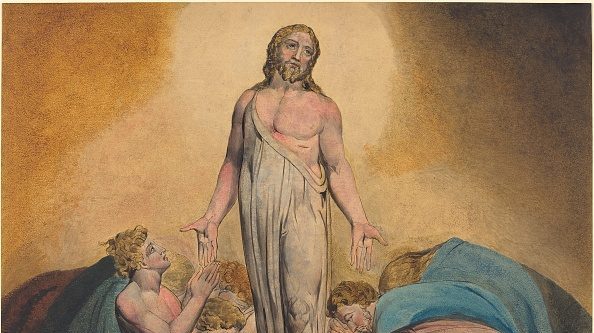
Christ Appearing to His Disciples After the Resurrection, circa 1795, by William Blake. (Photo by Heritage Art/Heritage Images via Getty Images)





At the center of Christianity lies a great big hole, more commonly known as the empty tomb. It’s around the absence of God that the feast of Easter turns, not some glorious revelation of him. The tomb is empty because Jesus is supposed to have risen from the dead, but the New Testament doesn’t actually recount this event. It shows Jesus before his death, and then as moving among his disciples afterward, but there’s another big hole between the two episodes.
This is because the resurrection can’t be represented. Not because it’s too sacred, but because although Christians believe it actually happened, it isn’t an event in the sense that the Budget or the war against Iran is an event. You wouldn’t have been able to take a photo of it had you been lurking around Jesus’s tomb with your phone. It’s not as though he yawned, scrambled to his feet, shucked off his shroud and walked out blinking into the sunlight. The resurrection throws into question the whole idea of what counts as something happening. Is waiting, for example, an event — or is it the absence of one? Falling in love is an event of a kind, but not in the way that burning a piece of toast is. The resurrection is beyond representation not because it isn’t real, but because it’s too real to make an image of. If there is something one might call ultimate reality, we wouldn’t be able to capture it in language. It would lie on the far side of our speech, like the unconscious.
But Jesus’s rising from the dead isn’t just a “spiritual” or symbolic affair, because it involves an actual human body. The risen Jesus eats with his friends to show that he’s not a ghost, he has real wounds in his hands and so on. Yet this body is of a different order from the body of, say, Pete Hegseth — not because it’s less flesh-and-blood than he is, but because it’s more intensely so.
Whether anything happened in the tomb or not also raises the question of who reported the body being missing. The first person to do so was Mary Magdalene, who was probably a sex worker and thus in the eyes of the establishment not the most dependable of witnesses. She was also of course a woman, and the testimony of women at the time was regarded as worthless. So the fact that it was Mary and some female companions who first reported that the tomb was empty would have been highly embarrassing for the Gospel writers, who might well have omitted this bit of the narrative had they felt able to do so. The fact that they didn’t suggests it was too widely believed to be left out.
All of this is deeply inconvenient for the pious of this world, who demand a rather more positive icon of the Almighty than an empty space. Icons, however, are specifically forbidden by the Yahweh of the Hebrew scriptures. You can’t make graven images of God because the only authentic image of him is human flesh and blood. You can’t wield him as an idol or fetish in combat with your enemies, or try to scramble into paradise by wafting incense at a statue of him. In fact, you can’t even give him a name, because this, too, would be a way of trying to have him in your pocket, using him as a tool to promote your own interests.
Then again, it’s easier for some Israelites to project their Oedipal fantasies onto him and see him as Big Daddy, a vengeful deity who will punish them for their transgressions and so relieve them of their guilt. The Hebrew name for this false image of Yahweh as patriarch and superego is Satan, which means Accuser. When Christian nationalist Americans hail God as Commander-in-Chief of the Cosmos, they are committing what the Scriptures know as idolatry, for all their neatly creased trousers and shiny white teeth. The bad news is that God has no more peculiar concern for the United States than he has for East Grinstead. There are no favorite nations — not even Israel.
In fact, God gets quite testy with the ancient Israelites. Some of them keep wanting him to behave like a Super Being, whereas in fact he isn’t a being at all, in the sense that the Princess Royal or a set of bagpipes is a being. He isn’t any kind of object or entity or individual. Nor does he keep meddling in human history like an American neocon. God and the universe don’t make two. He isn’t in Heaven in the sense that he might be in Chicago. He certainly isn’t in the skies, despite the fact that people tend to gesture reverently upwards when they invoke his name. In the Book of Isaiah, when the Israelites think that he can be appeased by burnt offerings, he complains that their incense stinks in his nostrils — and asks them what they are doing about protecting the widows and the orphans and shielding the poor from the violence of the rich.
When the Virgin Mary bursts out into a triumphal chant when she’s pregnant with Jesus, she praises the God who has brought down the mighty from the thrones and raised up the lowly, filled the poor with good things and sent the rich away empty. These are typical themes of the Hebrew scriptures. As an obscure young woman from a notoriously backward part of the country, Mary is an image of the poor herself. The child in her womb will be murdered by the Roman state for fearlessly speaking the truth. He will fall victim to the kind of torture and death reserved by the Romans for runaway slaves and political insurrectionists. In fact, he was lucky to get away with only six hours on the cross. Some victims of crucifixion thrashed around for days.
It’s doubtful that he was a revolutionary himself, but a few of his closest followers almost certainly were. One of them, Simon, is specifically called a Zealot, a member of the anti-imperialist guerrilla movement of the era; two others (James and John) are given a nickname with Zealot connotations, while Judas Iscariot might have sold his master out because he had hoped he would lead an armed rebellion against the Romans and was disappointed that he didn’t. Jesus himself was a vagrant with no profession who railed against the ruling caste and seems to have had a particular distaste for the family, not least his own. A fidelity to his mission takes priority over attending your kids’ graduation.
A great many pre-Christian societies had rituals of death, burial and resurrection. Vegetation and fertility cults, myths of the slain or wounded god who will finally regenerate the sterile land: all this, ironically, lurks beneath the surface of the most boldly “modern” of all English poems, T.S. Eliot’s The Waste Land. The poem is archaic and avant-garde at the same time. It would seem, perhaps, that these patterns and rhythms are somehow built into the human psyche. In this respect, Christianity doesn’t introduce something entirely new to humanity but builds on a long tradition of sacrificial victims. The victim in question is the scapegoat, who takes on itself the burden of sin and guilt of a whole community, and by dying to this barren condition rises to new life.
Christianity, however, transforms this pattern in the act of conforming to it. Fertility cults, sacrificed gods, the release of fresh water onto parched land and so on: all this is essentially about power. The tribe needs to exert power over Nature to grow its crops, and acts this out symbolically in the form of a god who is buried in the earth and then rises to new life. The seed must die in order for the plant to flower. What Christianity does is to raise all this from the level of Nature and biology to that of history and morality. Death is still essential for redemption — but now it’s death in the form of a loving self-giving to others, as exemplified in the life of Jesus. It’s this — not burnt offerings or slain idols — which constitutes the necessary condition of new life. You have to die to the system represented in Jesus’s day by the organized brutality and injustice of the Roman Empire, and be born again into a community of friendship. This is why baptism is about drowning, not washing.
It’s all a long way from bunny suits and painted eggs. Easter is about fun and joy, to be sure, but like any genuine happiness it comes at a steep price. Even if only in symbolic terms, you have to travel all the way through death and dispossession if you’re to emerge somewhere on the other side. Doing this without any guarantees up your sleeve is known as faith. This is why Jesus is said to descend into Hell when he dies — into that cacophony of mocking yelps, sniggers, hoots and cackles which is the domain of the demonic. The demonic is the sworn enemy of life and meaning, devoted to demolishing what it sees as the ludicrous fiction that anything human can be of the slightest value. You have to live all this in order to get beyond it, moving from Good Friday to Easter Sunday. Or as W.B. Yeats puts the point: “Nothing can be whole or sole /That has not been rent”.
You don’t, however, simply leave death behind. The most unpleasant part of the Christian message is that if you love properly, you’re likely to be killed. It’s the least cozy kind of love imaginable, compared with the romantic, erotic and sentimental brands of the stuff that are peddled nowadays. Jesus dies as a martyr, which is to say one who freely gives up their life for others. It’s a little extremist for English taste. But it’s unlikely that any power short of this is going to bring down the death-dealing imperial machine now ruled not by Caesar but by Donald J. Trump.