




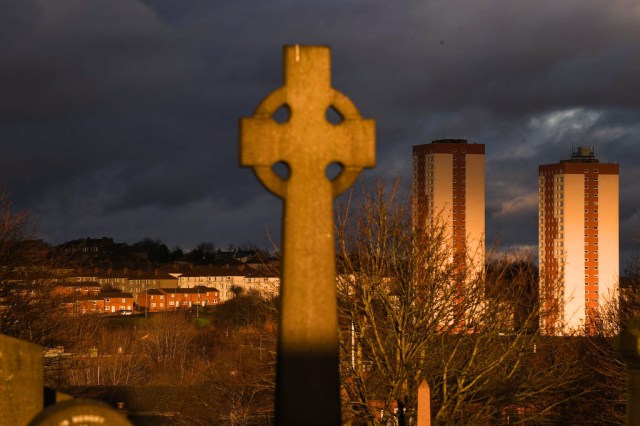
Is street activism what Glasgow needs? (Jeff J Mitchell/Getty)





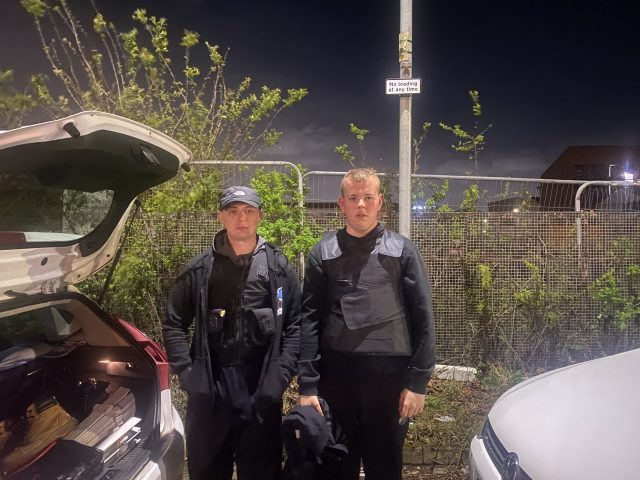
It has been raining for some time when the patrol assembles. There’s Darren Docherty, a lean 31-year-old with sunken eyes. He takes the lead. There’s also Lisa, a bartender by day who, as the only woman, is tasked with approaching lone girls. And there’s Docherty’s mate, Ross, his face covered by a balaclava, and his wee cousin, whose staffie is out ahead on her lead.
They splash through puddles on their way into town, but after a while the weather eases. The patrol wears mostly black, and stab-proof vests, though their work has not yet led to violence. Docherty, a joiner by day who founded Scots Active last year, has filled his pockets with the essentials: a yellow tube of naloxone, which reverses opioid overdoses; a flashlight; a pack of cigarettes; and a can of 2in1 Self-Defense Spray — a legal alternative to pepper spray that stains an assailant’s clothes.
Scots Active is just one of a number of night patrols that have formed across Glasgow in the past year. Dubbed vigilantes by the media, and disavowed by the police, they insist they are merely concerned citizens. The groups are doing “something the government cannae do”, says Lee, a lumbering young security guard who’s joined us to provide protection.
Trudging about until the early hours of the morning, the group hands out blankets to the homeless, and checks bridges along the Clyde where people might be considering suicide. Their primary motivation, however, and the reason why they have drawn such controversy, is their belief that the city’s women and girls are under threat from an influx of migrants. Drawn by a generous housing policy, more asylum seekers have ended up in Glasgow than any other local authority in Britain. Under the strain of supporting them all, tensions are beginning to rise.
Docherty’s patrol is the most visible manifestation of the city’s troubles. As we walk for hours, up and down throughout the city center, we see others. A teenager hunched into the corner of a subway stop, a glass pipe pushed up against his mouth. A sweet, childlike man with an Alsatian tied to his waist, who tells us that earlier that week he’d waded into a lake to die until the dog splashed in after him. Homeless men, vibrating in the cold.
Glasgow slumped in the 20th century, depopulating faster than any other British city. Then it began to recover, becoming something of a model for how post-industrial areas might be revived. Now, though, progress seems to be stalling, if not reversing. Youth violence is ticking up, with Will Linden of the Scottish Violence Reduction Unit warning of a sharp rise in knife crime. Glasgow still has the most drug deaths in Scotland — and Scotland the most in Europe.
The city’s Victorian architecture is meanwhile crumbling and burning and collapsing. When I arrive, a cube next to the train station remains cut off, weeks after a fire ripped out from a vape shop at the base of a 19th-century building. Peering over the barricades around it, I see black, charred stone.
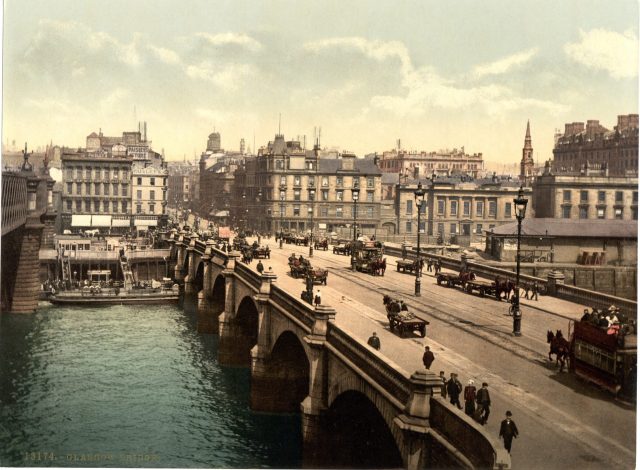
In a 2023 essay, Rory Olcayto, an architectural writer, provoked debate when he described the city as a shipwreck. “Psychologically Glasgow is paralyzed,” he wrote. “It can’t imagine a future for itself.” The conurbation is too vast and sprawling for Scotland to cope with. It has discarded much of its past, but is unsure of what its future will be, leaving only a trite marketing slogan: People Make Glasgow. “It’s not the same,” bemoaned Ally McCoist of the city earlier this month, introducing a note of despair to TalkSport’s football coverage. “It breaks your heart to walk about Glasgow.”
Now, Reform UK, campaigning on the slogan “Glasgow is broken”, are predicted to break through at the Scottish Parliament election on 7 May. According to an MRP poll published last week, the party should win two seats in the city, pushing Labour into third place both here and across Scotland as a whole. With its growing discontent, anti-migrant neurosis and extrajudicial street politics, the country seems to be swiftly converging with its southern neighbor.
As the patrol tramps through central Glasgow, the crack-smoking teenager seems to appear behind us. He’s a lookout, Docherty claims, keeping an eye on Scots Active for a gang of drug dealers who loiter around the St Enoch subway station. As we pass by them, I see about a dozen of these boys hovering beside its curved glass wall, a puffa-clad mass.
Despite Glasgow’s recent travails, it used to be a far more violent place. While we walk, Docherty tells me about his adolescence on a “scheme”, or estate, in Govanhill, an ethnically diverse neighborhood south of the Clyde. He was raised amid running street street battles with other young “teams”, or gangs, from different areas. His secondary school, he claims, was a “race war” where white children battled Pakistani and black rivals. In one fight, a boy stabbed and stabbed at him, wildly, as he struggled to get away. It was only when Docherty finally broke free that he realized one of his testicles had been severed from his body.
In the press, Scots Active has been labeled far-Right. When I put this to Lisa, she insists that the group doesn’t discriminate and would help anyone in need. Yet discussing the supposed drug dealers, who are mainly non-white, Docherty makes his racialized view of Scottish identity clear. “They might have been born here,” he says. “But no, they’re not from Scotland. They’re not young Scottish boys.” That’s part of a broader trend: Scots Active has tapped into a Scottish ecosystem of anti-migrant politics, protesting alongside groups such as Unite The Clans, which has rallied around the country.
Later, Docherty and I begin talking about the suicidal man walking his Alsatian, and he says he has always struggled with depression himself. Sometimes he blacks out and starts smashing things up: his house, his mum’s house, the building site he works on. The only thing that quiets the negative voices in his head, he tells me, is self-medicating with cannabis.
Audrey Dempsey, too, has witnessed the alienation and violence bred by poverty. When she was hired as an addiction support worker, back in the 2000s, she says things were better than today. Then, Glasgow suffered some of the sharpest budget cuts of any local authority in Britain. The charity Dempsey founded in response — No. 1 Baby and Family Support Service — aims to make up some of the gap by providing second-hand prams, cots, clothes and toys. Visiting her charity’s users, Dempsey finds terrible, debilitating conditions. In one house, she met a mother who was cooking for her children on £1 disposable BBQs, bought after their electricity ran out. Schools approach her asking for nappies because their pupils were never toilet trained. She believes such colossal breakdowns are partly fueled by the state’s perverse system of incentives. “It’s as if,” she says, “they’re trying to create a benefits culture in Scotland.”
In 2022, Dempsey was elected to Glasgow City Council as a Labour representative for Springburn. Having expanded as a center of railway manufacturing, the area collapsed after the Second World War, becoming one of the city’s poorest neighborhoods. The high rises built here in the late 20th century, to rehouse those moved out of tenements, became hives of social dysfunction. In 2010, a survey found it to be the most-feared neighborhood in Scotland for violent crime.
I meet Dempsey in a café on a retail park amid acres of tarmacked carpark, close to where William Wallace was captured by the English in 1305. She sketches a bleak vision of her city. “What’s been happening for the past 18, 19 years is definitely not progress,” she says. “The place is filthy. It’s run down. Services don’t exist anymore.” Last month, it was reported that health and social care services in Glasgow are facing a funding shortfall of almost £34 million.
Contributing to this budgetary pressure is the asylum system. Since 1999, Glasgow has been part of the national refugee dispersal system, in which the Home Office spreads asylum seekers across the country. Today, over 6,500 such people are currently in, with more than half of those in Glasgow. Once they are given refugee status, however, the migrants become the responsibility of the local authority. And in Scotland, homelessness legislation means that everybody must be housed. As for Glasgow, which declared a “housing emergency” in 2023, this has become a totemic issue.
Like Scots Active, with whom she has been out patrolling, Dempsey now fears ethnic violence. With community halls and public institutions shuttered, she believes it is impossible to properly integrate migrants. The councillor is convinced that race riots such as those that swept England in 2024 — but avoided Scotland — could break out here.
Her shifting views on migration, Dempsey tells me, have been driven by what happened to her daughter. Last year, she says, her 12-year-old girl was attacked by other children. She believes this was racially motivated and so, in its wake, asked at a council meeting about “racist attacks on white children and teachers”. When her comments were made public, the Labour Party suspended her. Now, she is standing for Reform in the Scottish parliamentary elections next week.
Dempsey is hopeful the party might provide the radical change she believes Glasgow needs. When I suggest that Nigel Farage is not known for his focus on child poverty, she agrees. “I have to be quite frank and say when I think of Reform in Scotland, I don’t think of Nigel Farage, ’cause I’ve never met him,” she says. “I think Malcolm Offord. And he gets it. He understands it. Now he does.”
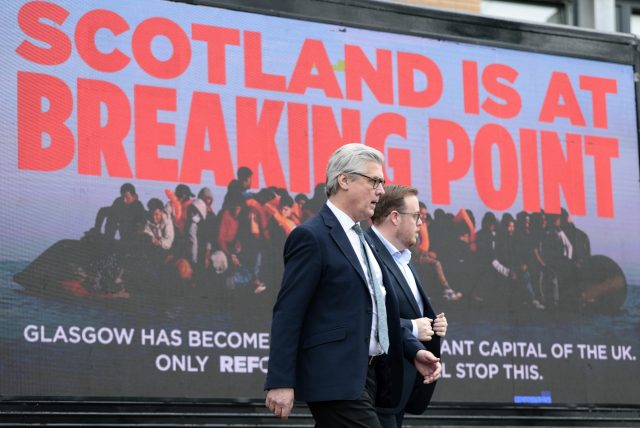
Offord, previously a Conservative member of the House of Lords, was recently unveiled as Reform’s leader in Scotland. Dempsey argues he demonstrated his commitment to change learning about Glasgow with her by visiting a homeless shelter and walking around with the night patrols. “Are [Reform] gonna be Tory point two?” she asks. “I think there’s enough people in there who are hellbent in making that not the case.”
Dempsey tells me she’s still angry that Sky News misrepresented her views on migration after she spoke to them last year. She is baffled that the journalist who interviewed her had doubted her belief that asylum and immigration were the biggest issues facing Glasgow. “I said to him, ‘have you never walked down Sauchiehall Street and spoke to people?’ You know, you talk to anybody, that’s the type of thing they say to you.”
The next day, I visit Sauchiehall Street myself. The route is Glasgow’s central shopping thoroughfare but, in recent years, it has declined precipitously. I go past vape shops, kebab houses, a half-demolished building, its facade ripped away. Delivery drivers on electric bikes weave past pedestrians at speed. Andrew Neil recently dubbed the area’s condition a “national scandal” but I struggle to see what makes it unique. It looks like every other high street in Britain.
Of the people I speak to, none say that immigration is the biggest issue facing Glasgow. Instead they list the rising cost of food, bills and gas, the closure of centers where the elderly might meet, the pathetic standard of the politicians who govern them. Catherine, a small woman in tortoiseshell glasses, thinks pedophiles could never be rehabilitated. She would like to be the prime minister, she adds sunnily, so that she could kill them herself.
That isn’t to say migration is a non-issue. Brian, sitting alone on a bench, says migration is not a problem at all, before complaining about people coming into the country and being housed immediately. He’s a socialist and voted Labour for decades before flipping to the SNP years ago. Labour had abandoned their principles. Is Glasgow broken? “Most cities are broken,” he says. “Most inner-city areas have their issues.”
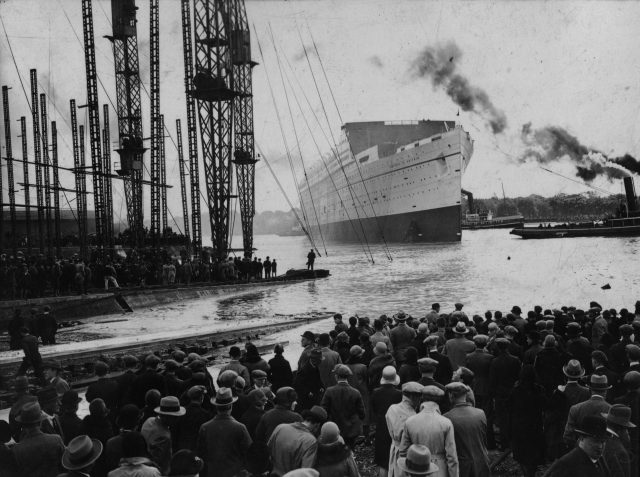
Over the past century, Govan became synonymous with such decline. The neighborhood, on the south side of the Clyde, had once been a world-center of shipbuilding, in 1913 producing more vessels than all of Germany combined. But such heights just increased the impact of the eventual crash. After 1945, the residents who could moved out to newly built social housing. Tenements were torn down to leave gaping scars in the streetscape.
On a windy afternoon, I visit a soot-blackened church where a gaggle of children are trying to bodyslam grown men into the ground. This is the Glasgow School of Wrestling, founded by Ravie Davie, a former young team member turned performer. Violence, Davie tells me, appears to be rising again after a period of decline. “A lot more kids are getting murdered or stabbed,” he says. “A lot are being put in prison.” The numbers partly reflect this: though the total number of children accused of violent crime has actually decreased, the level of those guilty of attempted murder has seen a sharp jump.
The trend seems to have an ironic cause. Because of Glasgow’s success in tackling postcode violence over the past decade, children can now travel more freely around the city. And that means they are more able to meet up for fights — and are more valuable employees for organized crime. If Docherty fought for “respect” and due to boredom, teenagers are now sucked into a more nefarious, profit-driven criminal vortex.
Below a monumental pipe organ, I speak to Davie’s cousin, Zander. The pair put a postmodern twist on their area’s reputation for violence, wrestling in character as tracksuited hoodlums named the Govan Team. Now, Zander says, they want to help get local children out of their bedrooms and away from trouble by teaching them this art.
Above Govan’s skyline loom vast sheds. It is along the docks here that Paul Sweeney began working as a shipbuilder as a young man, seduced by the romance of the Clyde’s industrial past. After being tapped by Sarah Brown, Gordon’s wife, he became a Labour MP and now represents Springburn in the Scottish Parliament. I had wanted to talk to him because Glasgow has recently been experiencing something of a shipbuilding revival.
Near where we meet stands the newly erected Janet Harvey Hall — a vast, otherworldly metal structure — where two Type 26 frigates are being built for the Royal Navy. BAE has invested £300 million in modernizing these facilities, where new capabilities to combat drones and hypersonic missiles are being built. With history restarting amid global conflict, the Clyde may yet find itself central to British security again.
As we talk, Sweeney and I walk through Fairfield Heritage, a museum in the offices of what was once Glasgow’s preeminent shipping firm, now in the shadow of BAE’s sheds. He is wearing a Fairfield Heritage t-shirt and colorful socks with little drawings of trains on them. I ask him about the glut of asylum seekers that some believe is tearing Glasgow apart.
The SNP government in Holyrood had created a powerful incentive for refugees to present themselves in Scottish cities like Glasgow because single men have just as much of a right to be housed as families, Sweeney says, but they had failed to build enough houses to keep up with the ensuing demand. “It feels politically disingenuous to build the ends but not the means. That’s kind of my critique of the SNP is that they’re always about good things, nice things for everyone, but never actually make the difficult trade-off decisions.”
Even so, Sweeney dismisses the idea that migrants are depriving Glaswegians of resources, something he says has been egged on by Reform. Most of the party’s voters he had met were angry, older men who had spent too much time watching GB News. “If anything, one thing Glasgow needs is more people. It’s a city that’s the most depopulated in the UK. If anything, Glasgow needs an orchestrated attempt to reinflate its population.”
We’d now reached what appeared to be the former Fairfield boardroom. It was all crown molding, thick red carpets and long wooden models of transatlantic ocean liners: an abandoned palace of the Glaswegian bourgeoisie. These men, who had fused Adam Smith’s Enlightenment with engineering genius, transformed the city, turning it into the dockyard of empire, the most easterly American city, the petri dish of industrial modernity. That seemed a long time ago now.
Glasgow had gone through a period of recovery since about 1990, Sweeney says, but then hit a phase of “one step forward, two steps back”. Devolution allowed the SNP to centralize power in Edinburgh, dragging resources eastward. He hopes the city might be granted a directly elected metro mayor, like Liverpool and Manchester, and thinks he would be good at the job.
Though he expresses optimism about Labour’s chances on 7 May, Sweeney also says that Starmer had become a drag on Labour’s chances of taking power in Holyrood, which now look slim to nonexistent. Anas Sarwar calling for the prime minister to resign had been essential, though. “It’s a bit like amputating an arm, you know? You would rather keep it, but if it’s gonna kill you, you might as well lose it.”
Next week, the SNP are expected to win Scotland again. The only remaining question seems to be whether they can claim an outright majority of seats. Neither outcome is likely to save the Glasgow shipwreck.
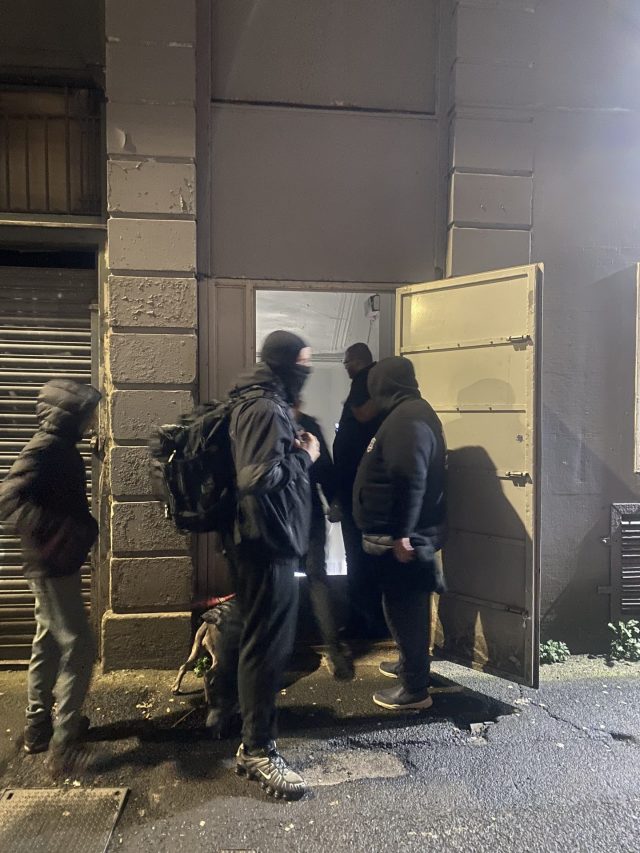
The night I accompany them, Scots Active’s patrol ends early. It had been a quiet night. They had seen a figure preparing to throw themselves to their death in the river, but on closer inspection it turned out to be a pole. Lisa had approached a lone girl, but she was just waiting for a bus. Some of the men had opened a mysterious, gray door behind which they feared migrants were doing something nefarious, but it only revealed a confused man who told them it was a pool club. Everywhere, phantasmagoric horrors seemed to lie in wait. But none were quite as they seemed.
