




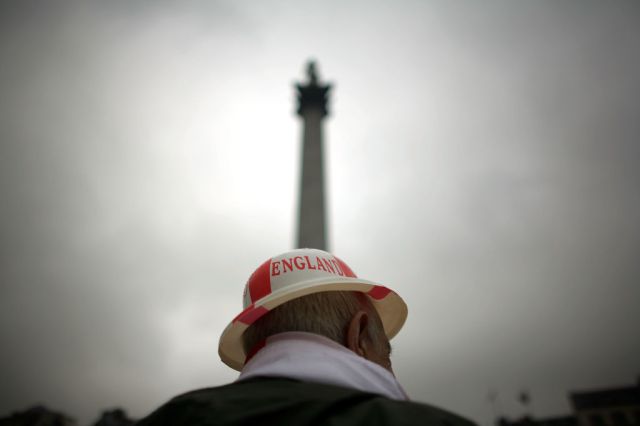
'We find ourselves in a destructive situation whereby England must blame London for all of its problems.' (Christopher Furlong/Getty Images)





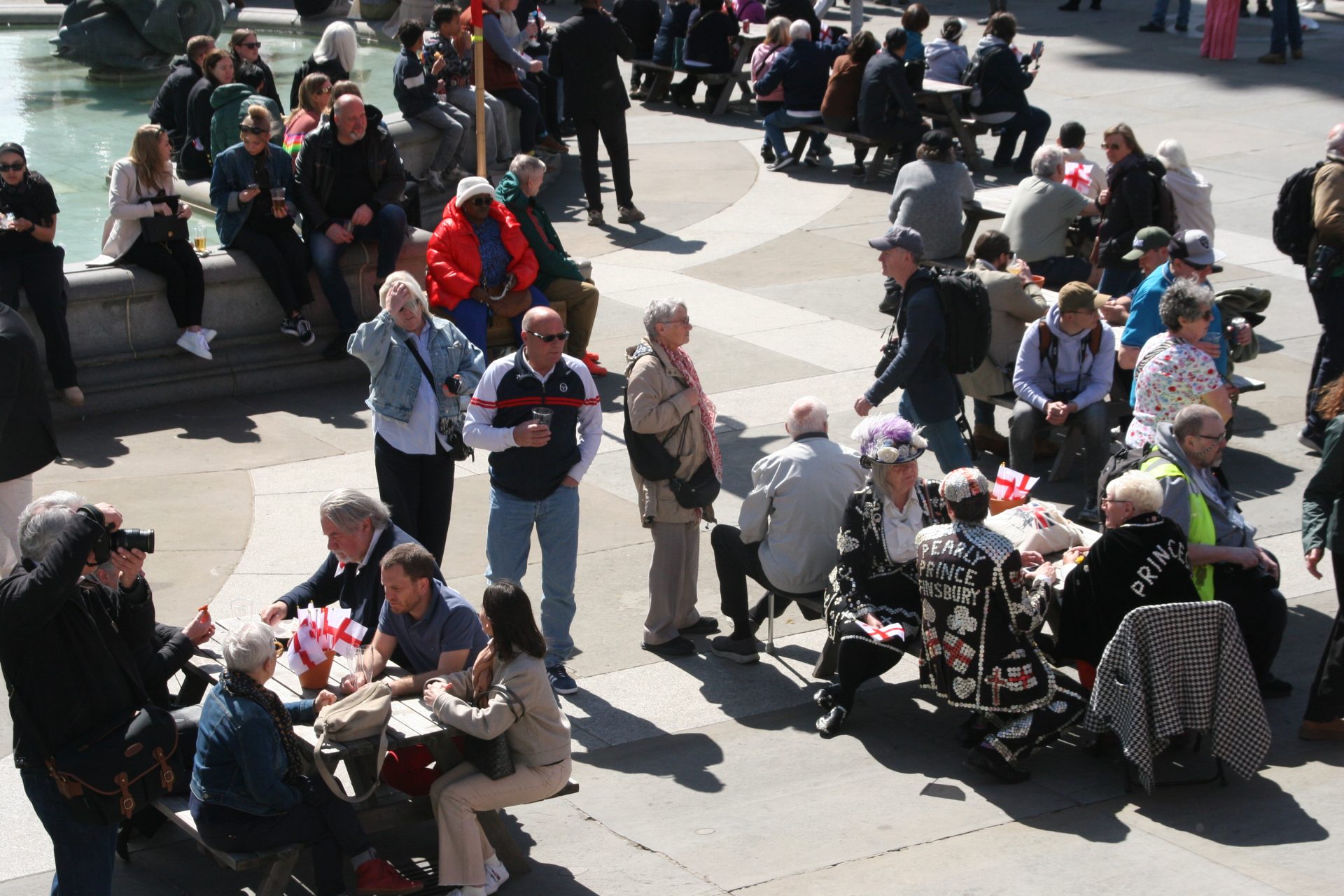
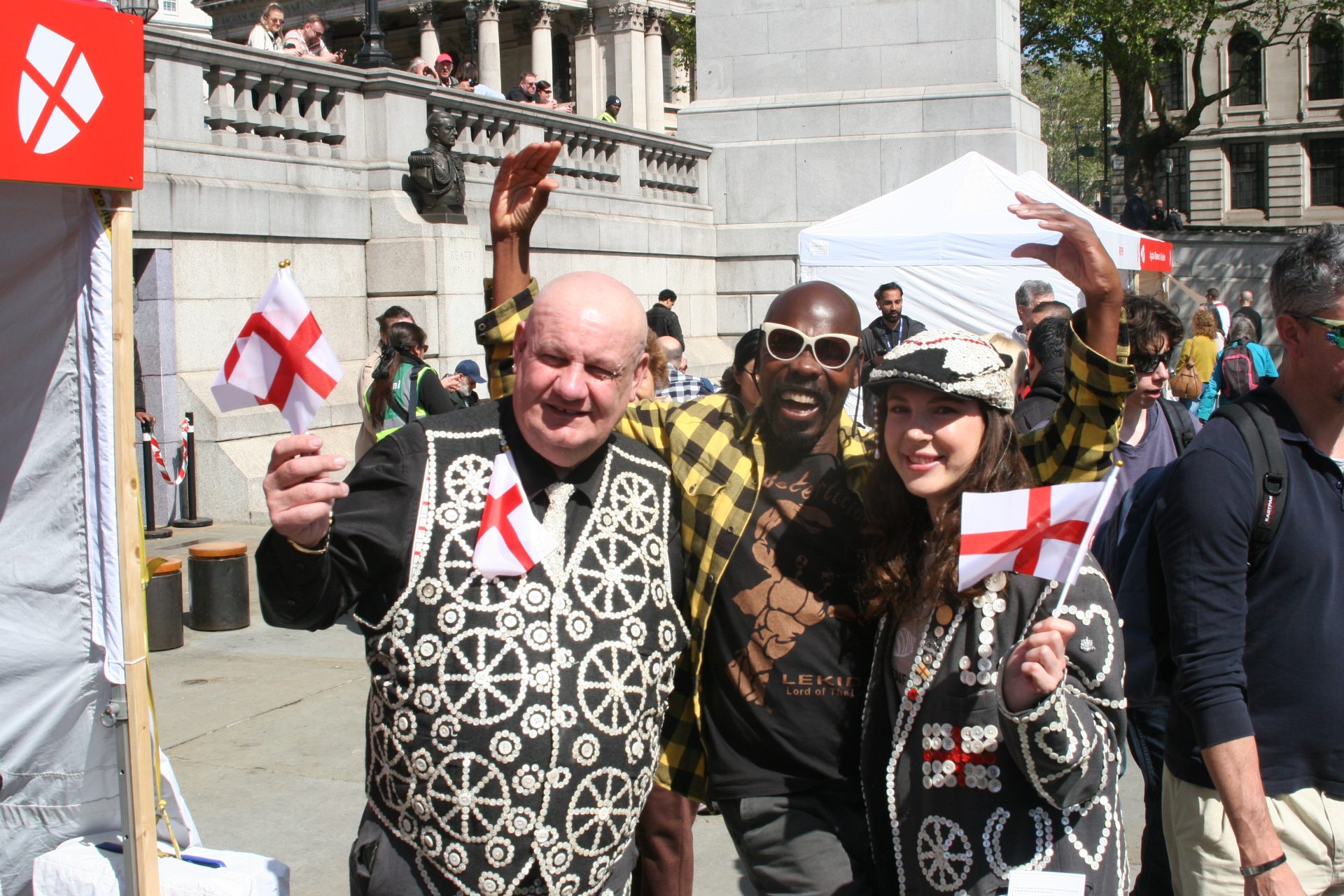
In a corner of Trafalgar Square, a gaggle of tourists watched Harry Maguire, winner of MasterChef 2025, talking about pastry. This, apparently, is what Englishness means today — at least according to London mayor Sadiq Khan. “English Cookery Demonstrations” was one of a handful of stands erected beneath Nelson’s Column for the Mayor’s underwhelming early St George’s Day celebration on Sunday. For the children, there were swing boats and “Make Your Own Bunting with Arty Pants”; for adults, some Pearly Kings and Queens and the RSPB. The musical acts were interspersed with poetry portraying St George as the patron saint of diversity. “Please use the hashtags #London for Everyone or #Loved and Wanted”, the compere reminded us. Later that afternoon, the Mayor turned up for a photo-op, followed by a social media post in which he wrongly claimed it was St George’s Day (it was in fact 19 April).
I searched all afternoon for a punter who was enthusiastic about the Mayor’s vision of Englishness, but found none. The small crowd in the square consisted almost entirely of tourists who happened to be wandering by, and friends and family of the performers. As for those who had come to celebrate England and St George, they were hoping for something quite different. “We’re surprised there’s not more English here,” said one disappointed woman who had traveled with her husband from Crawley. She remarked that the day before, when a Sikh celebration had taken place in the square, it was “absolutely mobbed”. They wanted a strong turnout to make a statement of resurgent English pride, especially as, on a previous trip to London, they had bumped into a Palestine march where one of the demonstrators had allegedly told them “you’re not welcome here” after seeing the husband’s Union Jack phone cover. This struck a nerve, since he had, in fact, been born on the Old Kent Road. He pointed dramatically to the bronze lions around Nelson’s Column: “May 7th. Those lions are gonna roar again,” he said in reference to the local elections next month.
Another man, a street sweeper who lives in Bow, gave me a similar account. “These wars, you know, Iran, Israel-Palestine, they’re protesting here every week, for no reason. This is a day for the British, for the English.” When I asked him about his 43 years living in the capital, he sucked his teeth. “It’s changed a lot, for the worse. Believe me.” He explained: “When I first got here it was very friendly, polite. You knew everyone, knew your neighbors. You don’t know your neighbors now. If you get on a bus or a train, you don’t know if someone’s going to pull out a knife and stab you.” Politicians, he said, “are only working for themselves”. Then he leaned in: “I think it’s time for the British to fight back.”
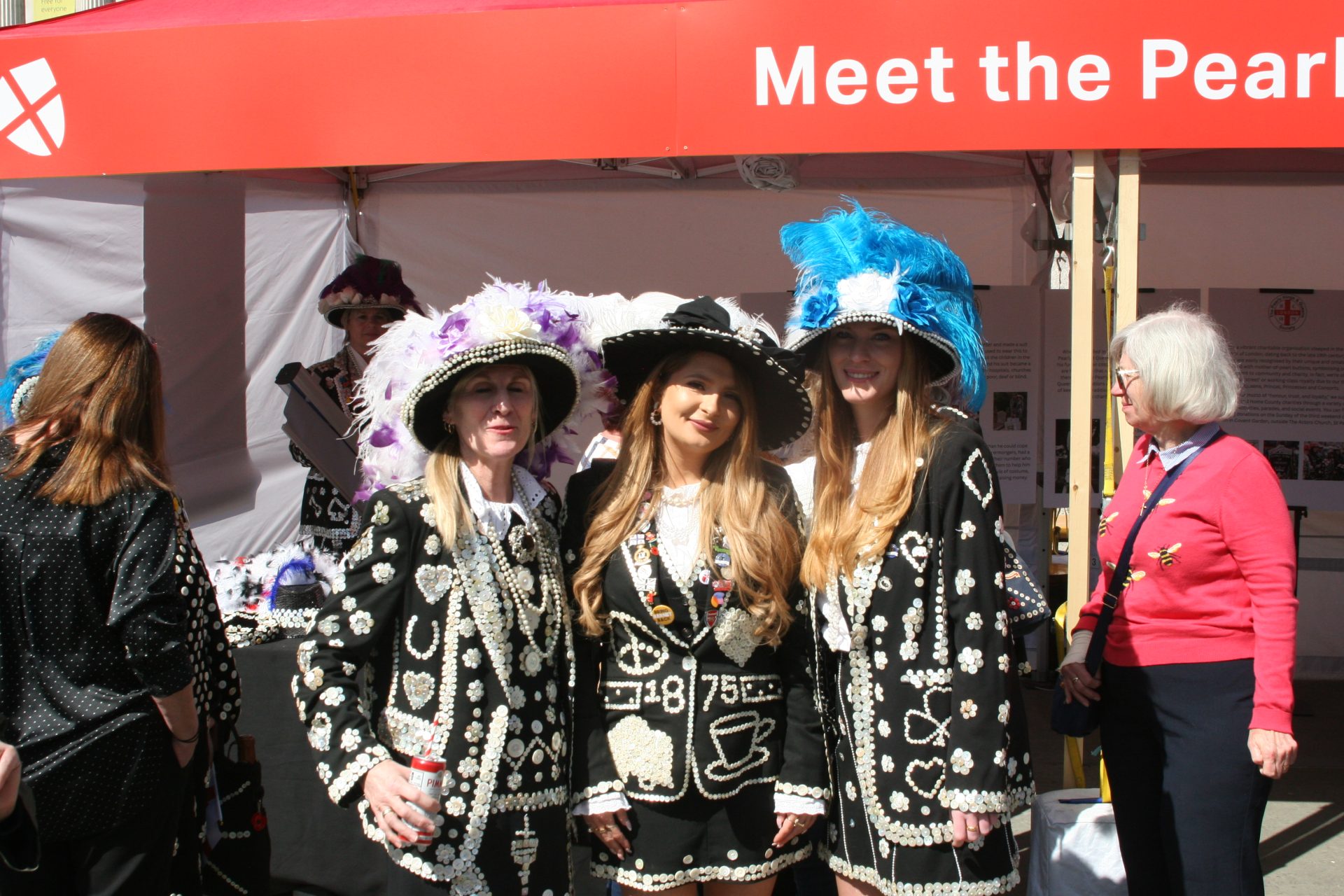
This peculiar non-event in Trafalgar Square, and the discontent at its margins, illustrate some important realities. The first is that London is not in any meaningful sense an English city. It is the capital of a multinational state, the United Kingdom, whose hopes of surviving intact are at odds with England having a strong identity. But principally, the city is best understood as an island within an island, a place unto itself, or as the Victorians had it, “not a town but a country covered with houses”. When Khan calls it a “global city” he is mostly correct. Its economy has long been built on trade with the rest of the world, not England (although it does pay for England). In the 13 years that the capital was my home, most of the people I lived, worked or socialized with had either arrived as adults from overseas, or had moved there to escape England. Needless to say, the latter would have called themselves British. Two exceptions proved the rule: international football tournaments, when everyone became honorary Englishmen and women, and the cockneys I knew in Bethnal Green, remnants of an English-identifying community which has largely decamped to Essex.
In Khan’s short video addressing the question “What does it mean to be English?”, he does of course imply that the capital is part of England. But on closer inspection, his idea of Englishness is defined by London rather than vice-versa. After nodding to the usual clichés — “fish and chips and a Sunday roast… our love of queuing, our incessant apologizing”— he moves onto “a tapestry made up of different cultures, faiths, histories and ideas, woven together to tell one story”. He concludes that being English means “we stand up for what we believe in” (at which point the video shows a “Refugees Welcome” sign). The event in Trafalgar Square suggests that he views Englishness like any other identity in his scheme of managed diversity, whereby the authorities, like a nursery teacher negotiating with tired toddlers, ensure that every group gets its moment at the center of attention, flying its flags and performing its rituals in public space.
None of this is entirely unique to Khan; it reflects the social realities of the city. In 2009, Conservative mayor Boris Johnson called for a “unifying” idea of Englishness, fit for a city that is “proud to showcase” its “many cultures and communities”. He also referred to St George as “a Cappadocian merchant who sold bacon to the Roman army”. Though Khan has gone further than his predecessors in building his personal brand on multiculturalism, no leader in London can ignore it.
But the other point hinted at by Sunday’s event is that, even among those who are eager to celebrate it, English identity still seems to have little political content beyond protest. The small sample of unhappy patriots I met all came from deprived backgrounds; one of them said he had “lost the lottery of life” (a strange reversal of Cecil Rhodes’ claim that “to be born an Englishman is to win first prize in the lottery of life”). They wanted to push back against other groups they saw as taking over public space in the city, and they shared a feeling of injustice at the Government’s failure to control migration, as well as a more general impression that the city was sliding into chaos. As one man told me — a Scot, as it happens — “It’s not English anymore, that’s the truth. It’s been taken over. The system’s allowed it… The whole system’s failed. The courts, the police, probation, the prisons, the NHS. It’s all gone.” But as for any sense of what it means to be English, it was clear that they all saw Englishness not only as a subset of Britishness, but as inseparable from it.
This seems consistent with the broader circumstances in which the rhetoric and symbols of Englishness have barged into the public realm over the past year. English flags have appeared, often alongside Union Jacks, at demonstrations outside asylum hotels, and of course as part of the last summer’s spasm of defiance, which saw flags going up on lampposts and motorway bridges across the country (variously interpreted as expressions of patriotism and attempts to intimidate minorities, both of which are probably true). In these cases, the St George’s Cross seems to draw more of its charge from the breaking of a taboo, the flag still being somewhat tarred by association with Right-wing extremism, than from any shared understanding of English identity.
Even on those parts of the Right which are now espousing ethnic nationalism, there is no positive vision of English society beyond one that is governed and largely inhabited by people of English ancestry. There is not even much reckoning with the blatant contradiction that this favored group includes most of those who despise Englishness as a political identity, while excluding many non-ethnically English who would welcome opportunities for patriotism. Such complexities tend to be drowned out by the almost pornographic narratives of British decline that circulate online, often focused on London’s alleged collapse into anarchy. As the people I met at Trafalgar Square testified, this vision is disturbingly familiar to some of the city’s poorer inhabitants; but its purpose is clearly to galvanize a nationalism with more anger than plausible answers.
Englishness is trapped in these volatile and divisive modes because efforts to reimagine it have been feeble; the uneasiness of public figures such as Khan and Johnson on the subject, insisting that the flag must be “reclaimed” for everyone but struggling to show much enthusiasm for it, only confirms its subversive appeal. But the deeper reason is simply that a former English consciousness fell by the wayside. Look back to the 19th century, and much of the 20th, and English patriotism appears to blaze proudly. “England expects that every man will do his duty,” said Nelson at Trafalgar. “Speak for England, Arthur!” was the backbench cry that signaled Parliament’s resolve to confront Hitler. But in these and many other evocative examples, “England” was a synonym for Britain, as it remains in many foreign languages today. As Englishness blended into the wider British state in which it predominated, and then into that state’s global empire (“the empire of England”, as Benjamin Disraeli called it), it inevitably lost much of its particularity, paving the way for a reversal that has resulted in many English now thinking of themselves as British.
Another peculiarity is that, as Robert Tombs notes in The English and their History, the country never had a particularly deep attachment to its folk traditions. To be sure, modern England has always been deeply invested in its past as an aesthetic matter: see, for instance, the much-mocked “Tudorbethan” facades of Thirties suburbs, and the sentimental love for the “green and pleasant land” of the English countryside. But in the crucial period when European countries saw their pre-modern heritage vanishing with the onset of industrialization — the period when cities like London bulged into mega-cities — the English, Tombs writes, were a “commercial and cosmopolitan” culture, which saw “no urgent need to discover their roots or throw off foreign influences, and were happy to buy in the good and the fashionable wherever it came from”. As a result, “English manifestations of ‘folk culture’ were pallid compared with the ebullient and assertive popular nationalism of Hungarian, Czech, Finnish, and Russian art and music”. The consequences of this are still evident on St George’s Day, when, in my experience, people pressed to think of English folk traditions can name only Morris Dancing.
This curtailed history has left Englishness with a mysterious, forlorn depth which has proven fertile for artistic expression, but which cannot be easily translated into politics. The poetry of Thomas Hardy and the music of Ralph Vaughan Williams contain a rich sense of England’s landscapes and rhythms of life as treasures to be recovered only in dreams. A century later, a ghostly vision of England as something lost to history and myth can still be found in Jez Butterworth’s 2009 play Jerusalem, or in PJ Harvey’s 2011 album Let England Shake. There are jaundiced accounts of England too — Philip Larkin and John Betjeman come to mind — but even here, there is a certain irony and regret which seems to defy political expression. Perhaps the setting which most people instinctively recognize to be English is the countryside, where it is still possible to see past the fund managers’ mansions and newbuild estates and to imagine an innocent world of pubs and churches, hedgerows and lanes. It was only when I left London and formed a connection with the Sussex landscape that I felt, viscerally and unexpectedly, like I had found England.
That this silent Englishness of culture and memory manages to exist apart from the St George’s Cross is surely something to be grateful for. A refuge from politics is not such a bad thing for a national identity to provide. But there is a more material problem, which pertains, again, to London. A more developed political Englishness would be valuable if it allowed different parts of the country to recognize their common cause in challenging the dominance of the capital, where too much power of every kind is concentrated.
During the 20th century, and especially since the Second World War, England’s impressive traditions of local government were sapped away by Westminster and Whitehall. The war effort, followed by the establishment of the NHS, the centralization of the planning and education systems, and the nationalization of industry, made for a stronger Britain at the expense of a weaker England. In the ensuing decades, as the country deindustrialized and globalized, London emerged as the overwhelming force in a service economy that relegated England’s other cities and regions to shadows of their former selves. The capital and the South East of England are the only parts of Britain that raise more revenue for the state than they receive. But they also enjoy favorable treatment. The data specialist and blogger Tom Forth has spent years arguing that Northern cities consistently lose out to London when it comes to investment in key areas such as transport, research and development and public institutions, even when they have the better economic case.
Meanwhile, Britain remains far more centralized than its European peers, even as its state has increasingly proven unfit for the responsibility it hoards. So we find ourselves in a destructive situation whereby England must blame London, as a political center, for all of its problems, from hospitals and schools to energy bills and river pollution, while also relying on the metropolis for fiscal support. And London, of course, is where the country’s financial and cultural elites overwhelmingly cluster, appearing in the provinces only in the resented but sorely needed guise of tourists and second-home owners. There is arguably already a latent English identity in this shared ambivalence towards the capital; jokes about London and Londoners are current across the country. But they are not enough to bridge the local identities of the different counties, cities and regions, which must therefore struggle to claw back power from the center separately.
It is difficult to imagine how these differences could be bridged without a dedicated forum for English politics. But the Scottish and Welsh experience suggests that layering new capitals on top of London, while it can sustain devolved political cultures, also encourages further antagonism and the fudging of accountability. So England must somehow fight the center without a center of its own. That is the country’s tragedy: London occupies the place where its capital should be.
Wessie du Toit writes about culture, design and ideas. His Substack is The Pathos of Things.
 wessiedutoit