




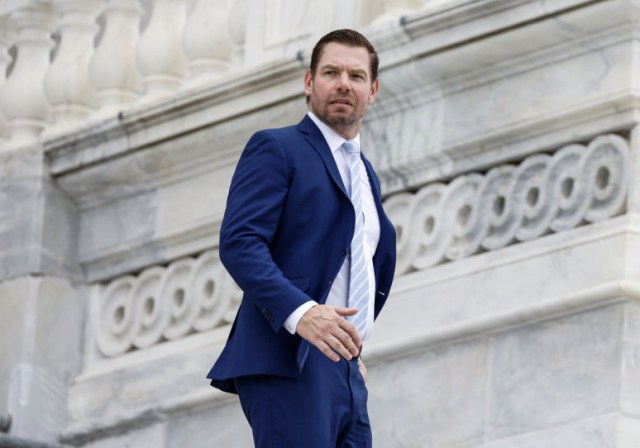
Rumors have been swirling around Swalwell for weeks. Credit: Getty





“I’ve never felt more uncomfortable in a campaign than in Eric Swalwell’s,” a former intern for the California lawmaker and would-be Democratic gubernatorial nominee told me. It’s sentiments like the intern’s — long circulating among party insiders in Washington and California, and shared with me by several of his staffers and interns — that have now brought the Swalwell campaign to ruin.
Somewhere in the back of his mind, Swalwell probably knew he had a problem. Several of them, actually: allegations of propositioning and sexually assaulting staffers and interns had followed him for years. Why, under those circumstances, did he choose to run for governor? The same reason any gambler keeps going after a long winning streak: if you go long enough without losing, you forget you can lose it all in a single hand.
The house, it turns out, always wins. Days ago, the congressman looked like the frontrunner in California’s gubernatorial race, a polished liberal with a strong anti-Trump national profile and impeccable #MeToo credentials. In 2018, few voices on Capitol Hill were louder in opposing Brett Kavanaugh’s confirmation to the Supreme Court; and Swalwell’s argument rested squarely on the principle of “believe all women.” That fall, when President Trump’s Department of Education directed universities to tighten their definitions of sexual harassment, Swalwell tweeted: “Support survivors. Believe survivors. We are with you.”
These maxims lost some of their force as liberals reckoned with the excesses of movements like #MeToo in the years that followed. But they were never entirely retracted. Swalwell’s career, in other words, was unraveled by the very principles he weaponized against others.
In an account first reported by the San Francisco Chronicle on Friday, an anonymous former intern accused the congressman of assaulting her twice while she was too drunk to consent. (Swalwell’s attorney had sent her a cease-and-desist letter the previous night; this failed to prevent the story from coming out.)
Then came a second report, this one featuring three named accusers. Their accounts ranged from unwanted touching to unsolicited explicit photos and Snapchat messages soliciting nudes in return. One woman said he exposed himself while she was at the wheel. In a video published online, Swalwell called the allegations “flat false” and vowed to fight them “with everything I have” — though, peculiarly, he apologized to his wife in the same breath. (In an interview with CNN, Swalwell’s lawyer refused to specify what, exactly, Swalwell was apologizing to his wife for.)
Swalwell is hardly eager to apply the principle of “believe all women” to his own case. And he may regret his previous fiery rhetoric, now that women who, in some cases, may have engaged in consensual activity with a powerful man have later claimed sexual assault. But his staff have been less circumspect. By Thursday, when rumors of the forthcoming allegations began circulating internally, staffers had begun to quit. By Friday, nearly all of Swalwell’s top advisors had resigned. And by Saturday, each of the 23 Democratic leaders who had endorsed his campaign, including his closest allies on Capitol Hill, had rescinded their support.
But the collapse of Swalwell’s campaign, several former Swalwell interns and staffers told me, had begun well before any reports became public. The former campaign intern who described the campaign as “uncomfortable” first grew uneasy at the California Democratic Party convention in February. People from “high circles” in Washington, he told me, were already whispering about Swalwell’s sexual encounters with congressional interns.
As campaign staffers mulled over the rumors — many still reluctant to believe them — this intern made up his mind. His commitment to the campaign was over. He stayed on in name, but in practice he “just tapped out.” He remained, he told me, only because he was curious to see how the campaign would respond once the story finally broke.
He was not alone. Other staffers, too, had begun growing uneasy in the weeks before the reports became public. Many effectively checked out in the week before their publication. There were no public allegations — at least, not yet. But mere whispers were enough to begin the campaign’s slow internal unraveling.
Early last week, a source within the campaign told me, the campaign began canceling meetings scheduled for later that week. By Thursday afternoon, many staffers and interns were already writing and sending in their resignation letters, bracing for the big Chronicle story. Some volunteers remained in denial: “There will be no big story published tomorrow,” one wrote in a campaign Signal chat. “It’s all hearsay to get us afraid.” But by the weekend, that position was no longer tenable. According to people in the campaign, a majority of staffers had resigned in response to the report.
I reviewed two campaign managers’ jointly written resignation letter, posted on a campaign Slack for interns Friday afternoon, which put it this way: “We came into this campaign looking to help elect a young principled leader to fight for the next generation and now it has been made clear that is not the case.” Half an hour later, that Slack had been deleted without warning. Several sources close to the campaign found the move perplexing, given that Swalwell, in his non-apology posted to X that evening, said he firmly intended to continue his campaign.
But everything seems to be shutting down. “No one asked me to stay or defended him to me after I resigned,” a now-departed campaign coordinator told me. He told me Swalwell’s hypocrisy was “antithetical to the values of our party,” and that he wanted Swalwell to resign and admit his wrongdoing. In short, to heed the old Swalwell — the one who believed all women.
One intern recalled the internal Slack going “berserk” on Friday afternoon, though the messages described here are based on my sources’ best recollection, since the whole Slack has since been deleted. The quiet-quitting of the past several weeks had exploded into a staff revolt. “If you still support Eric Swalwell after this, you’re a piece of shit,” one woman wrote. “Hey, I thought we believe all women,” another quipped. There were plenty more remarks in the same spirit. That is, save for one naive intern who asked, “So does this mean we are all done, or is the campaign still going?”
Despite reports of mass resignations across both Swalwell’s campaign and congressional offices, some staffers may stay for reasons that have little to do with loyalty. In a public statement condemning Swalwell and expressing horror at the allegations, senior campaign staff noted that “not everyone — in particular our junior staff — can immediately forfeit their income and benefits without significant personal risk or consequence.” But, as one person who has since left the campaign told me, “this statement should have come from [Swalwell], not his staffers.”
Then there is the matter of secrecy. Swalwell has been mired in controversy over his camp’s insistence that no one in his congressional office was ever compelled to sign a nondisclosure agreement. On the campaign side, a Swalwell adviser carefully told Politico that he had “never asked someone to personally sign an NDA,” though he clarified that the campaign did have a privacy agreement meant to protect confidential materials.
I’ve reviewed a signed copy of one such privacy agreement. It is a bizarrely skeletal, template-like document, still containing bracketed placeholders like “[TYPES OF CONFIDENTIAL INFORMATION].” Whatever its legal force, given how sloppily it was drafted, the document may help explain why everyone I interviewed spoke on condition of anonymity.
“I was really hoping that his campaign would go to hell anyway,” one former campaign team member told me. His disgust ran deeper than the sexual allegations. He’d long found Swalwell personally unsettling and inauthentic. “He’s fake anyway, and a very, very weird person,” he added. “Meeting him, you knew something was off, especially after hearing of his allegations. I was hoping [the campaign] would go to the shitbin. The difference between me and [those who stay quiet] is I know what’s right and what’s wrong.”
Perhaps Swalwell came to believe that his very public alignment with the politics of #MeToo offered a kind of insulation, that a man who had so conspicuously presented himself as an advocate for survivors would be harder to cast as the villain in such allegations. If so, his calculation now appears catastrophically foolish. A representative for the campaign didn’t respond to my request for comment by deadline.
Swalwell, of course, says he is being railroaded by a rush to judgment. So do a number of anti-woke commentators now rallying to his defense on principle. These are the very sorts of people the old Swalwell would have denounced without hesitation. During the Kavanaugh allegations, he posted “100% #BelieveSurvivors” and insisted that when “separate and independent” accusations all “look the same,” the “arrows point in the same directions.” What, he asked then, were the odds that “three or four women independently, who never met each other, would have similar experiences with one person?”
Faced now with allegations of his own, that moral certainty has disappeared on contact. His staff, however, appear to have taken his #MeToo pledges more seriously than he ever did.