




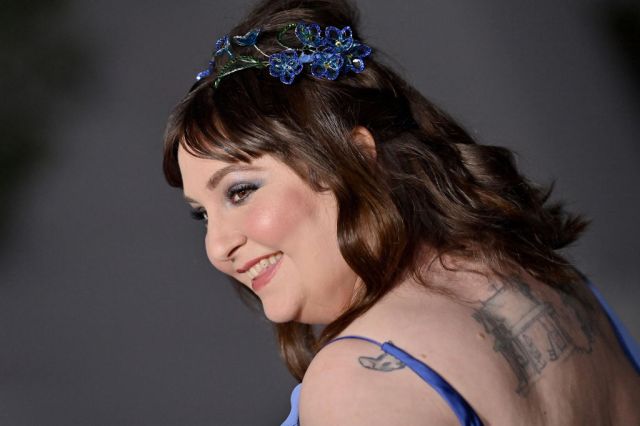
'How exhausting it must be to constantly monitor your image through the eyes of others; paging Berger!' Axelle/Bauer-Griffin/FilmMagic





So much of the malaise of young women today can be explained by them having based their expectations of adult life on the wrong HBO show. Though barely born when it ended, Gen Z still sees Sex and the City as a roadmap for modern romance — a promise that Real Life is a glossy, grinning blur of men, Manolos and self-discovery. With SATC as the sacred text, it’s unsurprising that cynicism flourishes among those cheated of cushy media jobs, whirlwind affairs and designer dresses who have instead been dealt a flopping job market, dating apps and wardrobes full of Chinese polyester. No, the proper preparation for the triumphs and humiliations of your twenties can only be found in Girls — and for that, even her many detractors have to thank Lena Dunham.
What Girls, which like SATC ran for six seasons (2012 to 2017), gets so hideously right is the body horror of young womanhood: it swaps soft-focus sex comedy with characters who are often grubby, flabby, ashamed and shockingly naked by the standards of primetime TV. The show’s early hype centered on this realism — and the seemingly compulsive frankness of its semi-autobiographical protagonist Hannah Horvath, played by Dunham. So often was she having terrible and humiliating on-screen sex, and so dramatically did she differ from the body types in porn where such acts were usually relegated, that Lena Dunham’s Body quickly came to dominate her public image. Reading her new memoir Famesick, released yesterday as a follow-up to the highly controversial 2014 essay collection Not That Kind of Girl, it’s obvious that in private, too, Dunham’s life was a kind of body horror.
Famesick is an account of Dunham’s twenties, which were pockmarked by maladies including shingles, colitis, appendix troubles, impetigo, endometriosis and then-undiagnosed Ehlers-Danlos syndrome — searing pains, surgeries upon surgeries and bedridden immobility relieved only by an ultimately problematic reliance on Klonopin. All the while she is tormented online by both fans and bullies — though mainly bullies — who love calling her variously “our fat sister” or a “fat whore” (depending on whether the intent is a compliment). Lena Dunham’s Body is pried at and poked on every page by characters ranging from a cleft-lipped early lover, the inspiration for Girls’s Adam, who gags her with her own tights, to a gynecologist who carries out an internal exam without her permission and bursts a cyst, “rip[ping] my fucking insides to shreds”. She crash diets on the advice of “proanorexia websites” then is told to regain the weight by a beloved but antagonistic TV producer who says: “It’s not funny if you’re too thin, it’s just Sex and the City all over again… if we lose it, we don’t have a clear voice.” Push and pull, push and pull; Dunham is at war with her body.
Like many talented but lost young women, Dunham took misguided refuge in the company of unimpressive and perverted men. The problem is, as so often happens, that no amount of plaudits or praise could derail the younger Dunham’s catastrophic lack of self-esteem so that she finds herself asking sewer-dwelling dudes to “slap me. Choke me. Punch me. Show me I’m nothing.” Never one to sugarcoat things, Dunham now seems to recognize these episodes for what they are — dangerous, dehumanizing and fruitless; she seems to want to warn today’s girls, who are in all likelihood also being “tied up with belts in Flatbush”, that there is nothing dignifying about pandering to pointless men.
But that old compulsion runs deeper than just sex. The memoir’s revelations of masochism, coupled with her defiant TV nudity and borderline incontinence when it comes to controversial public declarations, reveal that Dunham’s public and erotic instinct seems to be to show more in every sense, “as if revealing myself down to the guts” would change a lover’s, a viewer’s or the public’s mind about her. In the years since, the tortured self-absorption which once set Dunham apart has become universal: today, social media and dating apps have turned every young woman into a Lena-slash-Hannah. Fourteen years on from Girls’s debut, submitting to sadism in casual-sex encounters is as unremarkable as a kiss on the cheek, while Substacking about it afterwards is as routine as a post-shag shower. Turning 40 next month, Dunham — with her romantic recklessness and frightening honesty — embodies the psychic cost of thinking too much about how everyone else, and especially men, sees her.
And as the dating-Substack narcissists of 2026 will surely soon discover, none of this introspection makes life any easier. Dunham can’t stay off social media, obsessively reading hate comments; she can’t be friends with a co-star (Adam Driver, who was crucially in a relationship throughout Girls) without torturing herself that he might see her as “a mother? A boss? A girl? Fuckable? Unfuckable? Irritating? Brilliant?” How exhausting it must be to constantly monitor your image through the eyes of others; paging Berger! She cops to the “sort of blithe slutty persona” that goes with her campaigning work for Planned Parenthood and Obama, but there is nothing blithe about it: always ravenous for press coverage, she is repeatedly blown to bits by headlines like “Has Lena Dunham Finally Hung Herself?” (It’s hard to think of another actor or writer about whom something so vicious could be signed off.) The imagined audience of awed women and furious men bore down on Dunham’s private life and body more than any other because she was at points annoying, yes, but always annoyingly good.
Lena Dunham’s troubled relationship with her body sees her compare herself with female peers with an undeniably competitive prurience. The women in her memoir burst out of bikinis or “fill out … ’70s Levi’s”; they are “stunningly petite brunettes” or have “pert little breasts” or “would have looked … at home … at a modeling contest in the Winnetka Shopping Center” (this latter, somewhat catty, remark was reserved for Driver’s long-term and patently resented partner). It seems that Dunham handles her discomfort at being so viciously picked over by the media — including in articles where “it was noted that I walked in heels like a baby giraffe, that I should have had the money by now to fix my teeth, that I wasn’t as ugly as everyone said, that I was uglier” — by training her own lens obsessively on other women. Nor is her paranoid surveillance unjustified, if the many references to her long-term boyfriend Jack Antonoff’s ambiguously close working relationship (“always behind a locked door”) with “the teen pop star” who “called me ‘Aunt Lena’” — Lorde, probably — are taken into account.
Then there are the darker storms weathered: the twin “cancellation” events which will be the most hungrily awaited by social media. First, the firestorm which followed her 2014 memoir’s revelation of childhood curiosity about her baby sister’s body — a story that never should have made it to print but was nonetheless ungenerously interpreted by detractors as a confession of sexual abuse. She judges — rightly, in my view — that the furor was mostly an opportunity for anonymous commenters “to eradicate someone who had heretofore been only a nuisance to them”; in this sense it was a classic piece of 2010s Thermidorian Reaction offense-archivism.
The second cancellation is the more existential: a monumental betrayal of her own feminist credentials in the form of a 2017 statement defending Girls writer Murray Miller against rape accusations based on “insider knowledge” which she subsequently denied having. (Miller always denied the allegations, and no charge was brought). Dunham places the statement in the not-quite-explanatory context of post-surgery fug and the aforementioned love-hate relationship with her producer Jenni Konner, who co-signed it. It doesn’t help that she keeps referring to it as “the Big Bad … which I had experienced as a rupture of self”. Given how sensitively she describes her own sexual traumas, Dunham would do well to extend that tact to others — even if this means letting someone else pull focus.
As Dunham chronicles, her fame makes her writing a perpetual work of collective annotation: Dunham, the fans, the media and the haters, locked in an endless loop of interpretation. It is a system in which the project of “making our mind up about Lena Dunham” is never finished — she is an endlessly mixed-up woman refracted through endlessly fickle readers. Her legacy is not just profound honesty about what “girls” can expect from the world, but the bleakest biography of the Internet Age: the girl who held up a mirror to a certain generation became its most hunted target. Impulsive, compulsive and insecure, this exceptional talent was able to show Millennials the worst parts of themselves. When they didn’t like what they saw, they tore chunks again and again. Yet despite their best attempts to cancel and shame, it looks like this juggernaut will keep pushing. After all, Dunham is a better writer than most of her critics put together — trying to humiliate her is useless, for doing exactly that has been her life’s great work.
